


Dengue cases overwhelm Suhrawardy hospital

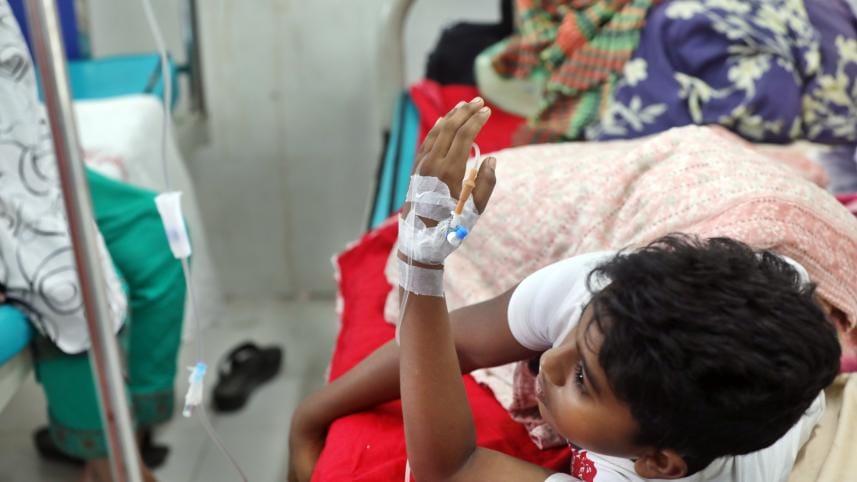
Thirteen-year-old Mohammad Abdul, a resident of Chandpur, has been undergoing treatment in the dengue ward at Shaheed Suhrawardy Medical College Hospital since Thursday, as his parents felt uncomfortable continuing treatment at the overcrowded district hospital.
"My son had been suffering from high fever since November 1. We took him to Chandpur District Hospital on November 5, where he was diagnosed with dengue," said Anowara Begum, Abdul's mother, yesterday.
 For all latest news, follow The Daily Star's Google News channel.
 She said although her son was admitted to the hospital, the overcrowded conditions made it difficult for him to receive proper care. "That is why we brought him to Suhrawardy hospital, travelling by launch, hoping for better treatment," she added.
"He is now feeling well, and we hope he will recover soon," Anowara said.
Giti Akhtar, a resident of Savar, was admitted to the hospital on November 6, as her family did not trust the local hospitals or clinics. She had been suffering from severe pain in her legs and body.
"I am now suffering from pneumonia along with dengue and was shifted to this ward a few days ago," said Giti.
Like Abdul and Giti, many dengue patients from outside Dhaka are coming to medical college hospitals in the capital in search of better treatment — a move that sometimes puts them at even greater risk.
According to the Directorate General of Health Services (DGHS), at least 307 dengue patients have died, while 76,514 others have been hospitalised so far this year. Of these, 53,986 hospitalised patients are from outside Dhaka, while 197 of the reported deaths occurred in the capital.
Among the deaths, the highest number -- 148 -- were recorded at Dhaka Medical College Hospital, followed by 48 under Dhaka North City Corporation and 41 in the Barishal division.
HM Nazmul Ahsan, associate professor at Shaheed Suhrawardy Medical College Hospital, said patients often arrive late mainly due to delayed decision-making and referrals from outside Dhaka.
"Many wait until their condition becomes critical. Others are referred from different districts. They often deteriorate on the way because if fluids are not administered properly during those first few hours, saving them becomes impossible," he said.
"Sometimes a patient starts the journey in pre-shock, but by the time they reach us after five or six hours, they are already in full shock. When they arrive at the emergency ward, there is very little we can do," he added.
"This is one reason why deaths are highest in Dhaka South City Corporation -- critically ill patients from different districts are referred here," he pointed out.
He emphasised that patients should always be stabilised before referral. "Recover from shock first, then send the patient to Dhaka," he advised.
Morshed Jahan, senior staff nurse at the women's dengue ward of Suhrawardy hospital, said they have been facing continuous pressure from dengue patients since last month.
"The number of patients in the ward was 65 on Thursday morning, but it came down to 48 after 22 patients were released later in the day -- though the beds may fill up again shortly," she said.
"To reduce the pressure, the authorities have recently opened another 18-bed dengue ward on another floor."
Comments