


‘Dhurandhar’: A hard-won gift for Bollywood at year's end

Released on December 5, Aditya Dhar's "Dhurandhar" emerged as one of the biggest Indian box-office successes of 2025, entering the thousand crore club within weeks of its release.
The film quickly established dominance across domestic and overseas markets and is widely regarded as one of the highest-grossing Hindi films of the year, with trade analysts noting that its theatrical run remains strong.
 For all latest news, follow The Daily Star's Google News channel.
 Starring Ranveer Singh alongside Akshaye Khanna, Sanjay Dutt, R Madhavan, Arjun Rampal and Sara Arjun, the film initially presents itself as a familiar big-budget spy thriller. Its marketing promises scale, violence and spectacle—hallmarks of contemporary Bollywood espionage cinema. However, the film ultimately distinguishes itself by subverting many of those expectations.
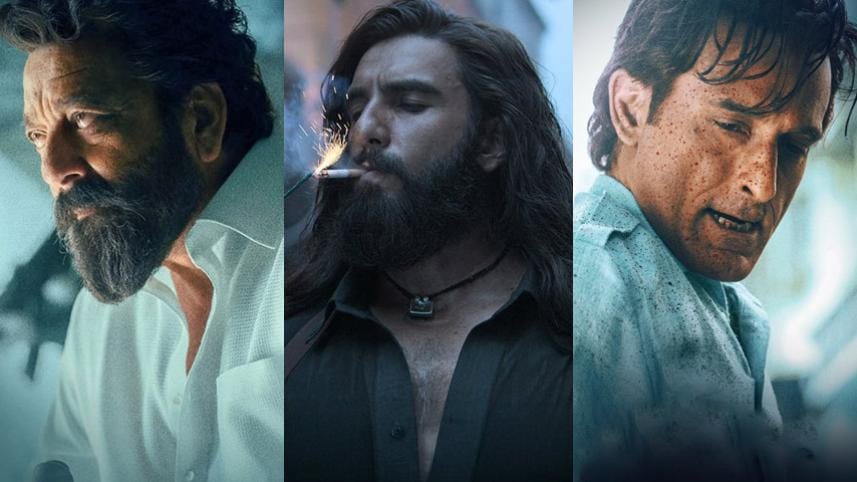
Rather than portraying espionage as glamorous fantasy, Aditya Dhar frames it as a prolonged psychological ordeal. "Dhurandhar" treats spycraft not as a stylish profession but as an existence marked by isolation, fear and moral compromise. As per several Indian news outlet's reviews and comments, violence in the film is raw and unsettling, presented as consequence rather than spectacle.
Set largely in Karachi's Lyari area, the narrative follows Hamza, an undercover Indian agent who enters hostile territory without heroic swagger. He is tested constantly, forced to negotiate survival before ideology. Even stripped of its undercover identity, the film functions effectively as a story of a man's gradual rise within a brutal underworld, shaped by power struggles, loyalty and fear.
As a result, "Dhurandhar" operates on two parallel tracks: a grounded spy thriller and an underworld ascent drama. The film also resists the globe-trotting tendencies typical of the genre. Its extended runtime unfolds within a tightly controlled geographical and emotional space, relying on chapters, long silences and dialogue-driven scenes. The pacing reflects the realities of intelligence work—defined by waiting, observation and sudden ruptures rather than continuous action.
Several reviewers have also mentioned that production design plays a crucial role in grounding the narrative. Lyari is depicted as a living, oppressive environment—dusty, crowded and worn down by time and violence.
The music similarly avoids exoticising Pakistan, blending qawwali, retro Bollywood, Punjabi folk and disco elements to create unease rather than romanticism.
Ranveer Singh delivers a restrained performance built on controlled stillness and calculated silence, while Akshaye Khanna provides emotional counterbalance through measured authority and quiet empathy.
Though not without flaws, the romantic subplot feels underdeveloped and the length demands patience, "Dhurandhar" remains resolute in its vision, as some explained. Moreover, in a genre crowded with glossy spy fantasies, the film stands apart by denying comfort and confronting audiences with a stark, morally complex reality, making it one of the most significant Hindi releases of the year.
Comments