


Zainul Abedin’s birth anniversary observed today
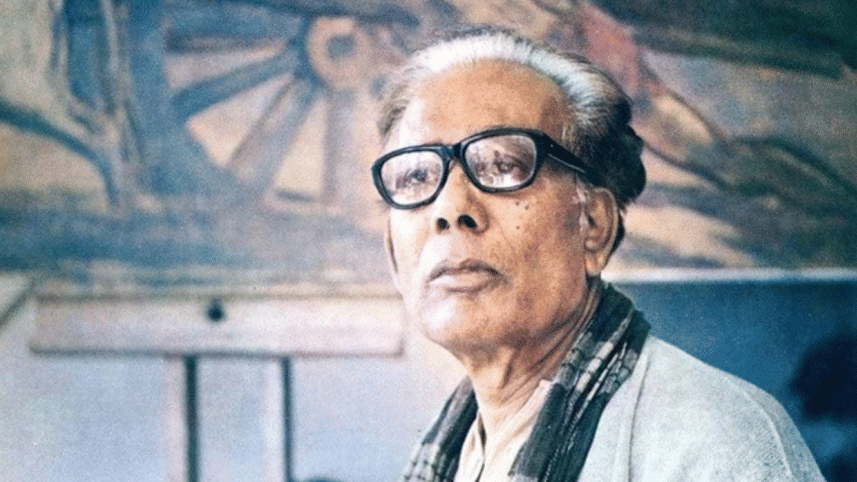
The birth anniversary of Zainul Abedin, widely revered as Shilpacharya, is being observed today with tributes and commemorative programmes.
Various organisations, including the Faculty of Fine Arts, University of Dhaka, along with members of Abedin's family, are paying homage by placing floral wreaths at his grave on the University of Dhaka campus in the morning.
 For all latest news, follow The Daily Star's Google News channel.
 "We will pay tribute to Shilpacharya Zainul Abedin by placing floral wreaths at his grave this morning," said Nisar Hossain, dean of the Faculty of Fine Arts.
Born on December 29, 1914, in Kishoreganj, then part of British India, Zainul Abedin spent his early years along the banks of the Brahmaputra River — a landscape that would deeply influence his artistic vision.
He enrolled at the Calcutta Government Art School in 1933 and later joined its faculty after graduation. Abedin rose to prominence through his powerful sketches depicting the Bengal famine of 1943. These works, later known as the Famine Sketches, were created using black ink on inexpensive brown paper and remain among the most haunting visual records of human suffering during colonial rule.
Following the partition of India in 1947, Abedin relocated to Dhaka with several of his contemporaries and played a leading role in establishing the region's first modern art institution. The Dhaka Art Institute, founded in 1948 under his guidance, later evolved into the Faculty of Fine Arts of Dhaka University and became the centre of modern art practice in then East Pakistan.
Abedin served as the institute's principal from 1949 and received the Hilal-e-Imtiaz in 1959, the highest civilian honour of Pakistan at the time. He retired voluntarily in 1967 and was awarded the honorary title Shilpacharya in recognition of his contribution to art and education.
His later works include the 65-foot scroll "Nabanna", portraying rural Bengal, and "Manpura '70", a 32-foot scroll recalling the devastation of the 1970 cyclone. During the political movement leading up to the Liberation War, Abedin formed the Charu O Karu Shilpi Sangram Parishad in 1971 and renounced his Hilal-e-Imtiaz title in protest against the Pakistani military regime.
He received an honorary D Litt from Delhi University in 1973 and was named National Professor in 1975. That same year, he founded the Folk Art Museum at Sonargaon and established the Zainul Abedin Sangrahashala in Mymensingh to preserve and display his works.

Zainul Abedin died on May 28, 1976, after battling lung cancer. Today, a significant number of his artworks are preserved in the collection of the Bangladesh National Museum.
Comments