


Miniature Dhaka: Inside ‘City of Memories’ by Kazi Salahuddin Ahmed


In the quiet corners of Alliance Française, a small cluster of canvases invites viewers into a Dhaka that no longer exists — or perhaps one that exists only in memory. In "City of Memories", Kazi Salahuddin Ahmed turns the familiar chaos of our own Old Dhaka into intimate, abstract landscapes, painted to recall the magic of the city.
The exhibition was inaugurated on Tuesday, November 18, 2025, at the Alliance Française's Gulshan premises and will continue until November 29. With more than 140 miniature works on display, the opening ceremony—graced by diplomats, artists, and long-time admirers—set the tone for an exploration into Salahuddin's vibrant abstraction of the city.
 For all latest news, follow The Daily Star's Google News channel.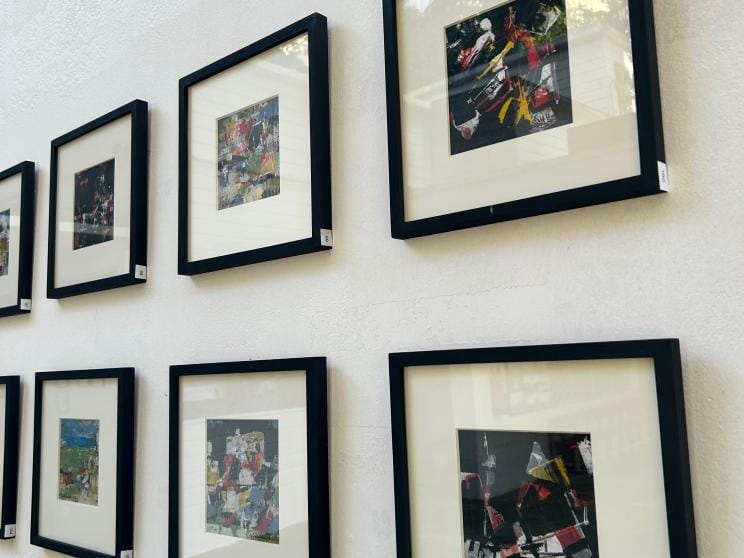
These small works — some barely six inches across — pull you in with an embrace of nostalgia. Each square seems to hold a neighbourhood, a lane, a rooftop, a young boy's vantage point of Old Dhaka before its colours faded and its rooftops were replaced by concrete towers.
As someone who turns to painting for solace, I was enchanted by how these miniatures held such big truths about what we are losing with time. The artist avoids literal representation completely; these scenes don't imitate the city so much as remember it. The textures recall broken plaster, eroded walls or old rooftops collapsing into colour— vivid in some places and blurred in others.
Certain colours dominate the emotional register. Yellow often explodes across the surface, echoing the heat and ferocity of urban life; blues and greens reminded me of calmer childhood hours spent watching rooftops fade into evening; reds flash like warnings — perhaps fires, perhaps festivities.
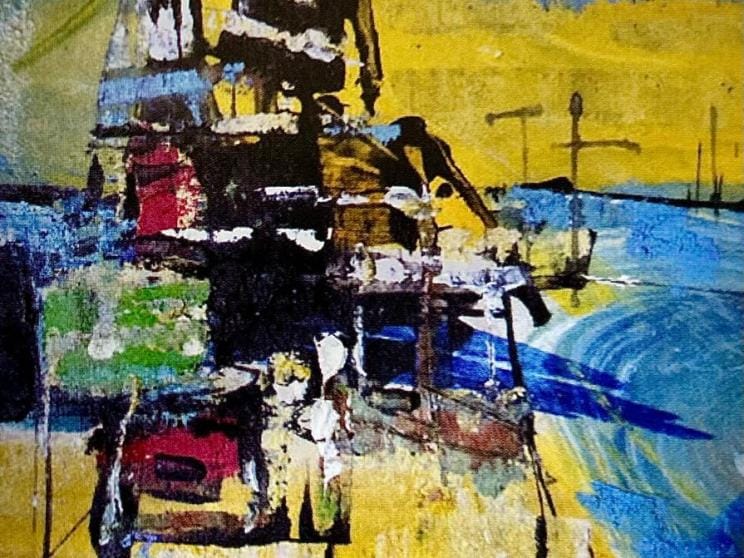
Curiosity eventually pushed me to speak with the artist. Salahuddin considers himself a child raised while being cradled in the arms of Old Dhaka—with all its chaos, heritage and changing rhythm. To portray that, he used multicolor to express the extravagance of festivities such as— Eid, Durga puja or Shakrain. He sounds almost melancholic when he says, "I don't go to my childhood home anymore. I feel like we are inside a well of some sort. It is that dark because of the buildings around." He worries about the rapid, unplanned development swallowing the city and believes decentralisation must enter the national planning conversation.
His dedication is lifelong. "I don't believe in focusing on multiple things. It doesn't build the foundation," he told me. "I was a child of Dhaka, and I want to spend the rest of my life working on preserving this city and its streets." In "City of Memories", this devotion materialises through compressed, tightly arranged compositions that capture the visual noise of Dhaka—the rickshaw bells, mismatched buildings, tangled wires—all dissolved into abstraction. Dhaka becomes a mosaic of emotion rather than geography.

What makes "City of Memories" powerful is its scale. These are not grand, wall-sized declarations. They are miniature windows — small enough to hold in your hands — that invite viewers to lean closer, to search, to decode. Their intimacy mirrors the intimacy of memory itself: personal, fragile, easily overlooked.
In a city where heritage is often swallowed whole by development, these tiny works feel like acts of preservation. They are reminders that cities are not built only of concrete and steel, but of textures, sounds, and fleeting images stored in the mind.
More than anything, "City of Memories" reads like a love letter — one written in the language of abstraction. Salahuddin's Dhaka is not perfect, polished or neatly arranged. It is messy, broken, sunlit, rusted and alive. It carries the debris of time and the glow of continuity.
Comments