


A midnight saga of Bengal’s wounds and whispers
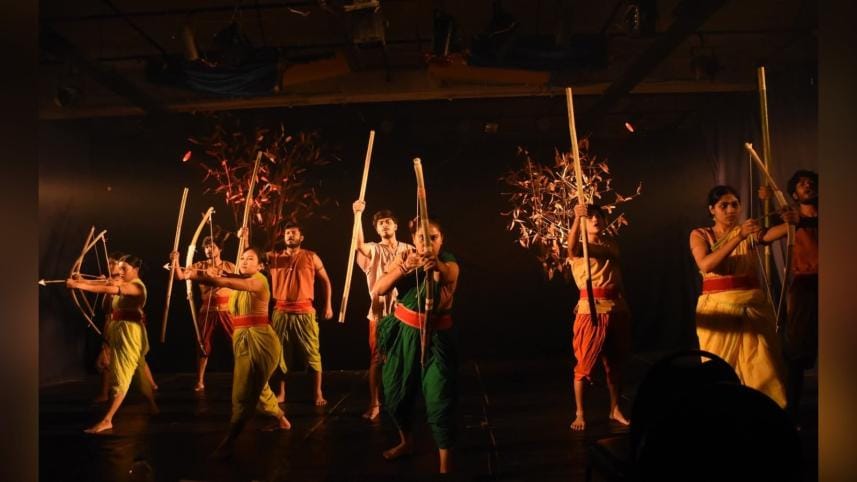
Invited by my dear friend Arko, I found myself on the grounds of Jahangirnagar University, a campus where blue sky meets restless artistic energy, watching what may be one of the most mesmerising and politically resonant productions I have seen in years.
"Neel Moyurer Jouban", adapted from Selina Hossain's novel, unfolds less as a conventional play and more as a folk-epic meditation on Bangladesh's never-ending search for identity. Directed by Yusuf Hassan Arko, now a leading torchbearer of the theatrical lineage shaped by Selim Al Deen, the production stands at the intersection of tradition and daring experiment. Arko, long known for weaving symbolism, music, and visual metaphor into his stagings, pushes further here—blending elements of Kabuki, proscenium theatre, and theatre-in-the-round to construct a space that feels simultaneously ancient and contemporary.
 For all latest news, follow The Daily Star's Google News channel.
Space as experience
The audience does not merely sit before the stage but within it. Two gangways slice through the hall, allowing actors to appear beside you, behind you, sometimes whispering past like memories you thought you had buried. These Kabuki-style walkways are used to serenade the audience with flowers and petals, transforming passageways into emotional arteries of the narrative. It is rare in Bangladeshi theatre to witness a spatial design so immersive yet minimalistic, where a handful of props, a boat, a platform, a symbolic sail, carry an entire world.
A cast of beginners, a performance of veterans
The cast, astonishingly composed of first-year, second-year, and final-year students, delivers performances of such clarity and conviction that the production feels far beyond an academic exercise. Among them, one figure towers emotionally: Dombi. From the moment she steps on stage, she radiates a conviction untouched by despair. Whatever compromises she makes for survival, her inner purity remains unwavering. She becomes the spine of the narrative, a symbol of those throughout Bengal's long history whose resistance demanded the ultimate price.
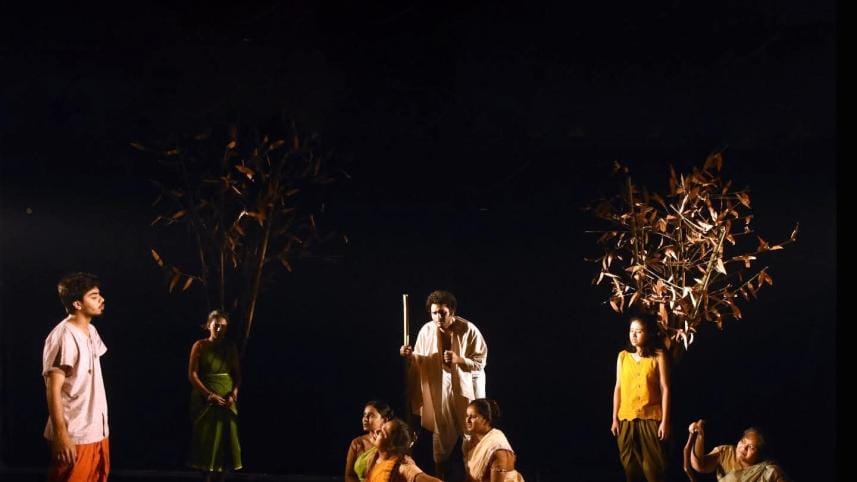
Opposing her is Debal Bodro, the Brahmin minister, portrayed by a teacher from the department itself. His performance is chilling, precise, and unnervingly relevant. Debal Bodro embodies the allegorical spectre embedded in Selina Hossain's novel: the unmistakable echo of Pakistan's rulers, the self-serving authoritarianism that sought to silence the Bengali voice before 1971 and continues to haunt Bangladesh's political consciousness. His final scenes, delivered with near-Shakespearean fury tempered by bureaucratic coldness, are unforgettable.
Kanu: the poet who cannot decide whether to speak
At the centre stands Kanu, a folk poet—part dreamer, part coward, part everyman. He symbolises the Bangladeshi condition itself.
We speak, then fall silent.
We resist, then retreat.
We whisper dissent, then hide behind the curtain of fear.
Kanu never truly finds his footing, and perhaps, in this moment of national political fragility, that is precisely the point. Bangladesh, like Kanu, oscillates between courage and quiet compliance, between longing and paralysis. He embodies a people whose history is full of sacrifice and whose present is riddled with uncertainty.

The midnight saga of Bengal
What Arko and his students achieve is the transformation of a literary narrative into a midnight saga—one that echoes decades of psychological wounds etched across the Bangalee nation. From the uncountable deaths of 1971, whether three thousand, three million, or thirty million, as political rhetoric shifts, to more recent tragedies, including the painful losses of July 2024, the land seems perpetually asked for another divine sacrifice.
Dombi becomes the symbol of that sacrifice: clear-voiced, unwavering, destined to fall. Kanu becomes the symbol of what remains—hesitant, wounded, unable to complete the journey, yet unable to stop dreaming.

Arko's vision: symbolism, geometry, and breath
A signature of Arko's direction over the years is the X-formation he repeatedly crafts with his ensemble. In "Neel Moyurer Jouban", it becomes a quietly radical device:
An X marking the crossroads of history.
An X dividing the audience's gaze.
An X echoing the fracture lines of a nation.
From every corner of this X, performers spill into the centre like tributaries converging into a river delta—a visual reminder of Bangladesh's geography and its metaphoric destiny.
Music plays an equally essential role. While Arko's productions have long relied on song, rhythm, and imagery, here the compositions feel almost ritualistic—echoes of Baul gaan, jatra, and whispered rebellion moving through the space like breath.
A production worthy of its legacy
Jahangirnagar University's Department of Drama and Dramatics, shaped by Selim Al Deen and carried forward by his protégés—once again demonstrates why it remains the beating heart of Bangladesh's theatrical imagination. The students perform with remarkable maturity, the staging is bold, and the political undercurrent, handled with nuance rather than blunt force, renders the production deeply resonant in today's socio-political climate.
"Neel Moyurer Jouban" is not merely a retelling of a novel. It is a mirror held up to Bangladesh's history—its wounds, its sacrifices, and its repeated struggle to articulate its own identity. If Dombi represents the clarity of sacrifice, Kanu represents the confusion of survival. And somewhere between the two lies the question the play asks, quietly yet insistently:
How many more sacrifices must Bangladesh make before it finds its voice, its identity and stops questioning its own birth as a nation?
Comments