


Char Haats: The unequal economics of the chars

In the middle of the Brahmaputra River, far from paved roads and permanent markets, lies the remote char of Daikhawa under Begumganj Union in Ulipur upazila of Kurigram. Life here is shaped by sand, silt, and uncertainty. For 65-year-old Javed Ali, a farmer, each year begins with a question: how much land will the river leave behind?
On the shifting sands of the char, Javed grows paddy, maize, jute, kaun (foxtail millet), wheat, chhena (proso millet), lentils, and whatever else the land allows. Some years, erosion takes away his fields; in others, fresh silt creates new plots. Around 70 families live on Daikhawa char, all dependent on agriculture. Crop cultivation and livestock rearing are their only means of survival.
 For all latest news, follow The Daily Star's Google News channel.
 Growing food on the char is arduous, but selling it is often harder.
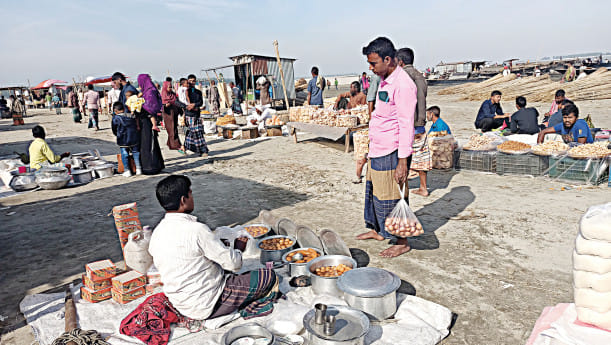
There is no permanent market nearby. When harvest time comes, farmers load sacks of grain onto boats and travel to makeshift markets that spring up along the riverbanks — the char haats. These markets operate only for a few hours each day and shift location as riverbanks erode or emerge. Here, farmers sell their produce at prices lower than those in mainland markets, while buying essentials at higher rates.
"We suffer more trying to sell our produce than we do growing it," Javed Ali said. "We bring our harvest by boat to the char market, only to sell it at low prices. Due to the lack of transport, we can't go to markets on the mainland. And we have to buy essentials from char markets at higher prices."

According to him, farmers sell their crops at 8–10 percent less than mainland prices and buy goods at 8–10 percent more. "That loss stays with us every season," he said.
For char residents, this unequal exchange is not new. Azgor Ali Mondol, 75, another farmer from Daikhawa, said char markets have existed for generations. "These markets are temporary. Depending on the riverbank's condition, they pop up on different chars at different times. Traders from the mainland bring goods to sell and also buy products from us. We come here by boat."
"Selling at low prices and buying at high prices has become our norm," he added quietly. "We've accepted it. This is our fate."
The scale of this system is vast. According to the Kurigram Char Development Committee, more than 650 chars lie along the Brahmaputra, Teesta, and Dudhkumar rivers across Kurigram, Gaibandha, Lalmonirhat, and Rangpur. Kurigram alone has about 450 chars on the Brahmaputra. Despite their remoteness, these chars are served by just 18–20 char markets.Every day, thousands of farmers depend on these haats.
At the Jorgachh char market on the Brahmaputra in Chilmari upazila, activity begins before sunrise. By noon, the market disappears as quickly as it forms. Nadim Mondol, 55, a farmer from Montola char, arrives early with his produce.
"Mainland markets open after noon, but char markets start at sunrise and end by noon," he said. "We prepare early in the morning, sell our goods, buy what we need, and return home by boat."
Each char market typically sees 1,000–1,200 farmers bringing their produce. Around 150–200 traders attend. Despite its temporary nature, a single market can see transactions worth more than Tk 1 crore in a few hours.
Traders argue that the price difference reflects logistics rather than exploitation. Shamsul Alam, a trader at the Jorgachh market, said produce is bought cheaper and sold dearer because of transport costs.

"It's not discrimination," he said. "Horse-drawn carts are the only means of transporting goods in the chars. These markets are 5–7 kilometres from the mainland. The cost of transporting goods by horse-drawn cart makes prices higher. That's why farmers get less for their crops and pay more for essentials."
According to him, transporting one maund of goods by horse-drawn cart costs Tk 120–150. "I've been buying produce from char markets for 39 years," he said.
Shahed Ali, a seller of agricultural inputs, echoed this view. "We bring fertilisers, seeds, pesticides, and diesel from the mainland using horse-drawn carts. If anything remains unsold, we take it back the same way. That's why we sell at higher prices than in mainland markets. The extra charge is only for transportation."
The carts themselves are part of a fragile economy. Majidul Islam, a horse-drawn cart driver, earns Tk 1,800–2,000 a day transporting goods. Half of that income goes to feeding his horse. "I've been driving a cart for 20 years," he said.
Each char market has 50–60 such carts. Each can carry 10–12 maunds of goods. No alternative transport exists on the sandy terrain. Moving just one kilometre can take 20–25 minutes, with the driver walking beside the horse under the sun.
For development experts, char haats are both a lifeline and a symbol of inequality. Professor Shafiqul Islam Bebu, convener of the Kurigram Char Development Committee, said char residents are trapped in a cycle of disadvantage.
"They live with the constant struggle of selling at low rates and buying at high rates, along with many other inequalities," he said. "Many government and NGO projects have been implemented, but there has been no real change. Without a separate ministry for char development, their welfare is not possible."
He believes a dedicated 'Char Ministry' could help establish permanent markets, improve transport, and ensure fair prices. "Char residents are also protesting for it," he said.
S Dilip Roy is a journalist at The Daily Star.
Send your articles for Slow Reads to slowreads@thedailystar.net. Check out our submission guidelines for details.
Comments