


‘Baakmuhurto’ attempts to decolonise art through printmaking


“How can the idea of decolonisation lead artists toward new paths?”
This is the question that viewers see on the wall when they first go to “Baakmuhurto / A Turning Moment” at Shala Neighbourhood Art Space, Aloki. It is a question that we have all thought about, but in different ways. Decolonisation has been injected in our veins for centuries, and everyone has wondered at least once in their lives — Who am I without invasion?
 For all latest news, follow The Daily Star's Google News channel.
 Running from June 5 to June 12, 2026, daily from 3:00pm to 9:00pm, “Baakmuhurto / A Turning Moment” emerges from a collective exploration of printmaking, artistic negotiation, and historical reflection. The exhibition creates a space beyond the dominant discourses of modernism by revisiting historical developments in art and arriving at new critical images.
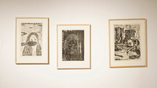
The answer to the question of decolonisation usually turns into a socio-political argument, and for an artist, it is not different either. But the art of decolonisation has also existed for a long time now. It exists in the way artists look back at history, in the way they question inherited forms, and in the way they attempt to create a language that belongs to their own time and reality.
At Shala Neighbourhood Art Space, Baakmuhurto steps in to answer such questions and highlight reality through lines, figures, textures, and abstract forms. The country’s artistic and cultural history is too rich to be infected with colonisation. And this thinking has evolved as artworks move towards a post-colonial time period with more expressiveness.

The works on display carry the sharpness of printmaking. Some pieces use human figures, hands, animals, rural symbols, and repeated patterns. Others move towards darker, more fragmented visuals. Each artwork tells the story of the people and their history. While some works show the fighters of our nation, some show the sacrifice and struggles of our mothers. The pieces are filled with elements that belong to us—like the diversity of our seasons or our heritage symbol Rickshaw.
Legendary artists like SM Sultan and Kamrul Hasan, whose art represented local visuals, or Zainul Abedin, whose sketches about famine forebode the collapse of agrarian society and the criticism of inevitable city-centred modernism, already carried this visual language. Their works showed that art could speak about people, land, hunger, labour, and identity without needing to borrow its voice from elsewhere.
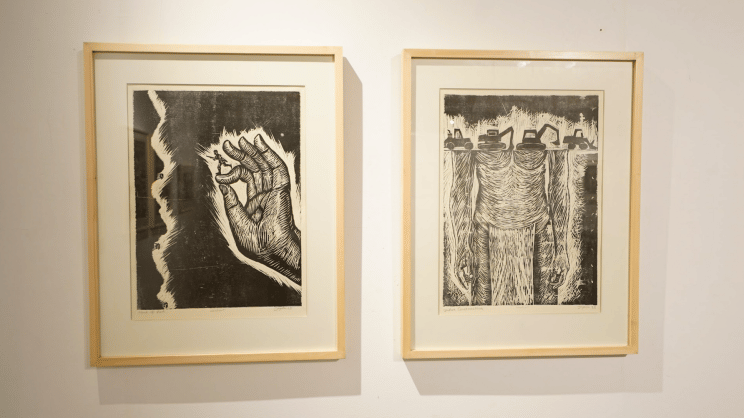
In that sense, “Baakmuhurto” continues a much older conversation. It paints a picture of the desire to create a shared space for navigating different artistic positions developed from within the same postcolonial condition. The exhibition does not treat printmaking merely as a medium. Here, printmaking is not just a technique, but a way of thinking, questioning, and transforming.
If this collective engagement succeeds in initiating even a subtle shift in our artistic positions and methods, then the title “Baakmuhurto” may continue to hold relevance as a true turning moment into the future.
Comments