


The economy Khaleda Zia trusted others to build


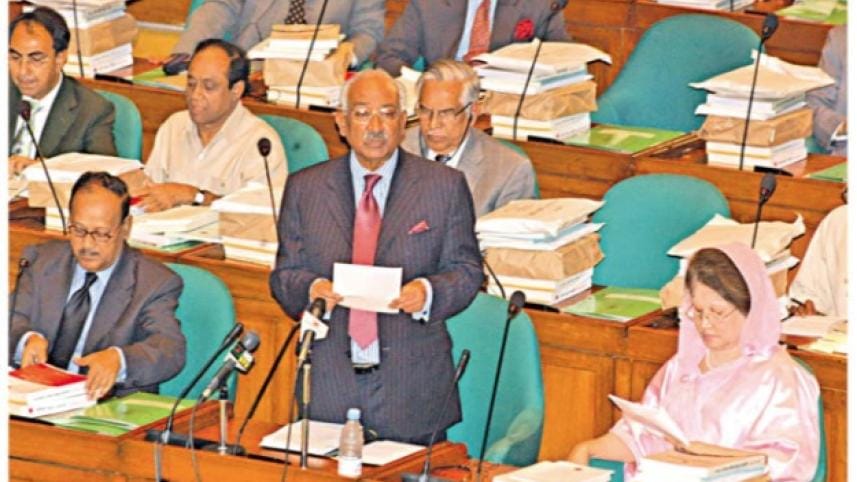
When Khaleda Zia took office in March 1991, there was little reason to expect that she would leave a lasting economic imprint on Bangladesh.
She entered politics late, and under extraordinary circumstances, moving from private life into the leadership of a fractured party after the assassination of her husband. She did not claim fluency in economics. She did not speak the language of policy models or macroeconomic theory.
 For all latest news, follow The Daily Star's Google News channel.
 Yet, more than three decades later and after her demise yesterday, economists say many of the changes that transformed the country's economy began during her years in power.
Her contribution was not technical expertise but judgment about placing the right people in the right positions, according to Zahid Hussain, former lead economist at the World Bank's Dhaka office.
Bangladesh, in the early 1990s, was emerging from years of centralised state control. Imports were rationed through quotas. Banking and industry were dominated by the state. Growth was slow, and investor confidence was fragile.
In her early tenures in office, Khaleda Zia allowed the economy to breathe. She listened and extended firm political support to those who knew what needed to be done.
As an example, Hussain said former finance minister Saifur Rahman received political backing from Khaleda Zia in rolling out the value-added tax (VAT) in 1991. Without her support, it would have been impossible to implement such sweeping changes at that time.
Over the years, VAT has now become the backbone of the country's revenue system.
Under her leadership, the import quota system was abolished. This allowed supply and demand to determine trade flows, while tariff barriers were cut not selectively, but across the board.
Private banks were allowed to open and do business under a regulatory framework that did not previously exist. Institutions such as the Board of Investment and the Privatisation Commission were set up to reduce bureaucratic choke points.
Perhaps the most far-reaching decision came during her 2001-2006 tenure, when Bangladesh liberalised its exchange rate in 2003.
"That was a transformative reform," said former World Bank economist Hussain.
The move is widely appreciated for anchoring trade competitiveness and macroeconomic stability as the country became more connected to global markets.
She chose capable people, gave them room to work and, importantly, shielded them when reforms proved unpopular. Without her backing, the former World Bank economist said, it would have been difficult to push through reforms such as implementing the VAT.
The results were gradual but lasting. Average economic growth rose from below 4 percent in the late 1980s to above 5 percent in the following decade, according to the Bangladesh Bureau of Statistics (BBS).
Poverty also began to fall, from nearly 57 percent in the early 1990s to about 50 percent by the end of her first term. Growth accelerated further during her 2001-2006 tenure, even as income inequality widened.
Her imprint reached beyond macro policy. The former prime minister also contributed to social transformation.
During her first tenure, primary education was made mandatory for the first time.
Programmes such as food for education and stipends for girls increased school enrolment and reshaped the future workforce.
In agriculture, her government partnered with NGOs to deliver numerous services to farmers, spreading new seed varieties, fertilisers and irrigation methods at the grassroots.
Khaleda Zia also preserved what worked. Facilities such as bonded warehouses and back-to-back letters of credit (LCs), introduced earlier, were maintained, allowing the garment sector to deepen its links with global buyers.
Remittance channels to the Middle East were expanded, boosting foreign exchange inflows and building reserves.
There were difficult decisions as well. Loss-making state enterprises, including Adamjee Jute Mill, were privatised amid resistance.
Telecom services and mobile phones entered the market, transforming connections for businesses and households.
The Bangladesh Bank was given greater operational independence, insulating economic decisions from day-to-day politics.
Professor Mustafizur Rahman, distinguished fellow of local think tank Centre for Policy Dialogue (CPD), said that when Khaleda Zia first took office, wealth and economic power were concentrated in very few hands after a decade of autocratic rule.
"The economy began to recover under her leadership," said Rahman, adding that many of the steps she took were "unpopular but necessary".
The Bangladesh Economic Association, a platform for professional economists in Bangladesh, described her as a key architect of Bangladesh's economic and social transformation.
The foundations of the economy were laid during her tenure through initiatives such as privatisation, energising the labour market, VAT introduction for national revenue mobilisation and deregulation, said the association.
Professor Mohammed Helal Uddin, member secretary of the Bangladesh Economic Association and executive vice chairman of the Microcredit Regulatory Authority (MRA), recalled her contributions to reforms and women's empowerment.
He said some reform initiatives were taken during military ruler Ershad's regime, but they were taken in the face of pressure from the International Monetary Fund (IMF) or the World Bank.
"But her government showed a true spirit and political commitment towards reform. Besides, when she took any step, she did everything she could to implement it firmly," he added.
Comments