


Comforters replacing blankets as urban winter favourite

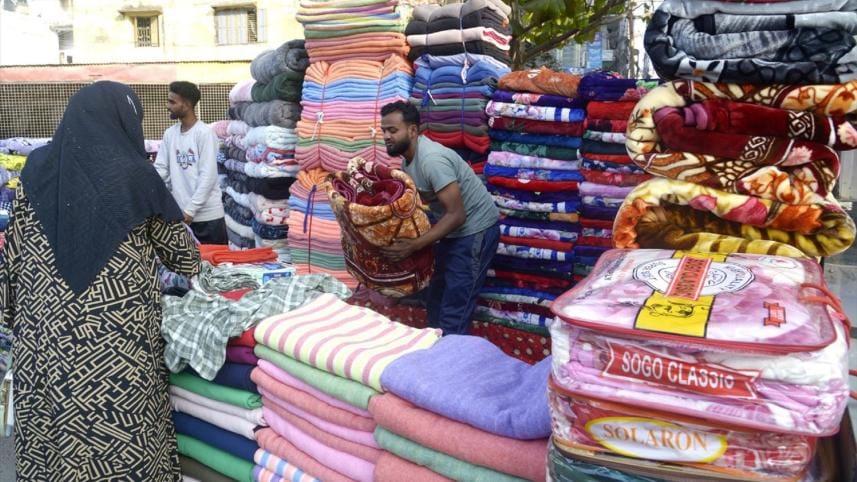
When Rumana Parveen Rinky, a private jobholder, went shopping for winter essentials this year, she opted for something new -- a comforter.
"It's light, washable, and easy to use," she said, explaining the reason behind switching from the heavy blanket she used in previous winters.
 For all latest news, follow The Daily Star's Google News channel.
 "Blankets are often too warm for Dhaka's winter. The comforter, on the other hand, is just right."
Rinky represents a growing group of urban consumers who are choosing comforters as a convenient and cost-effective alternative to traditional quilts (locally known as lep) or imported blankets. "Even the price of a comforter is lower than a blanket," she added, highlighting a key factor for many middle-income families.
With local brands increasing production and offering a wide range of designs at competitive prices, industry insiders say comforters are not just a passing trend but a long-term change in how urban Bangladesh keeps warm in winter.
Market insiders say the comforter market size is within Tk 200 crore, as it is still largely urban-centric.
With temperatures falling during cold waves, comforter sales have surged. Pran-RFL Group reported a 40 percent year-on-year growth during this season so far.
"This year, we have seen a stronger response than in previous winters. People now clearly understand the value of comforters," said Kamruzzaman Kamal, marketing director of Pran-RFL Group. He attributed the growth to the cold wave affecting Dhaka and other urban centres.
Pran-RFL, the country's largest local comforter manufacturer, produces about 5,000 units daily, priced between Tk 1,300 and Tk 3,000.
"People traditionally used cotton quilts or imported blankets from China, Korea, and Thailand. Comforters are gradually replacing those because they are more practical," Kamal said.
He added that comforters are likely to become the standard winter sleeping arrangement in Bangladesh.
While Pran-RFL leads the market, several home textile firms and cushion manufacturers have also entered the segment. Imported comforters and pillows continue to supplement the local supply.
However, Md Musa, owner of Musa Bedding in Uttara Sector 3, acknowledged that comforter demand is gradually rising, but noted that many customers still prefer traditional quilts during peak winter.
"We sell both imported and locally made comforters. Their prices are generally lower than traditional quilts, which makes them an attractive option for cost-conscious buyers," he added.
"Over the past five to six years, we've seen a clear shift. While people in rural areas once used simple cotton layers for warmth, comforters are now becoming the preferred choice," said M Shahadat Hossain Sohel, president of the Bangladesh Terry Towel and Linen Manufacturers and Exporters Association.
He said comforters are a modern upgrade of traditional quilts, made with advanced materials and technology. In global markets, poly-cotton fabrics with 8 to 12 ounces of padding are standard. Bangladeshi manufacturers have adopted similar methods, using locally produced padding to meet rising demand.
Major players like Youngone and Devonair have strengthened the local supply chain by producing high-quality padding materials. "This has enabled many companies to serve both domestic and export markets," he added.
"Comforters are no longer limited to Dhaka or other big cities. They are reaching villages as well, thanks to local production and better distribution," Sohel said.
"Bangladeshi entrepreneurs are quick to adapt to trends. What we're seeing now in the comforter industry reflects that adaptability," he added.
Md Naim Hossain, an accountant at a comforter shop on Uttara's Jashim Uddin Road, said that demand for comforters has risen sharply this winter.
He said the store has sold several thousand comforters in the past one and a half months, showing strong seasonal demand.
"Home textile manufacturers now offer a wide range of comforters, from regular to premium quality," he said. "Prices usually range between Tk 3,000 and Tk 6,500, and they can be washed with normal water or in a washing machine, which makes them very convenient."
Comments