


Economy now in better shape
in global supply chain
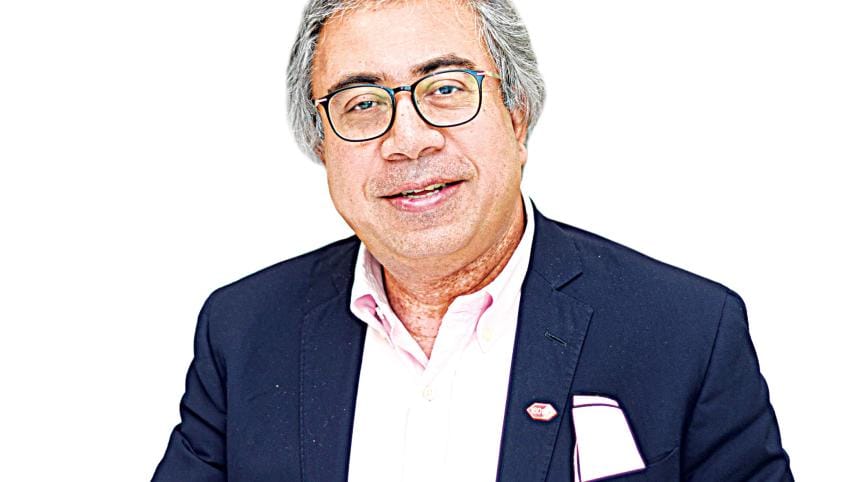
The country's economy is now in better shape than it was before or immediately after last year's mass uprising amid a dollar crisis, said Md Mahbub ur Rahman, chief executive officer of HSBC Bangladesh.
The senior HSBC official said the next phase of growth will depend on how well Bangladesh nurtures domestic demand, strengthens its infrastructure, and positions itself within shifting global supply chains.
 For all latest news, follow The Daily Star's Google News channel.
 He believes the current economic slowdown provides a strategic window for local businesses to build strength for the future.
In an interview with The Daily Star, Rahman said, "My take is that it [economy] is much better than what it was 15 months or 18 months back, but it should be much better than what it is today."
"We have to go a long way," he said on the eve of the British multinational celebrating 29 years in Bangladesh today. Apart from facilitating imports and public infrastructure financing, HSBC Bangladesh today caters to nearly 10 percent of the country's exports.

Rahman, the first Bangladeshi to lead the bank in the country since 2020, said HSBC is committed to helping the country unlock new opportunities for the next wave of sustainable, resilient and future-ready businesses.
Speaking about shifts in global trade and supply chain strategy, he said three forces will shape Bangladesh's economic direction.
He pointed to Bangladesh's large domestic market supported by remittances, strong demand for infrastructure in a densely populated country, and its geographic advantage as global supply chains realign across Asia and the Middle East.
The first driver, Rahman said, is domestic demand, supported by a population of about 18 crore, nearly half of whom are under the age of 25. This young demographic creates a strong consumption base, much of it driven by remittances from Bangladeshis working abroad.
"The job is not in Bangladesh, but the job is actually outside. That money is coming to have disposable income for the family, so they go to the market. It is a huge infusion of that money going to the market," he said.
Infrastructure is the second pillar. Rahman said a country of 18 crore people within roughly 55,000 square miles must continue to expand transport networks, logistics capacity and public services to support growth.
"When you have 180 million people within 55,000 square miles, what you need is more infrastructure, whether it is airports, whether it is ports, whether it is roads and highways, whether it is public transportation," he said. "Something that probably we ignore is our riverways."
He said stronger infrastructure improves efficiency, connects economic zones, brings down travel time, and speeds up business activity.
Public investment also generates employment and circulates money through the economy. He emphasised careful planning to ensure that infrastructure spending delivers long-term returns.
The HSBC Bangladesh CEO also pointed to digitalisation as an area where Bangladesh has made progress and should continue to build capacity.
The third driver, and the one he considers most important, is supply chain reconfiguration.
An MBA graduate from the Kellogg HKUST programme, Rahman said Bangladesh's geographic proximity to major economies gives it an advantage at a time when global buyers are diversifying.
"Whenever we talk about China plus one or China plus two, the question is how we are going to seize those opportunities. Supply chain is key. Bangladesh is geographically close to two large economies, China and India, and ASEAN. What we did not explore that much is the Middle East. Most of the cases, if not all, show that those markets are opening up as an export destination for Bangladesh."
He said Bangladesh has strong connectivity, with major trade hubs in Asia reachable within a few hours of flying time.
"Within four hours, you can go to Hong Kong, Singapore, Malaysia, Guangzhou in China, two hours to Delhi, three hours to Mumbai, and half an hour to Kolkata. The question is, how do we tap those markets for our exports?"
He said HSBC has access to 90 percent of global trade flows and works with most large apparel buyers worldwide.
"Of the top 20 buyers, 17 are our clients," he said, adding that the bank helps connect international buyers with Bangladeshi suppliers. "The connectivity helps, and the opportunity unfolds."
Rahman said the country has long-standing expertise in garments, supported by strong relationships with global buyers.
But he said diversification, value addition, and logistics readiness are increasingly important as export patterns become more fragmented and automated.
"Understanding buyers' strategies, consumer trends, and the rapid shift toward fast, multi-destination shipments is becoming essential for sustaining competitiveness," he said.
"What has got us here will not take us there," he added, highlighting the evolving nature of export logistics.
Rahman described how contracts now require shipments to multiple destinations. Buyers run stores across the Middle East, China, ASEAN nations, and Europe, demanding faster and more precise rotations.
"Now the export is like $50,000 going directly to that shop, directly going to the rack. They are asking for rotations."
"Export has become hugely automated, digitalised, fragmented," said the official at HSBC, which has been recognised as the Best Trade Finance Bank for the seventh year in Bangladesh and eighth year globally in the Euromoney Trade Finance Survey 2025.
He said Bangladesh exports most of its goods to the European Union, about one-fifth to the United States, and the remainder to other markets.
EU buyers, he mentioned, often use Bangladesh as a hub for broader international distribution. "We have to see our proximity and what our buyers' international strategy is, where they would be growing."
Tariff parity is another factor. "Bangladesh's tariff with other countries is still okay, as the tariff rate is not an outlier at this moment," he said.
But the competitive advantages can be eroded by tariff and non-tariff barriers, he warned.
"We have to see whether we are able to add value in terms of what is expected by the importing countries and the consumers. Everybody loves their customers. We have to love our customers and understand our customers."
Rahman said competitiveness depends on efficiency, sustainability, worker upskilling, capital structure, and deeper engagement with global buyers.
"Do whatever is in your control. Put that efficiency, because ultimately, we have to bring value to our customers. We could become uncompetitive by having the duty in place. But production efficiency, sustainability, upskilling the workers, understanding the value chain, and an appropriate capital structure are important so that profit does not get sucked up by the interest cost."
On winding down HSBC's retail operations in Bangladesh, the CEO said the bank is exiting retail in other markets such as Australia, Sri Lanka, Indonesia, and New Zealand, while keeping operations in Hong Kong, Singapore, and the UK.
According to him, some jobs will be affected, but the bank is redeploying staff where possible and helping others find external opportunities.
"We are not exiting Bangladesh but realigning our business here with our global strategy," he said. "We remain committed to continuing our corporate and institutional banking businesses in Bangladesh, and we recognise the importance of being here for our international corporate clients."
"We are focusing on our strength," he added.
Rahman stressed the need for stability and enabling policies. "Any business, global or local, wants stability and certainty."
"The character of capital is that it actually wants consistency, stability, and return. Consistency is equally applicable to foreign investors and local investors. Having a coexistence of foreign and local, and a business-friendly environment, can only be ensured with a government that has a people's mandate," he concluded.
Comments