


Remembering Razia Khan Amin: The pen that forged a generation’s courage
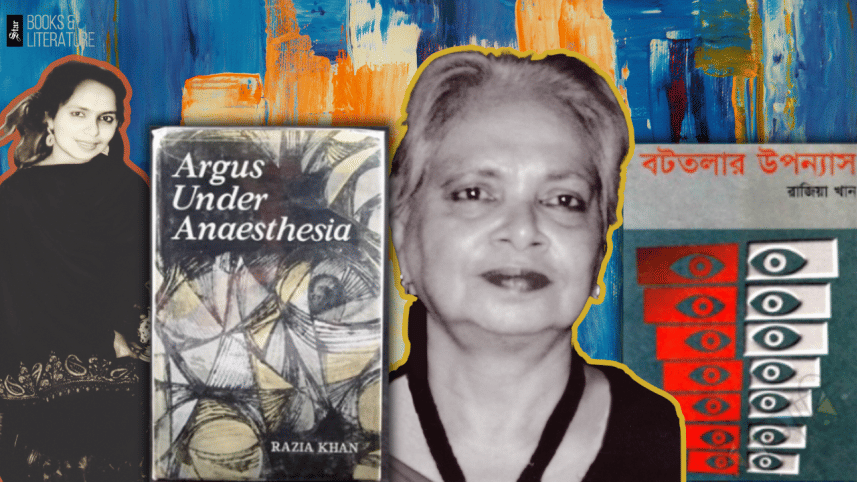
While serving as the Chair & Professor in the English Department of Dhaka University, she infused a fresh vitality in tune with the enthusiasm and spirit of her students, shaping generations with her distinctive voice and writing—whether in classes, seminars, creative works, recitations, theatrical performances, radio presentations and broadcasting, or through her role as a journalist on the Editorial Board of the then Pakistan Observer (now The Bangladesh Observer).
She is none other than RKA, or Razia Khan Amin. I remember her on the occasion of her fourteenth death anniversary, on December 28, as my esteemed teacher—an educator, a storyteller and novelist, a prolific bilingual writer, playwright, and one of the finest poets in the literary landscape of contemporary Bangladesh, particularly within the broader literary tradition of the subcontinent.
 For all latest news, follow The Daily Star's Google News channel.
 We—a small group of second‑year Honours students—gathered in her office one bright spring morning carrying with us the excitement of youthful ambition to request a modest fund from the department so we could publish a literary flyer: a small collection of writings contributed by both the boys and the girls of the class.
We were not prepared to ask for funds and felt a twinge of fear, thinking RKA might instruct us to focus solely on our studies instead of pursuing extracurricular activities that could hinder our academic progress. She listened to our urge attentively and, with a gentle smile, said, "The department does not have such funding." After a brief pause, she added softly, "Wait a moment, boys!"
Opening the drawer of her desk, she reached into her purse and handed us a crisp 100‑taka note. During the '80s and '90s, such a donation was enough to produce a pamphlet. Her personal contribution enabled the printing and wide circulation of our flyer, reaching both the students of the department and members of other literary organisations based in the DU campus.
This financial support was never merely for the production of a flyer; it was a profound message: students must continue their creative work to uphold democracy, equity, and empowerment—principles she believed throughout her life—and the very mandates of our long‑struggled Liberation in 1971, earned through the immense sacrifice of our flesh and blood against the Pakistani regime.
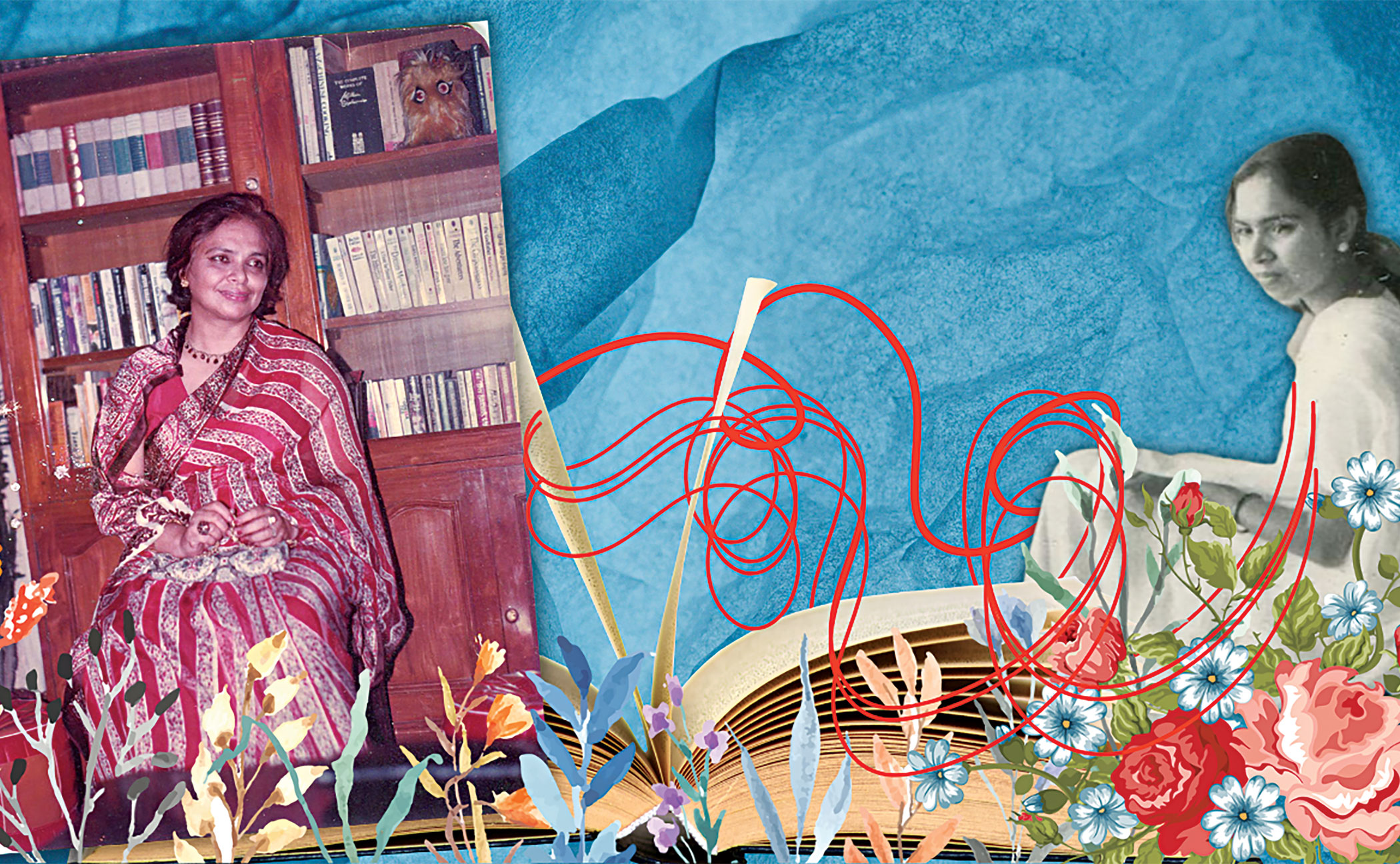
RKA understood the burdens weighing on young minds, having witnessed the partition of the subcontinent under the Two‑Nations Theory, which led to massive riots between Hindus and Muslims in 1947. She had seen riots while neighbours turned against neighbours across the land—a quest for a new horizon of freedom that instead culminated in violence—it was a tragic experience that perhaps shaped her imaginative journeys into a past filled with sweet memories and hidden worries.
Drawing on her memories and haunting flashbacks of the Partition, she produced a unique novel titled Bottolar Uponnash at just 18. Published in 1959, the book portrayed a range of protagonists engaged in the manyfold colours of love across different faiths, cultures, and religions. It represented an effort to bring the lived consciousness of a neglected segment of society into Bangla literature. Crafted with deliberate intent, the novel focused on the struggles of subaltern life and ordinary individuals—particularly women—during the 1950s in what was then East Pakistan (now Bangladesh).
The hope of emancipation faded within a very short period, and the novel, in many ways, explored subaltern life through a woman's perspective within a deeply patriarchal social structure. Thus, RKA returned to anecdotes of love to show how intricate it is to hold love, lust, and laughter when identity asserts itself in the post‑independence era of Pakistan. The novel revolves around several characters: Moin (Muslim), Shumita (Hindu), Heiti (Anglo‑Indian), Ahsan (Muslim), and Subrata (Hindu).
A talented English literature scholar RKA achieved first class first in both Honours and Masters, and later with a British Council scholarship, she pursued her advanced studies in English Literature at the University of Birmingham, UK.
RKA was honoured with a number of distinguished awards for her contributions to literature and scholarly research: the PEN Playwriting competition (1956), Pope Gold Medal winning student at DU (1957), the Bangla Academy Award (1975), Ekushey Padak (1997), Kamor Mushtari Padak (1985), Druhee Katha-Shahityak Abdur Rouf Choudhury Memorial Award (1999), Lekhika Sangha Gold Medal (1998), and Anannya Shahitya Purushkar (2003).
Her notable works, among others, include: Anukalpa (1959), Proticitra (1975) Citra-kabya (1980), He Mohajibon (1983), Draupadi (1992), and Padatik (1996). She has also written four volumes of Bangla poetry, as well as two English-language volumes, titled Argus Under Anesthesia (1976), and Cruel April (1977).
Her English works appeared posthumously in two volumes—Collected Poems (2014) and Omnibus Edition (2020). She also wrote two novels—The Enchanted Delta and The Tamarind Tree—published posthumously in 2020. Her work centres on gender, nationalism, and multiculturalism, celebrating Bangladeshi identity and advocating for women's empowerment.
About her novel Ishwar and Iblis, RKA mentioned that "these are primeval concepts but they are operating forcibly in human life." "I have chosen these themes in the pattern of a story from modern life," she added. In her poem "Argus Under Anaesthesia", she epitomised the genocide of 1971, and the mass exodus of Bangladeshi refugees to India: "Departures lay heavy over the fields. The mourning corn/ bent with grief; impossible phantasmagoria/ Haunting the eyes/ Of deserted dogs and cattle."
Her teaching style extended far beyond traditional explanation; she brought the text to life by simulating the trends and trivialities of society. Her classes were always well attended, and her lectures on Alexander Pope's "The Rape of the Lock" were not intended simply to explore the vanity and triviality of the 18th century aristocratic society, but to draw an immediate comparison with the complexity and bareness of our own. Her observations on culture, society, and human behaviour enriched our literary imagination. Enriched by her further studies in England, she brought a depth of experience and perspective that made her classes intellectually vibrant and unforgettable.
Last but not least, when our literary flyer was published after her generous contribution, RKA went through it and later called us into her room. She told me she had read my poem, "A Triple Fold on the Belly" as well, and asked with a smile, "Shailo, is this really how you see women?" I hesitated for a moment before replying, then nodded and said, "Yes, madam." She responded, "Thank you. You have the boldness—and you can be a writer, without a doubt."
Her inspiring words have never left me. That inspiration still echoes within me and continues to shape my writing—whether poetry or prose, research or books, policy work or corporate vision, reflections on geopolitical crises or explorations of historical necessity—all of it carries traces of her encouragement. Her gift of boldness still travels with me, across borders and across genres.
Rest in peace, esteemed RKA madam. Your presence endures in the pages you wrote, the students you shaped, and the quiet brilliance you gifted to our literary world.
Iqbal Shailo, PhD is a geopolitical scholar who lives and works in Ottawa, Canada. Email: iqbalshailo@gmail.com; Web: www.iqbalshailo.com.
Comments