


Khushwant Singh remembered: Legacy, language and Indian writing
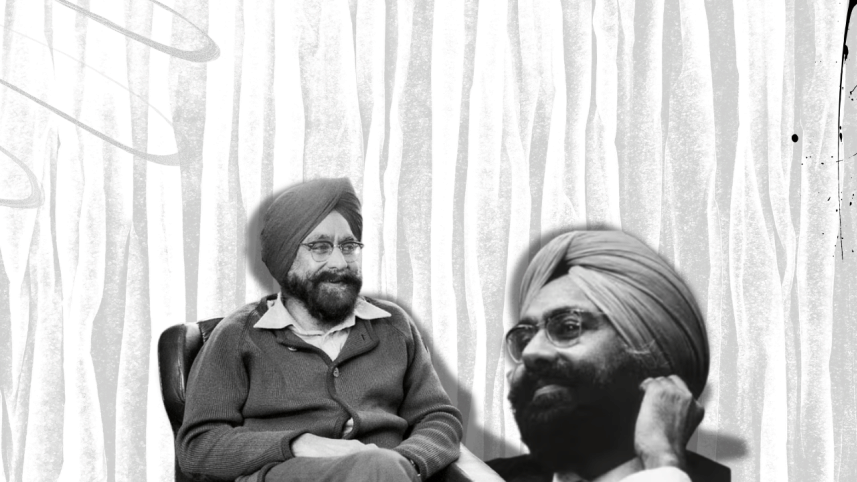
As the calendar turned to February 2, 2026, marking what would have been the 111th birthday of Khushwant Singh, the silence from his iconic Sujan Singh Park residence feels particularly loud. Singh was more than a writer; he was a cultural weather vane who pointed toward honesty even when the winds of political correctness blew the hardest. 12 years after his passing, his legacy remains a foundational pillar of modern Indian-English literature and journalism.
 For all latest news, follow The Daily Star's Google News channel.
 Khushwant Singh (1915–2014) was a man who architected a legacy. His contribution to the Indian consciousness is tripartite: the historian’s rigour, the novelist’s empathy, and the journalist’s irreverence. Before he was the “King of Malice”, he was the scholar of the Sikhs. His two-volume A History of the Sikhs (1469-1838) remains the definitive academic text on the subject, a testament to a man who, despite his self-proclaimed agnosticism, possessed a deep, soulful respect for heritage and truth.
In 1956, he gave us Train to Pakistan (Chatto & Windus, 1956). It wasn’t just a book; it was a mirror held up to a bleeding nation. While others romanticised the dawn of independence, Singh focused on the twilight of humanity in the village of Mano Majra. However, as the editor of The Illustrated Weekly of India, he didn't just increase circulation; he democratised the Indian magazine. He mixed highbrow poetry with “naughty” jokes, proving that a serious intellect need not be a sombre one.
Perhaps Singh’s most enduring gift was his relationship with language. He wrote in what he called “flawless Queen’s English”, yet his prose never felt foreign. He successfully “Indianised” the colonial tongue—not through broken grammar, but through a rhythm and sensibility that was distinctly subcontinental. He stripped away the Victorian verbosity that plagued early Indian English writers. He brought the soul of Urdu poetry and Punjabi earthy wit into English prose. He pioneered the “personal” column in India, making the author a relatable, flawed character. He was a master translator, bridging the gap between the divine verses of the Gurbani or the Urdu ghazals of Ghalib and the modern English reader. He understood that for a language to live in India, it had to breathe the air of the bazaar as well as the darbar.
In 2026, Singh’s trenchant secularism feels more relevant than ever. He was a man who returned his Padma Bhushan in 1984 in protest against Operation Blue Star, yet remained a fierce critic of religious fundamentalism of all stripes. He practiced a “secularism of the heart”—a belief that one could be a nonbeliever and still be a man of deep ethics and communal harmony. He famously joked that his only religion was “the religion of the good man.” This brand of humanism, delivered with a wink and a glass of premium Scotch, made him the ultimate bridge-builder in a fractured society.
The caricature of Khushwant Singh sitting inside a light bulb—the logo of his famous column—remains the perfect metaphor for his life. He was a source of illumination in dark times, a man who believed that the best way to fight gloom was with a sharp wit and a clear sentence.
As we remember him today, we don't just celebrate a writer; we celebrate a way of being. He taught us that one could be a scholar without being a bore, a patriot without being a chauvinist, and a critic without being a hater. In the library of the Indian mind, the shelf reserved for Khushwant Singh remains the most well-thumbed, the most laughed over, and arguably, the most essential.
Ahsan Iman, PhD works in the Bangladesh Technical Education Board under the Ministry of Education.
Comments