


16 Days of activism: The abuse that leaves no bruise

When 32-year-old Akhi (not her real name) finally left her marriage last year, it was not the beatings that drove her away. It was the slow erasure of her being.
Soon after the wedding, her husband forced her to quit a six-year corporate career. Over the next four years, he dictated what she wore, what she cooked, which friends and relatives she could meet, and even when she had to sleep.
 For all latest news, follow The Daily Star's Google News channel.
 "At first, I thought these were just the 'normal adjustments' of married life," she said.
"But the rules kept expanding. He demanded my phone password, monitored my calls and social media, forced me to remove male friends and former colleagues, and even sent messages to them pretending to be me to check if I was in any relationship. He also insisted I keep my location on whenever I stepped out.
"If I was late replying to his messages, he accused me of infidelity. He never hit me, but he controlled every part of my life. I felt like I was living in a prison."
Akhi's experience is far from unique. Across Bangladesh, controlling behaviour has long existed as psychological abuse that leaves no marks and rarely enters police or medical records.
The Violence Against Women (VAW) Survey 2024, conducted on 27,476 women aged 15 and above nationwide, by Bangladesh Bureau of Statistics and UNFPA, found that 68 percent of women who faced intimate partner violence (IPV) experienced controlling behaviour. The rate was 71.1 percent among divorced, separated, or widowed women.
Experts warn such coercive control is often the first step toward physical violence, economic deprivation, sexual coercion, and femicide.
The survey measured restrictions on women's autonomy, decision-making, and social interactions.
HIDDEN IN PLAIN SIGHT
Controlling behaviour cuts across education, income, and geography. From villages to Dhaka's middle-class areas, husbands dictate when women can leave home, how long they may be out, whom they may meet, and even when they must return.
The VAW Survey found nearly 40 percent of women need permission to access healthcare; 29 percent face mistreatment linked to in-laws; a quarter report insults to their parents; and 15 percent are restricted from recreational activities.
Women reported partners trying to stop them from seeing friends or family, demanding to know their whereabouts, showing jealousy when they spoke to other men, [monitored their behaviour], or enforcing permission to access healthcare.
Other forms included forcing women to wear a veil, restricting education or work, limiting outings, insulting parents, and monitoring social media.
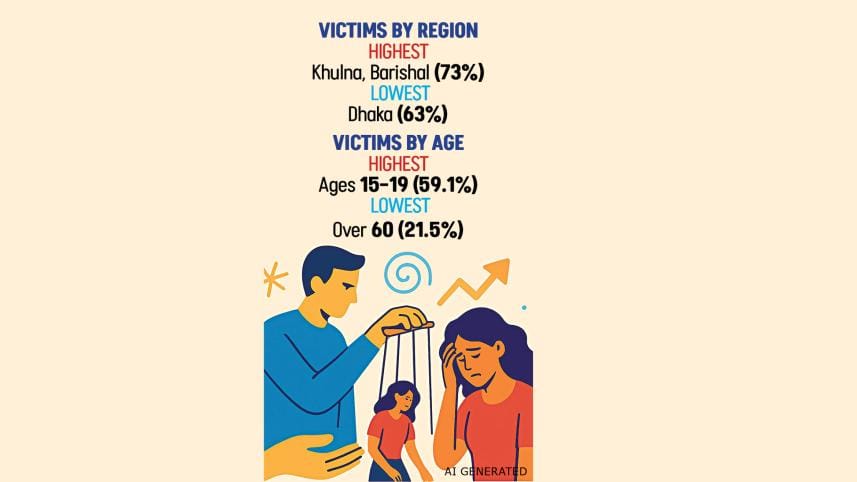
Regional variations are stark: Khulna and Barishal report prevalence above 73 percent, while Dhaka has 63 percent. Rates are higher in disaster-prone regions (73.2 percent vs 65.3 percent), and urban areas outside city corporations exceed the national average at 70.4 percent.
Younger women are most at risk: 59.1 percent of girls aged 15–19 report current controlling behaviour, dropping sharply after age 60. Education and wealth reduce vulnerability; 71.5 percent of women with no or pre-primary education report lifetime exposure, compared with 54.8 percent of graduates.
Raisul Islam, programme officer at the National Helpline Centre for Violence Against Women and Children-109, said they received 19,584 calls related to psychological abuse in the first eight months of this year. "Most calls involve husband's domination, restrictions on movement, control over clothing, interference in personal freedom, and denial of financial support."
NORMALISATION OF PATRIARCHAL CONTROL
Fauzia Moslem, president of Bangladesh Mahila Parishad, said women's subordination stems from the belief that they are meant to be controlled. "Many men feel entitled to decide if their wives can work, reflecting a patriarchal power imbalance. Controlling behaviour is a core feature of patriarchal masculinity that harms both women and men."
She said the behaviour has worsened over time. "Household competition and stress have increased, reducing empathy and placing greater pressure on young women. This mindset has been so normalised that many women do not even recognise it as violence. They assume it is simply how things are supposed to be."
Dr Sunjida Shahriah, physician and psychotherapy practitioner, said controlling behaviour often hides behind concern or family honour. "Small restrictions accumulate over time, making women accept them as routine. With no visible injuries and low awareness, such abuse remains unseen, leaving survivors unsure if they are being harmed at all."
Although the Domestic Violence (Prevention and Protection) Act 2010 recognises controlling behaviour as psychological abuse, no other law does, explained Advocate Sifat-E-Noor Khanam of BLAST.
"This makes it almost impossible to prosecute," she said.
"Implementation is negligible. Many women, social workers, and even lawyers are unaware of the law's provisions, leaving complaints filed under the wrong laws and courts unresponsive to psychological harm.
"Most women say the abuse began with small disagreements, then escalated over five or ten years. By the time they seek help, it has become unbearable and sometimes violent."
Highlighting the lack of state support, she said, "Victim Support Centres allow only five-day stays. Women don't just need shelter. They need a survival plan, income, and long-term protection. The state has left the biggest gap here."
Farhana Yeasmin, deputy commissioner of the Women Support and Investigation Division at Dhaka Metropolitan Police, said, "Women come to us only when violence becomes physical. By then, the psychological abuse has been ongoing for years.
"I've been in charge for a year and have not seen a single case filed for this type of abuse, not one."
THE INVISIBLE WOUNDS
Dr Shahriah said controlling behaviour leaves deep emotional scars, often more lasting than physical abuse. "Long-term coercive control triggers trauma, depression, anxiety, and post-traumatic stress disorder. Gaslighting distorts memory and reality, while constant surveillance, insults, or financial penalties trap women in a mental prison."
Gaslighting is when someone makes you doubt your own memory, feelings, or reality so they can control the situation or shift blame.
She said survivors need trauma-informed, empowerment-focused care, including counselling to restore autonomy, psychoeducation to reduce self-blame, and life skills to counter economic dependence. "Support groups can help break isolation."
Advocate Sifat said solutions require systemic change.
She outlined three steps: educating children early about gender equality, establishing state-funded shelters so women can report abuse securely, and reforming the law to explicitly recognise psychological abuse with clear proof standards.
"Awareness alone is not enough," Fauzia Moslem warned. "Women must reclaim their skills and decision-making to break free from controlling environments, especially where control is subtle, relentless, and shatters their lives in silence."
Comments