


Grieving on a delay
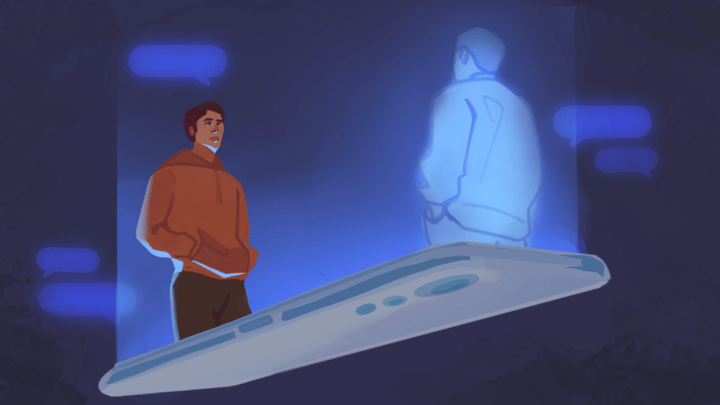
I have said goodbye to two people in the last few years. One is dead, and one is not. The distance between those two losses, and what social media has done to that distance, is the subject of this article.
My best friend died in late 2024. He was 23; I was 22. The death was sudden, and what struck me was how little I felt at the time. No collapse, no tears, just a flatness where the grief was supposed to be. He had been studying in the United States, and our friendship had been living inside our phones since he left for university. His absence did not feel like absence. It felt like a delayed reply. Two years on, part of me is still waiting for the message.
 For all latest news, follow The Daily Star's Google News channel.
 The day after the incident, I accidentally deleted our Facebook Messenger chat. Years of messages, voice notes, and links sent at 3 AM., were gone with a single misplaced tap. The photos and videos were still saved elsewhere, his face still moving in old videos. But the thread, the running record of an entire friendship, was missing. It was the first time something in me registered what I had been refusing to feel: that he was not coming back.
There is something specific about how my generation grieves, and it has very little to do with how much we care. Older generations were granted a clean break by default. The dead left behind a few photographs in an album, a recording, and perhaps a stack of letters. Our dead leave behind a backup. They laugh in 1080p in our camera rolls. Their last "seen at" timestamp does not move, but everything else they sent us is there, scrollable and searchable.
Continuing-bonds theory, a framework that emerged in grief psychology in the mid-1990s, suggests that maintaining a relationship with the deceased can be healthy rather than pathological. By that measure, my generation should be the best-equipped in history. We can rewatch the dead, hear them, and search our chats for the last thing they said. Memory used to ambush you on a Sunday afternoon, while ours waits until we choose to look.
A version of the same problem appears in relationships that end while everyone is still alive. Two years after losing him, I went through a breakup I will not go into here. Moving on from a person, in 2026, is not the task it was a generation ago. WhatsApp keeps the contact, the cloud keeps the photographs, and Spotify keeps suggesting playlists you used to share. They are always a message away. Blocking helps, but blocking can be undone, and you know it. Every act of not reaching out becomes a small, ongoing decision.
What has surprised me is that this may be the more honest version. The older model relied on forgetting, and forgetting is a liar. People threw away the gifts and lost the photographs, and within a year the brain would edit the relationship into something kinder than it had been. Optimism bias did the heavy lifting; regret did the rest. The cloud refuses that revision. It holds the arguments, the photographs, and texts from the night you fought. Choosing not to reach out, when you could in thirty seconds, is more deliberate than losing a number in 2002 ever was.
That leaves me with two kinds of grief pulling in opposite directions. The friend I lost is everywhere and therefore nowhere. I keep waiting for a notification that will not come. The person I left, I could message in under a minute, and I keep choosing not to. The first feels like an emotion suspended in mid-air. The second feels like the most deliberate goodbye I have ever said.
None of this is to say the old way was better, but the archive has changed what grief is. With the dead, it blurs the line between presence and absence until they stop feeling gone. With the living, it forces a kind of honesty. The question is no longer how to forget. It is what we choose to keep open, what we choose to close, and what those choices reveal about us.
References:
- Death Studies. (2006). Continuing conversation about continuing bonds.
Sharar Chowdhury is learning how to be a manager and believes "I'm confused" is not a complete sentence. Send him emails at: sharar672@gmail.com




Comments