


Provoked into protest?

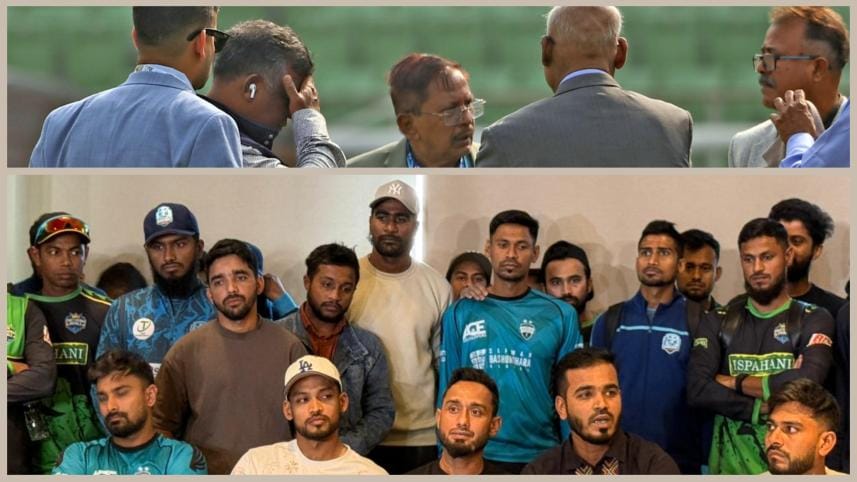
A handful of spectators waited in the stands, clinging to the hope that the Dhaka phase of the Bangladesh Premier League (BPL) would eventually begin yesterday. But as evening fell, security personnel of the Bangladesh Cricket Board (BCB) asked them to leave. What followed in the empty stadium was a light show, its flashes only underlining the darkness.
The BPL has long been no stranger to controversy, but never on this scale.
 For all latest news, follow The Daily Star's Google News channel.
 The escalation of tensions intensified since Wednesday night. At the Home of Cricket in Mirpur, BCB director M Najmul Islam made controversial remarks about the players. Within hours, the Cricketers’ Welfare Association of Bangladesh (CWAB) announced a hardline stance: players would not take the field unless Najmul stepped down.
Yesterday, as the BPL was set to resume following the Sylhet phase, the players held firm. No team turned up. With no option left, the matches were called off. While the first game was scheduled for 1:00 pm, the players were holding a press conference at their team hotel, which began at 2:30 pm.
It soon became clear that director Najmul’s comments were only the trigger. What followed was an outpouring of long-simmering grievances.
Alongside all centrally contracted players, captains from all three formats -- Najmul Hossain Shanto, Mehidy Hasan Miraz and Liton Das -- were particularly vocal. Never before has the BCB found itself in such a public and total deadlock.
The roots of the crisis run deep: after last year’s election -- boycotted by most organisers -- the new board led by Aminul Islam Bulbul soured ties with Dhaka clubs, leaving eight First Division teams withdrawn, dozens of players without livelihoods, and the Dhaka Premier League’s future uncertain, with no solution yet from the board.
CWAB president Mithun said the players see little sincerity in resolving these issues, describing a culture of deflection and inertia. “One person says the other can’t be reached,” he said, adding that when it comes to solving players’ problems, “no one is available”.
Shanto raised the unresolved harassment allegation involving women’s cricketer Jahanara Alam. Although a committee was formed, its report has yet to be made public. He said everyone had hoped for a “swift and fair decision”, but the delay had been deeply disappointing and had discouraged others from coming forward.
Liton highlighted poor facilities in women’s cricket, while Shamsur Rahman Shuvo criticised the handling of fixing allegations. Ahead of this year’s BPL, nine players were barred from the auction over suspected misconduct without evidence, yet allowed in other domestic leagues, creating confusion and stigma.
The tournament itself has been mired in controversy: promised transparency and committee reports remain unpublished, its structure unstable, with a sixth team added before another franchise pulled out, forcing the BCB to take over.
All this has unfolded as the board remains locked in negotiations with the ICC over venue changes and its refusal to travel to India for the upcoming World Cup. Ironically, Mustafizur Rahman -- whose “respect” the BCB has cited in its communications -- was present at the players’ press conference, joining the protest after feeling his dignity had been undermined by the board director’s remarks.
The uncertainty surrounding World Cup participation has also unsettled the squad. Only two days earlier, CWAB leaders had said security was the board’s responsibility but that there was “no alternative” to playing the tournament.
The atmosphere is now suffocating. Despite repeated controversial remarks -- including Najmul earlier labelling former captain Tamim Iqbal an “Indian agent” -- no disciplinary action has been taken, nor has the BCB formally condemned the comments. The president has instead dismissed them as “personal opinions”.
In this deadlock, Bangladesh cricket is bound to suffer. But beyond lost fixtures -- and the risk of broadcasters and sponsors backing away -- what unfolded yesterday cut deeper, forcing a reckoning with what Bangladesh cricket has been and what it now risks becoming.
Comments