


Reading Nazrul in an age of inequality

Poet Kazi Nazrul Islam is widely known as the “Rebel Poet”, but he was also a profound “Poet of Equality”. Nazrul’s ideas about equality emerged from the realities of his own life. The experiences of his childhood, adolescence, and youth exposed him directly and starkly to poverty, inequality, and injustice in the real world. As a result, socialist and egalitarian ideas are powerfully reflected in his poems, songs, and essays.
In this context, it should be noted that Rabindranath Tagore also spoke strongly in favour of equality and justice. However, Tagore’s vision of equality came mainly from intellectual consciousness, moral awareness, and philosophical reflection, rather than from the harsh realities of lived experience. Nazrul’s conception of equality, on the other hand, emerged directly from life itself.
 For all latest news, follow The Daily Star's Google News channel.
 In different writings, Nazrul sometimes spoke of “equality” and sometimes of “equity”. This distinction was deliberate. The idea of equity is relative, whereas equality is absolute. When Nazrul spoke of universal humanity, he did so from an absolute perspective. But when he discussed equality between men and women, he approached it from a relative perspective. In this sense, Nazrul’s philosophy of equality operated on two levels: one collective and the other individual.
At the collective level, Nazrul reached the highest dimension of egalitarian thought. Universal humanity and the welfare of humankind as a whole were central to this vision. To him, every human life was valuable and significant. Therefore, he boldly declared:
“I sing the song of equality -
Nothing is greater than humanity,
Nothing more glorious.”
The essence of this philosophy was to establish all people in equal love, respect, and dignity. Nazrul extended this respect and dignity even to the poor. In his poem Daridro (“Poverty”), he elevated the dignity of poverty to a sublime level. He wrote forcefully:
“O Poverty,
You have made me great; you have given me the honour of Christ.
You have adorned me with the crown of thorns
And given me the fearless courage of frank expression.”
Nazrul established the dignity and pride that can exist within poverty on equal footing with wealth itself. This sense of equality is unparalleled. He also expressed his commitment to universal humanity in his famous essay Amar Jabanbandi (“My Deposition”).
From the individual perspective, Nazrul viewed equality through four dimensions: between the rich and the poor; between labourers and capitalists; between religious communities; and between men and women. He mocked the inequality between rich and poor in these lines:
“You may lie on the upper floor,
While we remain below;
Yet we shall no longer call you gods -
That illusion is false today.”
Nazrul clearly exposed how the wealth of the rich is built upon the exploitation of the poor:
“Whose blood stains your palace red?
Open your blindfold and see - every brick bears the witness of that blood.
You may not know it,
But every grain of dust on the road knows
The meaning of those roads, ships, carts, and palaces!”
Or again:
“I saw one day on the train,
A porter pushed down by a wealthy gentleman.
Tears filled my eyes -
Must the weak everywhere suffer like this?”
Yet Nazrul never lost hope. Deeply committed to humanity, he believed that one day inequality would come to an end. He envisioned a future in which the poor would finally receive what was rightfully theirs:
“The blessed day is coming,
The debt has grown day by day -
It must be repaid in full!”
But that debt remains unpaid even today. Exploitation has not ended. In many societies, poor people remain marginalised, living in a constant state of deprivation and vulnerability.
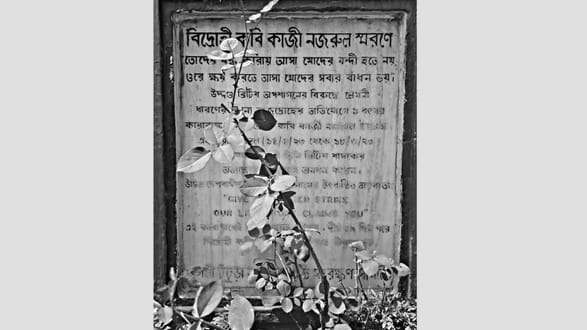
The inequality between labourers and capitalists creates deep social injustice. Workers become the exploited, while capitalists become the exploiters. Civilisation and development are built upon the sweat and blood of labourers, while capitalists accumulate wealth through their exploitation. Such is the nature of capitalism — inequality is its defining rule. Nazrul therefore wrote:
“Your cars run on the roads, ships sail on the seas,
Steam engines run on the railways, factories spread across the land—
Tell me, whose gifts are these?”
Nazrul, the socialist poet, always stood beside workers. He strongly condemned the inequality between labourers and capitalists:
“Those steam engines run on the bones of self-sacrificing men,
Yet the gentlemen ride them in comfort
While the labourers fall beneath.
Have you paid them fairly?
Silence, you liars!
Tell me how little you gave the workers,
And how many millions you earned!”
Nazrul examined religious inequality from three perspectives: humanity, division among people, and religious hypocrisy. He consistently argued that humanity is the greatest religion of all. Thus, he declared:
“There is no distinction of country, time, or race;
In every land, in every age,
Humanity is kin to all.”
From this perspective, Nazrul embraced secularism in his thought. This is why he wrote both Shyama Sangeet and Islamic songs. He proclaimed the universal message of humanity:
“People of all ages and all lands, come together
And listen to the flute of unity.
If one person suffers pain,
That pain echoes equally in all hearts.
The insult of one
Is the shame of all humanity.”
Nazrul was outspoken against religious narrow-mindedness. He identified sectarianism as one of humanity’s greatest obstacles. A champion of free thought and liberal humanism, he called upon people to free themselves from all forms of narrowness and prejudice:
“Break open all the locked doors of the heart today,
Remove every painted covering of skin!
Let the vast blue air of the sky
Rush wildly into this breast - open every latch!”
Formalistic and ritualistic religion creates divisions among people. God becomes divided into Allah, Bhagavan, and God; places of worship become divided into mosques, temples, and churches. From such divisions emerges inequality. Nazrul therefore asked:
“Who are you? Persian? Jain? Jew? Santal? Bhil? Garo?
Follower of Confucius? Disciple of Charvaka? Speak on!
Friend, be whatever you wish—
Carry any scripture upon your back and mind:
Quran, Purana, Veda, Bible, Tripitaka -
Read as much as you like.
But why this futile labour, this torment of the mind?
Why bargain in the marketplace
When fresh flowers bloom along the road?”
Against such religious inequality, Nazrul proclaimed a message of unity:
“I sing the song of equality -
Where all barriers and divisions dissolve,
Where Hindu, Buddhist, Muslim, and Christian unite.
I sing the song of equality!”
Religion, for Nazrul, was not contained within dry scriptures, rituals, or ceremonies. Nor was it confined to places of worship. The true source of religion lay in the human heart. Thus, he could say:
“Brother, I have heard no greater truth -
There is no temple or Kaaba greater than the human heart.”
However, Nazrul’s greatest rebellion was against religious hypocrisy. Any religious practice that tramples upon the poor and leaves the hungry to starve is nothing but hypocrisy. Such hypocrisy creates divisions and inequality among people. Under its influence, self-appointed guardians monopolise religion. Then:
“The starving cry out:
Alas, the god of that temple priest is not yours!”
Or:
“In your mosques and temples, O Lord,
There is no claim of humanity;
Priests and clerics have locked every door.”
Nazrul was deeply pained by hypocrisy carried out in the name of religion. He lamented:
“Alas, house of worship,
Hypocrites climb your minarets singing songs of selfish victory!”
And his rebellious voice thundered:
“Who dares lock the house of God?
Leave every door open -
Strike with hammers and shovels!”
On the issue of gender equality, Nazrul’s poem Nari (“Woman”) is one of the clearest expressions of his thought. The poem strongly advocates women’s rights, social status, and empowerment. Nazrul glorified women’s roles as mothers, daughters, wives, and beloved companions. He also celebrated women’s contributions to civilisation. Yet, in doing so, he did not always fully articulate women’s identity as independent human beings. Still, it must be acknowledged that Nazrul placed women on a remarkable level of equality with men. Thus, he declared boldly:
“I sing the song of equality -
In my eyes there is no distinction
Between man and woman.”
Nazrul gave equal dignity to women’s role in human history:
“Whatever is great and eternally beneficial in this world,
Half of it was created by women,
And half by men.”
Looking towards the future, he called for social reform and warned men about the consequences of imprisoning women:
“That age is obsolete
When men were not slaves but women were.
This is the age of suffering, the age of humanity, the age of equality.
No one shall remain another’s prisoner.
If men imprison women,
Then in the ages to come
Men themselves will suffer
In the prisons they created.
Such is the law of the age -
Oppression will return to oppress the oppressor.”
After discussing Nazrul’s philosophy of equality, an important question arises: how relevant is it today? We now live in an unequal, unstable, and unsustainable world. Contemporary society is marked by inequality—between nations, races, regions, socio-economic groups, ethnic communities, religions, and genders. Inequality exists both in opportunities and in outcomes. In this unequal environment, divisions among people are increasing, while excessive individualism has become increasingly dominant.
At the personal, social, and state levels, unequal power structures have created instability, violence, and terrorism. Social cohesion is weakening, and human tolerance is deteriorating. In many ways, this has made society increasingly fragile.
In this context, Nazrul’s vision of universal humanity and humanism remains deeply relevant. To transform our mentality and move towards a more balanced society, we can return to Nazrul’s universal humanism. From that humanism, a new journey towards human development may begin.
The four dimensions of Nazrul’s individual vision of equality remain equally relevant today—whether concerning gender equality, economic inequality, or the conflict between labour and capital. Despite significant progress, discrimination between men and women still exists in many societies, both in opportunities and outcomes. Nazrul’s ideas can offer important guidance in overcoming such inequalities.
Similarly, Nazrul’s analysis of religious inequality and hypocrisy can help confront modern religious extremism, fundamentalism, violence, and terrorism. At a time when communalism and religious fanaticism threaten human values, returning to Nazrul may help resist these destructive forces.
Nazrul’s philosophy of equality remains relevant for all ages because it is rooted in universal human values. However, more discussion and research on his egalitarian thought are necessary so that Nazrul may continue to remain relevant in the changing world of the future.
Selim Jahan is the former director of the Human Development Report Office under the United Nations Development Programme and lead author of the Human Development Report.
Comments