


Pakistan whitewash and what it says about Bangladesh's Test cricket journey

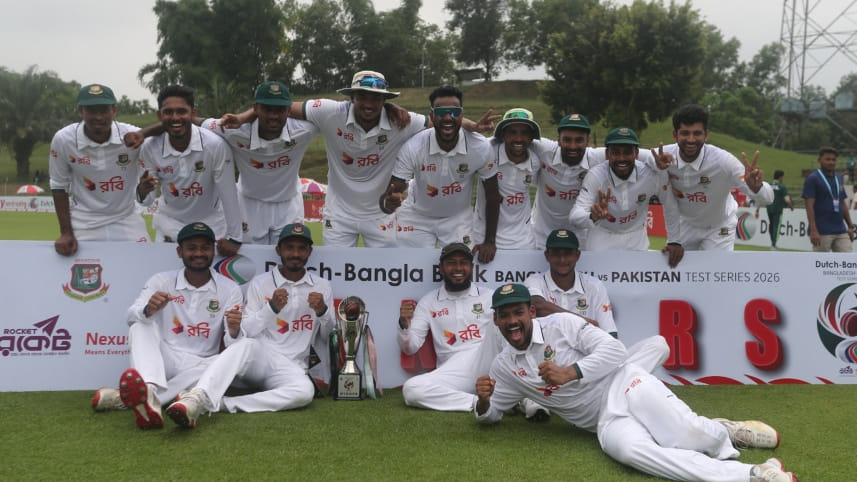
Bangladesh cricket has just witnessed a landmark moment, with player reactions and celebratory pictures already flooding social media. But before delving into this moment, it is important to remember that the back-to-back Test series whitewashes of Pakistan—first away in Rawalpindi in 2024, and now at home in 2026—represent a moment of vindication for a team that spent decades fighting ridicule, self-doubt, and structural shortcomings in the game’s most demanding format. So, how did we arrive here?
It would be inaccurate to say that Bangladesh earned its Test status in 2000 as a qualified cricketing nation. The achievement was instead driven largely by political leadership, cricketing diplomacy, and the strength of the subcontinental bloc within the International Cricket Council (ICC). At that time, Bangladesh was the only Test-playing nation whose first-class domestic structure was formed only after receiving Test status. Much like a premature birth, initial survival was precarious. Consequently, Bangladesh spent its first few years struggling as the care required to nurture a “premature” cricketing structure was sorely lacking. The Bangladesh Cricket Board (BCB) leadership often preferred shortcuts over visionary planning. Players were often fielded indiscriminately rather than based on their suitability for this format, making it difficult to build a solid foundation.
 For all latest news, follow The Daily Star's Google News channel.
 This trend began to shift after 2015, as signs of more deliberate nurturing emerged. By then, players like Shakib Al Hasan, Tamim Iqbal, and Mushfiqur Rahim had become established, and an aura of confidence began to develop. The victory against England at home in 2016, followed by the Test win against a powerhouse like Australia in 2017, marked a turning point. The secret behind these successes against superior sides lay in spin-friendly wickets. Having once been a team that lost consistently, Bangladesh achieved another landmark victory in 2017 in their 100th Test match, against Sri Lanka—a notable achievement given the latter’s ability to win in subcontinental conditions.
However, relying solely on rank turners and a battery of spinners was insufficient for becoming a major Test nation. The BCB realised this about three years later, aided by the emergence of a promising group of pacers, which broadened its strategic outlook. In 2022, Bangladesh secured a historic victory in New Zealand, prevailing in pace-friendly conditions. Pacer Ebadot Hossain played a pivotal role in that triumph at Mount Maunganui, a feat rarely achieved by other subcontinental teams like India, Pakistan, or Sri Lanka in New Zealand.
Then-captain Mominul Haque successfully convinced team management of the importance of fast bowlers. Alongside Ebadot, the pipeline began to flourish with the likes of Taskin Ahmed, Shoriful Islam, Hasan Mahmud, and Khaled Ahmed. Amid this, the emergence of Nahid Rana, a young man from Chapainawabganj who is taller than the average Bangladeshi and bowls with surprising pace, added a new dimension. It became urgent to manage their workloads, groom them, and devise strategies based on opposition teams. There is no denying that this approach has been followed consistently since 2022-23. Despite a lack of absolute consistency, the results began to show. Since then, we have also seen a more thoughtful approach to preparing home pitches, reflecting a renewed emphasis on pace.
After receiving Test status as the 10th nation, Bangladesh languished at the bottom of the rankings for years. Defeats were inevitable, often accompanied only by flashes of individual brilliance or “what if” narratives of narrow losses. For a long time, Bangladesh’s rise to ninth place in the rankings had more to do with Zimbabwe’s decline than our own progress. We remained around ninth for years, reaching eighth only once in 2018. Now, by whitewashing Pakistan at home, we have climbed to seventh place for the first time. A major achievement indeed.
The whitewash of Pakistan in Rawalpindi in August 2024 was the result of processes followed over the previous two years. With a few exceptions, the batting order found stability as Najmul Hossain Shanto, Litton Das, Mushfiqur Rahim, and Mominul Haque grew more experienced and consistent. In the bowling department, the enduring presence of spinners Taijul Islam and Mehidy Hasan Miraz, combined with the rise of the pacers, provided a balanced attack. The 2026 home Test series whitewash is the fruit of this continuity. Among the 12 Test-playing nations, Bangladesh had long been ahead of only Zimbabwe, Ireland, and Afghanistan. Now, by surpassing Pakistan and the West Indies, we have reached seventh place. Barring a major setback, this position should remain secure for the time being.
However, the next challenge is far from easy. Truth be told, we still have a long way to go before we can consistently compete with the top cricketing nations. The domestic first-class structure remains questionable, and the pipeline is not yet deep enough beyond a handful of players. There is a need for greater intensity among players to fight for every position. We must manage the euphoria following successes and look at ourselves in the mirror of reality, self-reflecting past the praise. There must also be a drive to build a “Test culture” in the country. It is encouraging that the current Test captain, Shanto, shares this realisation.
In Test cricket, battles occur within the battle—fights of mindset and cricketing intellect. To challenge the giants of the game in any condition, our foundations in these areas must be strengthened.
In the latest home series, Bangladesh also capitalised on a psychological advantage. Backed by the necessary cricketing skills, the team was brimming with confidence. From that position, they were able to rattle the opposition mentally during intense moments on the field, sending a clear message that they would not yield an inch. In cricket, especially in the Test format, sledging is an inevitable component during tense moments. While many may not like it, even the biggest cricketing nations are rarely seen playing with a gentle, submissive demeanour. At one time, crumbling under opposition sledging was our destiny; over the past few years, a mentality of responding eye-to-eye has emerged.
Bangladesh has made history by whitewashing Pakistan in Test series twice in a row. This is a significant step forward for the representatives of the red and green in this elite format. To maintain this momentum, it will be vital to manage emotions, embrace reality, and show the patience to follow each process consistently. The nature of cricket is constantly evolving. Instead of basking in complacency, we must adapt and develop with the times to maintain our place at the highest level. The role of organisational leadership will be crucial in the days ahead.
Ekush Tapader is a reporter at The Daily Star’s sports section, with a primary focus on cricket.
Views expressed in this article are the author's own.
Follow The Daily Star Opinion on Facebook for the latest opinions, commentaries, and analyses by experts and professionals. To contribute your article or letter to The Daily Star Opinion, see our guidelines for submission.
Comments