Building a nation in print: Paper, textbooks, and publishing in East Pakistan
Walk through the narrow lanes of old Dhaka in the 1950s and you’d hear it before you saw it: the rhythmic thrum of presses, the chatter of compositors, the swish of paper reams unwrapped and weighed. In shops stacked to their rafters, publishers bargained with paper dealers, schoolteachers thumbed fresh primers, and children tugged at sleeves for the newest detective novel. East Pakistan’s early decades were many things—turbulent, ambitious, improvisational—but above all they were printed.
This is the story of how Dhaka’s book people—publishers, printers, booksellers, illustrators, teachers, and civil servants—helped assemble the infrastructure of learning and debate in a young nation. It is also the story of bamboo forests and offset machines, of foreign exchange lists and children’s biographies, of an emergent Bengali reading public whose appetite re-shaped supply chains. In these interlocking worlds of paper and pedagogy, East Pakistan built not only an industry but a cultural vision of itself.
A city of presses, a bazaar of books
By the time of independence, Dhaka already possessed a deep printing lineage. The city’s historic market district had long nurtured what people informally called a Bangla Bazar—a cluster where publishers, printers, booksellers, textbook traders, paper dealers, and stationery shops operated cheek by jowl. That market ecology mattered. Long before centralised planning arrived, the bazaar gave writers and readers a practical path: a manuscript could find a compositor, a proofreader, a printer, a binder, a jacket artist, and—crucially—a bookseller who knew which school or thana might buy two dozen copies on credit.
The local publishing scene was not monolithic. A vibrant roster of Dhaka houses—Majid Publishing House, Mullick Brothers, Wadud Publications, Purbachal Prakashani, Azad Publishing House, Bards and Books, Kitabistan, Maju Publications, Standard Publication, and Aziz Book House—anchored the trade. Some specialised in school texts and reference works; others cultivated fiction, drama, and children’s magazines. All of them, in different ways, were learning on the job: pricing reams, choosing type sizes for new litho plates, aligning curricula to syllabi that shifted with education policy.
The scale was still modest. In the early 1960s, a government survey counted 803 publishers nationwide; 154 of them were in Dhaka, with another two hundred-plus booksellers operating across East Pakistan, including 183 in the capital alone. Many were not “firms” in the modern sense but single-proprietor outfits, family partnerships, or author-publishers who farmed out printing and haggled shelf space title by title. Yet this small-bore structure was also a strength. It kept the system responsive to local demand: a popular storybook could be hurried back onto the press; a school inspector’s approval could turn a modest primer into a reliable seasonal income.
Paper first: The mills that fed the presses
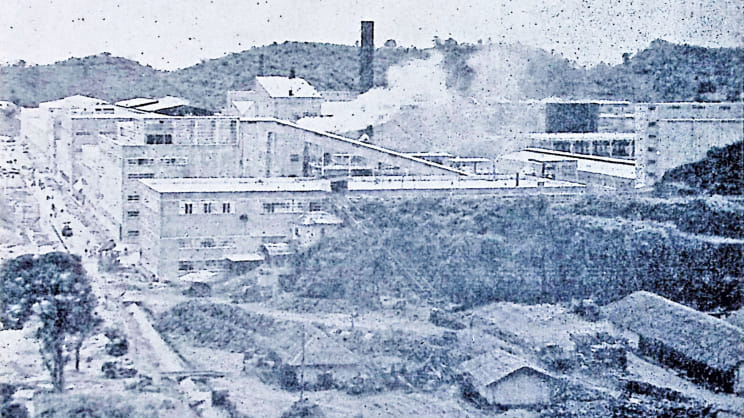
Every book begins as paper, and East Pakistan’s most transformative industrial development of the 1950s was papermaking at scale. The Karnaphuli Paper Mills in Chittagong came into operation early in the decade and grew into one of Asia’s largest producers, joined by the Khulna Newsprint Mills and by factories like Adamjee Card & Cardboard and Sethi Straw Board. Together they formed the backbone of a regional supply chain that, for the first time, allowed East Pakistan’s printers to buy domestic stock: white printing papers, mechanically finished and glazed varieties, newsprint, art and imitation art papers, ivory and boxboard, fine opaque dictionary stock, binding board and cloth, kraft packing sheets—the full tool kit of a book economy.
But papermaking is an ecological industry before it is an industrial one, and the mills’ fortunes rose and fell with bamboo. Between 1959 and 1961, large swathes of the bamboo forests went into a natural flowering cycle. To preserve future yields, the mills left stands uncut for years. Paper supply tightened sharply; the Paper Trade Association registered a 42 percent shortfall in printing paper, and planners estimated national demand (some 54,000 long tons) outstripped installed capacity even at full tilt. Shortages rippled outward: presses triaged jobs; publishers delayed seasonal releases; schools made do.
Quality, too, was a battleground. Printers grumbled that local sheets varied in thickness and grain, showed subpar glazing, and scuffed easily in transit. As offset and photomechanical processes spread—often with German, Swiss, or American machines—the mismatch between mill specifications and imported press tolerances became glaring. Paradoxically, even with these compromises, domestic paper could be dearer than comparable imports once transport and handling were factored in. The industry’s response was pragmatic rather than purist. When textbook deadlines loomed and purse strings tightened, printers and publishers chose workable stock over ideal stock. The result was a visible signature of the period: books sturdy enough for classroom life, if not always showpieces of finish.

Machines and skills: Building a print workforce
If paper is the body, machinery is the spine. The 1950s and 1960s saw an influx of offset presses and ancillary equipment into East Pakistan, aided at times by external credit lines and a general push to modernise printing for newspapers and government work. The technological shift created a parallel demand for skilled labour in composition, plate-making, press operation, colour separation, and binding.
Dhaka’s solution was to teach its way through the gap. The Institute of Graphic Arts, established in 1967, aimed to produce the technicians and supervisors the expanding sector urgently needed. Its arrival complemented a wider regional rise in graphic arts education and brought the book trade into dialogue with design: jacket typography became bolder, interior layouts cleaner, and illustration programmes more ambitious. Even when a book’s paper felt coarse or a stitch line showed, the visual identity of Bangla publishing grew more distinctive—with jacket art that drew on local motifs, landscape palettes, and a sense of Bengali modernity that was neither derivative nor provincial.
A planned reading public: The Dhaka Textbook Board
No single market guaranteed printers’ survival like the school textbook. In 1958, following national education policy recommendations, textbooks moved decisively into the public domain of planning and procurement. The East Pakistan Textbook Board (EPTBB), headquartered in Dhaka, assumed responsibility for commissioning, standardising, and supervising school texts in Bangla and other requisite subjects. Crucially, the EPTBB relied on local publishers and printers, paying royalties and spreading work across the city’s presses rather than concentrating it all in a single state plant.
The scale was transformative. Between 1961 and 1964, East Pakistan produced 134 new textbooks in Bangla, with a staggering 25.1 million copies printed—numbers that reveal the demographic and developmental stakes of schooling. The Board’s commissioning process knitted together authors, editors, illustrators, and presses, while a Central Syllabus Committee guided content in nationally sensitive areas such as English, history, and general science. International players found niches at the margins—Oxford University Press, for example, supplied textbooks to private schools outside the government stream—but Dhaka’s ecosystem did the heavy lifting for the mass market. For printers, textbook seasons meant full order books; for publishers, royalties underwrote riskier lists in fiction, drama, or reference.
The downstream effects were everywhere. Bookshops multiplied not only in Dhaka but across the province; a 1966 survey counted 183 sellers in the capital and 207 elsewhere in East Pakistan. Many were seasonal shops that sprang up when school lists were announced, stocking slates and pencils alongside the requisite readers. Around them grew a shadow economy of “wayside” stalls hawking weeklies, romances, historical page-turners about the glories of Islam, and locally adored paperbacks.
Children’s books: 738 doors to imagination
The surest barometer of a reading culture is what it offers its youngest members. In 1962, the National Book Centre published a UNESCO-supported survey of children’s literature in East Pakistan. The numbers astonish: between 1947 and 1964, Dhaka’s presses issued 738 titles for children in Bangla—intended for the roughly seven million students enrolled from Class I to Class X.
What did those children read? Biographies led the list (180 titles), with subjects ranging from the Prophet of Islam to Muhammad Ali Jinnah, and from poets like Nazrul Islam and Rabindranath Tagore to scientists such as Jagadish Chandra Bose. Literary fiction was the next giant: 150 short-story collections, 49 fairy-tale volumes, 42 novels, and 33 dramas, mixing translations and homegrown tales. Poetry was sparse (just 13 books), but science writing for the curious child—on matter, space, light, electricity, chemistry, sound, and the solar system—claimed a meaningful niche. Travelogues were rare (13 titles), a reminder that books were often a substitute for expensive journeys. Translators, meanwhile, made the world familiar: Alice in Wonderland, Gulliver’s Travels, Great Expectations, Silas Marner, Aesop’s Fables—all recast in Bangla for East Pakistan’s schoolchildren.
The shelves looked different, too. As observers noted at the time, Bangla book jackets drew “much more upon local art traditions and scenic surroundings,” cultivating a visual language that felt rooted rather than generic. In a literal sense, children were learning to read their country’s landscapes in colour and line.
The legal-economic choreography: Imports, lists, and licences
Publishing requires more than paper and ink; it depends on the bureaucratic frame that governs what can be imported, sold, and taught. In the early 1960s, foreign exchange regulations organised reading matter into categories: scientific and technical books, textbooks and reference works, periodicals, fiction and novels, maps and charts, manuscripts and proofs, and all materials prescribed by government and educational institutions. A “Free List” and an “Open General List” (OGL) differentiated items requiring no licence from those that did. Certain genres—“horror,” “comics,” anything deemed “anti-Islamic” or “obscene”—were explicitly barred.
For East Pakistan’s book trade, these lists functioned like a traffic light system. They cued booksellers on which invoices would clear without friction and which needed extra paperwork; they shaped university librarians’ acquisition plans; and they signalled national priorities. Because English remained the language of higher education, most prescribed and recommended college-level texts were still foreign. Import permits allowed buyers in Dhaka to order from Indian, British, or American publishers (at different periods and under changing restrictions), while book-aid initiatives—USAID’s Book Development Project, The Asia Foundation shipments, and USIS textbook translations—flowed into university and technical libraries, chronically underfunded and lagging in the latest science and engineering materials.
The numbers tell their own tale. By 1964, East Pakistan counted roughly nine million literate adults—an enormous potential market but one stratified by language, level of schooling, and income. University and specialised libraries skewed heavily towards English. Book import bans and licensing slowdowns sharpened the pain: a single delayed invoice could derail a semester.
UNESCO, the National Book Centre, and a culture of encouragement
One of the era’s quieter successes was an ethos of encouragement—prizes, surveys, and training—that treated publishing as a public good. With UNESCO’s help, the National Book Centre (NBC) opened its East Pakistan operations in 1960 to promote reading, improve production standards, and provide technical services. The NBC documented the trade’s realities (how many books were printed, in which subjects and languages, and at what cost), organised festivals and exhibitions, and did something psychologically vital: it celebrated excellence.
Annual book prizes honoured publishers in Bangla alongside those in Urdu, spotlighting East Pakistan houses such as Kitabistan, Green Publications, Studentways, Sahityaka, Katha Bitan, and others for distinguished work. It was a small mechanism with outsized effects. A trophy and a citation could sway a school board’s adoption decision; it validated investments in better binding or jacket art; it told a generation of editors that their choices mattered.
Supply, demand, and the stubborn arithmetic of cost
Behind every success story lurked the ledger. For publishers in Dhaka, the single largest cost driver was paper. When mill quality sagged, printers compensated with make-ready time and careful adjustment; when prices rose, publishers trimmed margins, downsized print runs, or shifted to cheaper stocks for interior forms while saving the better sheets for covers. Import licensing added a second layer of uncertainty; a policy tweak could mean a semester’s worth of science texts idling in a port.
Even so, the industry expanded. Surveyors estimated that, across the country, printing had become the third-largest employer by the mid-1960s, with some 2,000 presses operating. In East Pakistan, ninety-plus factories were registered under the Factories Act, and many more smaller presses hummed beyond the formal count. Print runs for general titles often hovered around a thousand copies, but school adoptions and popular fiction pushed volumes higher. Binding—drawing on older crafts traditions—could be exquisite when budgets allowed, and publishers invested in eye-catching dust jackets, knowing a two-colour litho with a striking illustration might be the difference between a stack that sat and a stack that sold.
What people read: Languages and subjects
A bibliographic survey catalogued roughly 25,000 books printed nationally between 1947 and 1961. The language breakdown mattered profoundly in East Pakistan: about 40.8 per cent of all titles were in Bangla, 21.2 per cent in English, and 27 per cent in Urdu, with smaller shares in other languages. For Dhaka’s book world, the trend lines were clear. As schooling expanded and a provincial public asserted its linguistic preferences, demand for Bangla titles intensified—not only in literature but in religion, social sciences, and practical “useful arts.” Subject-wise, literature dominated (just over 20 per cent of titles), religion followed (nearly 17 per cent), and social sciences trailed close behind, reflecting a society that was debating identity, ethics, governance, and history on the page.
These were not abstract choices. A rise in Bangla publishing meant more work for local writers and translators, more commissions for Dhaka illustrators, more plate-making at local presses, and more royalties circulating within the city. It also meant a subtler shift in self-conception: students learned physics terms in Bangla, devoured serialised mysteries set on familiar riverbanks, and encountered biographies that braided global figures with national icons.
The invisible labour that made it possible
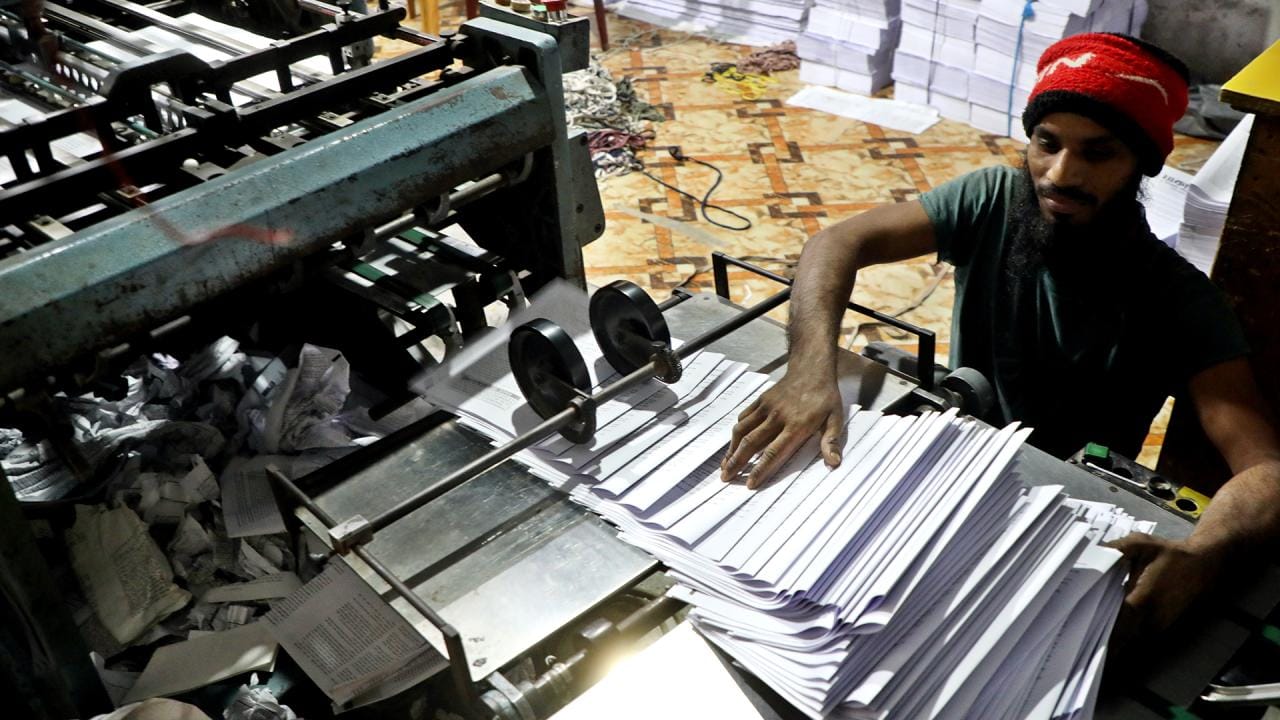
We rightly remember the marquee houses and prize lists, but early East Pakistan’s print culture rested on networks of invisible labour. Typesetters who could compose a complex Bangla line without slowing the forme; proofreaders with hawk eyes for diacritics; foremen who coaxed uneven stock through temperamental presses; binders who stitched by hand and squared up spines that would not split under a schoolboy’s satchel. Women worked in sorting rooms and on finishing lines; travelling salesmen shouldered parcels to district towns, negotiated consignment terms, and took back returns with stoic good humour.
Many of these workers crossed domains. A calligrapher might moonlight as a jacket artist; a schoolteacher might edit primers in vacation months; an author could advance costs on a civic handbook and recover them slowly from two dozen patient retailers. In a sector where banks declined collateral and credit was scarce, reputation and reciprocity functioned as the real currency. The city’s book bazaar was a credit commons.
A nation on the page
By the mid-1960s, Dhaka’s publishing world was both more modern and more itself. It had offset presses and a graphics institute; it had paper mills with all their promise and problems; it had an education board that could summon millions of copies on deadline. It had bookshops that reached every district and a children’s list rich in biographies, tales, translations, and science. It had regulations that channelled imports and donors who filled some gaps. It had its own aesthetic: jackets that looked like Bengal, not somewhere else.
Most importantly, it had readers—lakh after lakh of them. They were students and shopkeepers, village schoolmasters and clerks, nurses and newly trained engineers. They bought what they could afford and borrowed what they could not, reading in courtyards and tea stalls, in library corners and on buses. As they did, they assembled a civic conversation about who they were and what they wanted to become.
If we look back today from the vantage point of Dhaka’s contemporary book fairs, robust newspapers, and buzzing independent presses, the throughline is unmistakable. The early decades’ improvisations—the mills that sometimes faltered, the lists that sometimes constrained, the ad hoc firms that sometimes vanished—nonetheless built capacity and confidence. They proved that an industry could be local and ambitious at once, and that a culture could be knit from paper even when paper was scarce.
To build a nation in print is to do many unglamorous things well: to specify a sheet and price a ream, to commission a diagram that actually teaches, to translate a chapter without losing its grace, to stitch a binding that will survive a monsoon. East Pakistan did those things, and Dhaka was its engine room. In the pressrooms and bookshops of those years, a city found its voice—and put it, indelibly, on the page.
Nadeem Omar Tarar is a Visiting Senior Research Fellow at the Department of Anthropology, University of Texas at Austin, Texas, USA. He can be reached at notarar@gmail.com.
Send your articles for Slow Reads to slowreads@thedailystar.net. Check out our submission guidelines for details.
Beyond the loom: How Jamdani preserves the values of peace
Hair oil, bumblebees, and the lost world of Bengali advertising art
The tale of some rare portraits from Nazrul’s final days

Tuning the melody of Baul songs into peace education
Shreemati Rassundari and the making of the first autobiography by a Bengali woman
Nabayug: Nazrul’s radical pen and Fazlul Huq’s leadership
Reading Nazrul in an age of inequality

East Bengal’s victory and the memory of lost homes
The stolen haq of Qurbani hides