


Bhashani and the gayebi janazah of 1968: A photographic history
In Dhaka, the Agartala Conspiracy Case was underway. Across the country, demonstrations and processions were being held in support of the Six-Point Movement. The Ayub–Monem government was suppressing them with an iron hand. It was December 7, 1968. That day, auto-rickshaw drivers were observing a half-day strike. From the morning, sporadic clashes broke out between police and the public. But when police bullets killed three working-class men, the situation quickly turned tense. To regain control, the government imposed Section 144. Maulana Abdul Hamid Khan Bhashani, the President of the National Awami Party, announced a programme to hold a gayebi janazah (funeral prayer in absentia). The assignment to cover the event fell on journalist Ahmed Nurul Alam, then a junior reporter at Dainik Azad.
He went to the premise of Baitul Mukarram Mosque in the morning and found hardly any people there. But there were large numbers of police and EPR personnel. In front of the mosque stood water cannons and riot-control vehicles. The atmosphere was heavy and tense. It seemed unlikely that people would turn up for the gayebi janazah.
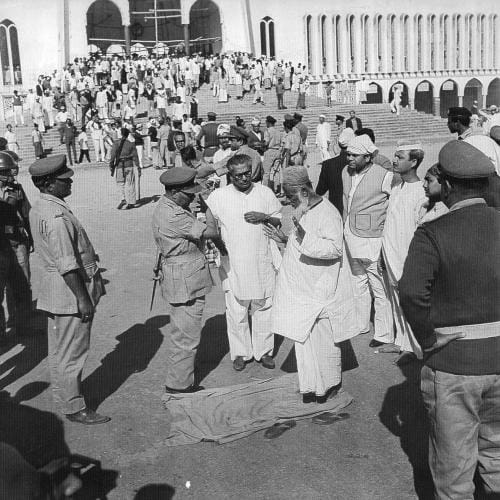
At noon, Bhashani arrived in a rickshaw. He wore his customary white panjabi and lungi, a shawl draped over his shoulder, a cane cap on his head, and black sandals on his feet.
Seeing Bhashani, the then Inspector General of Police, Mohiuddin Ahmed, rushed towards him at lightning speed. Behind him came DIG Sadeq Ahmed Chowdhury and other senior police officials. The IGP said, "Huzur, you cannot offer the funeral prayer here." Bhashani remained unmoved. He spread his shawl on the ground. The IGP tried to resist. Bhashani brushed him aside with his left hand and said, "Move aside, Mohiuddin. I do not recognise Section 144. I am going to offer the gayebi janazah now. If you must shoot, then shoot."
Standing on the shawl, he made his niyat and began the prayer. Immediately, people appeared from all sides and stood in rows behind him. It became clear that the crowd had been waiting for this very moment.
The IGP and law-enforcement officials watched helplessly. After the prayer, Bhashani began a munajat, through which he delivered his statement. He prayed for the souls of the deceased and then gave a short speech. In an emotional voice he said, "We asked for rice, for clothing; we asked for freedom of speech. But the reactionary ruling clique has gifted us bullets. Yet we shall never bow to bullets."
In the middle of the speech, he declared that Governor Monem Khan's House [now Bangabhaban] would be encircled. Defying Section 144, he began to walk. Several hundred people followed behind him. When a Pakistani soldier stepped forward with a raised rifle to stop the crowd, Bhashani shouted, "Khamosh!". As he grabbed the rifle with one hand, a non-Bengali officer rushed in and pulled the soldier back.
Then, leading a large procession, Bhashani set off towards the Governor's House. Near the Gulistan Cinema Hall, water cannons were used in an attempt to disperse the crowd. But Bhashani remained unwavering. With a smaller group of followers, he walked right up to the gate of the Governor's House. In those days, the gate stood quite close to Gulistan (it was moved later). Slogans continued for a long time. Bhashani declared, "Tomorrow there will be another strike." From that day began a series of continuous strikes and protests, which ultimately grew into the mass uprising of 1969, culminating in Sheikh Mujib's release.
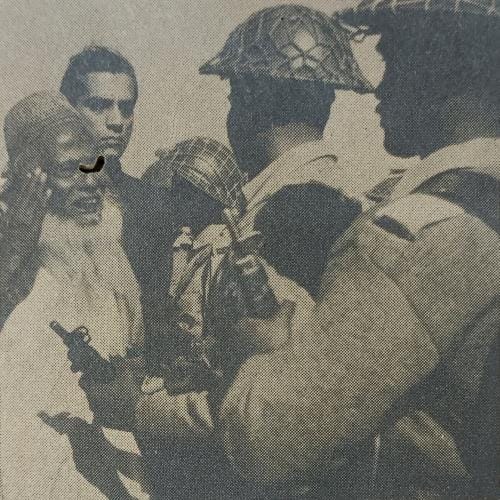
One of the key witnesses of this historic moment was Haider Akbar Khan Rono—an iconic figure of the communist movement and an organiser of the 1969 uprising. In an account (Rajnitir Maulana: Majlum Jananeta Bikhobher Karigor, Mohiuddin Ahmed, Batighar, February 2023, p. 218) he notes: "I have heard many speeches by Bhashani, but I had never seen him in such a form. This scene was captured by a camera and later published in the newspapers."
Drawing from Haider Akbar Khan Rono's account, I went to the Poet Sufia Kamal National Public Library and traced the photograph published on the back page of The Pakistan Observer.
To understand what truly happened on December 7, 1968, I examined seven newspapers published the following day: The Daily Pakistan (later Dainik Bangla), Azad, Sangbad, Ittefaq, Purbodesh, Morning News and Pakistan Observer (later Bangladesh Observer). None of these newspapers published a photograph of Bhashani's gayebi janazah that day. The reason was a government ban. To cover up the incident, the government had sent press notes to newspaper offices the previous night. Therefore, on December 8, the papers could not publish Bhashani's photograph. But on December 9, almost all newspapers carried large, prominent images of the gayebi janazah.
The handsome man in a white pyjama and panjabi standing between Bhashani and the IGP during the prayer is often mistakenly believed to be NAP leader Mohiuddin Ahmed (later an Awami League leader). Debates about this still circulate on social media. From the caption of the photograph used in Syed Irfanul Bari's book on Bhashani, we learn that the man standing beside Bhashani was Saeedul Hasan. This is supported by Haider Akbar Khan Rono as well. He writes: "That day Maulana Bhashani was staying at Saeedul Hasan's residence in Eskaton. Around 12 noon, Bhashani arrived in front of Baitul Mukarram by rickshaw. Seeing him, hundreds of people rushed forward."

However, Dainik Azad reported that "Maulana Bhashani arrived at Baitul Mukarram at 1.20 pm."
Naturally, the question arises: who was this Saeedul Hasan? He was a prominent NAP leader and a distinguished industrialist, a deeply trusted political associate of Maulana Bhashani. In 1971, he was martyred at the hands of the Pakistani occupation forces. Whenever Bhashani visited Dhaka, he stayed at Saeedul Hasan's residence in Eskaton. He was the uncle of BRAC founder Sir Fazle Hasan Abed. The confusion arises because he and Mohiuddin Ahmed were similar in height and appearance.
That day, three people were killed by police and EPR gunfire: Abdul Majid, a clerk at the Hatirpool Power House; Abu Mia, an employee at a bicycle repair shop in Nilkhet; and an unidentified boy. In the historical record, they are considered the first martyrs of the 1969 mass uprising.
Shahadat Parvez is a photographer and researcher. The article is translated by Samia Huda.
Send your articles for Slow Reads to slowreads@thedailystar.net. Check out our submission guidelines for details.