


Trust has returned, but has the state changed?

One hundred days is not enough to make a final judgment on any government. This is even truer in Bangladesh, where an elected government has taken office after a period of interim rule, political uncertainty, a fragile economy, worsening law and order, and deep public distrust in state institutions. Still, one hundred days are not meaningless. This period tells us whether a government has been able to set its priorities and, more importantly, whether it has the administrative capacity to act on those priorities.
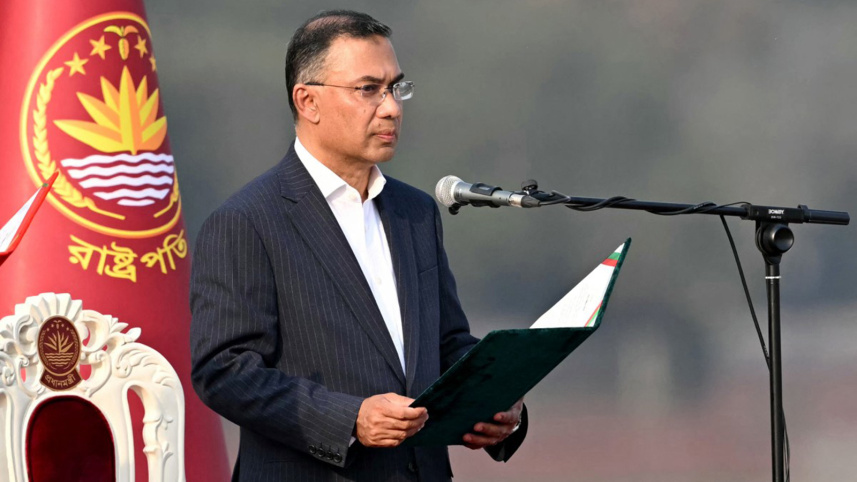
The BNP came to power with a two-thirds majority in the February election, and Tarique Rahman was sworn in as prime minister on 17 February. This was not only a political comeback for the BNP. It was also a major test for Bangladesh’s democratic transition.
The first achievement of this government is political. During the interim government, society had slipped into a dangerous phase of uncertainty, mob pressure, arbitrary power, and administrative hesitation. The arrival of an elected government created, at least initially, a sense of relief. Many people saw the election result as a way out of fear and unpredictability. That sense of trust matters. A state does not run on law alone. It also runs on citizens’ belief that authority has legitimacy.
But this is where caution is necessary. The return of political trust does not automatically mean the return of administrative order. In fact, the gap between the two is perhaps the biggest lesson of the government’s first one hundred days.
The government began with several visible welfare initiatives. The family card programme is the most important among them. One of the BNP’s major election promises was to provide monthly support to low-income families, and the government moved quickly to launch the programme on a pilot basis. According to reports, around 37,000 families were brought under the first phase, with priority given to women-headed households. The support is supposed to be sent directly through mobile wallets or bank accounts. Around Tk 38.7 crore has reportedly been allocated for the pilot phase until June 2026.
The first achievement of this government is political. During the interim government, society had slipped into a dangerous phase of uncertainty, mob pressure, arbitrary power, and administrative hesitation. The arrival of an elected government created, at least initially, a sense of relief. Many people saw the election result as a way out of fear and unpredictability. That sense of trust matters. A state does not run on law alone. It also runs on citizens’ belief that authority has legitimacy.
This is a welcome step. Given poverty, inflation, and the rising cost of living in both rural and urban Bangladesh, the family card can provide real relief to poor families. But the programme also raises questions about its sustainability. The projected cost over five years is around Tk 1.33 trillion. Such a social protection programme cannot be sustained indefinitely through borrowing. Revenue collection must increase, and waste must be reduced. So the intention is good. But financing, beneficiary selection, and protection from local political capture will determine whether this becomes a serious welfare programme or another clientelist distribution network.
The farmers’ card is another positive initiative. The programme was launched in Tangail in April. In the first phase, more than 22,000 farmers were reportedly included, while the government has said it wants to bring around 27.5 million farmers under the system within five years. The card is supposed to help farmers access subsidies, seeds, fertiliser, machinery, low-interest loans, crop insurance, weather alerts, and market information. For an agriculture-dependent country like Bangladesh, this could become a meaningful reform if it reduces dependence on middlemen. The government has to reach out to farmers directly. But again, implementation will matter more than announcements. Bangladesh has no shortage of good-looking projects. The problem usually begins when lists are prepared, funds are distributed, and local power brokers enter the system.
The government has also tried to give early importance to the environment. The plan to plant 250 million trees over five years, along with the formation of a special cell under the Prime Minister’s Office, shows that the issue has received political attention. In a climate-vulnerable country like Bangladesh, large-scale afforestation is certainly necessary. But our experience with such projects is mixed. Tree plantation often becomes more about photo opportunities than long-term ecological planning. Who will supply the trees, what species will be planted, where they will be planted, who will look after them, and how the money will be spent are not minor questions. Without transparency, even a good environmental initiative can become another site of waste and corruption.
Another major step is the expansion of the school feeding, or mid-day meal, programme. This can help children’s nutrition, school attendance, and classroom concentration. Reports suggest that around three million students, more than 19,000 schools, and over 150 upazilas have been brought under the programme. The intention behind the initiative is clearly positive.
But this is also where administrative weakness has become visible. Complaints have already emerged from different areas about rotten eggs, poor-quality bread, unripe bananas, and the general quality of the food. The government later held meetings with suppliers, field-level officials, and local administrators and promised stronger monitoring. Quality control should have been strict from the beginning. Goodwill cannot replace efficiency.
Law and order remain the weakest chapter of the government’s first one hundred days. The public had expected the new elected government to bring crime under control quickly after the disorder of the interim period. Initially, there was a sense of relief. But it did not last long. The joint forces’ operation in Jungle Salimpur was necessary and symbolically important. The recovery of arms, ammunition, and explosives showed that some spaces had long operated outside effective state control. But one operation cannot rebuild the state unless such actions are followed by a systematic nationwide campaign against extortion networks, teenage gangs, land grabbers, politically protected criminals, and local terror groups.
The government’s handling of the fuel crisis has been mixed. The US-Israel attack on Iran created pressure in the global energy market, and Bangladesh also felt the shock. At first, the government tried to avoid raising fuel prices to spare the public further suffering and prevent a rise in prices more broadly. It relied on subsidies. Politically, this was understandable. But economically, it created panic. People began to expect that prices would rise later, which encouraged hoarding and abnormal demand. In April, the government finally increased fuel prices by 10 to 15 percent. The decision was unpopular, but not irrational. After the price increase, fuel queues reportedly declined in many places, and panic buying slowed down. This shows that part of the crisis was not only about supply. The fuel crisis exposed a larger problem regarding fuel security. Bangladesh needs a clearer long-term policy on fuel import, storage, pricing, and industrial supply. Otherwise, every external shock will return as an internal governance crisis.
The most serious moral and administrative failure in the government’s first hundred days has been the measles outbreak. By 25 May 2026, the death toll from confirmed measles and measles-like symptoms had reached 545, according to DGHS figures reported by The Daily Star. Earlier, Reuters reported that by 23 May, Bangladesh had recorded 62,507 suspected measles cases and 8,494 laboratory-confirmed infections since 15 March. At least 86 children had died from confirmed measles, while another 426 children had died with symptoms consistent with the disease. WHO’s April update had already warned that the outbreak had spread across 58 of 64 districts. So this is no longer only a health-sector crisis. It is a test of state capacity.
The original responsibility for the outbreak does not fall entirely on the present government. Vaccine shortages, gaps in routine immunisation, previous stock-outs, and poor decisions during the interim government period created the background for this crisis. However, the current government cannot be free of responsibility. Once the outbreak became visible, the response needed to be faster, stronger, and more humane. Hospitals needed better preparation. Vitamin A supplies, isolation facilities, district-level response teams, and direct communication with affected families should have been more visible.
Law and order remain the weakest chapter of the government’s first one hundred days. The public had expected the new elected government to bring crime under control quickly after the disorder of the interim period. Initially, there was a sense of relief. But it did not last long. The joint forces’ operation in Jungle Salimpur was necessary and symbolically important. The recovery of arms, ammunition, and explosives showed that some spaces had long operated outside effective state control. But one operation cannot rebuild the state unless such actions are followed by a systematic nationwide campaign against extortion networks, teenage gangs, land grabbers, politically protected criminals, and local terror groups.
The other major concern is reform. Before coming to power, the BNP promised institutional reforms, including judicial independence, human rights protection, anti-corruption measures, and police reform. But after taking office, several reform-oriented ordinances were cancelled or suspended. The 2025 Human Rights Commission Ordinance was cancelled, and the 2009 law was restored. Ordinances related to judicial appointments and a Supreme Court secretariat were also rolled back. This is perhaps the most worrying sign. These institutions were at the centre of public discussion because people wanted a way out of politicised control. If the new government simply returns to the old framework, then it may win elections but fail to reform the state.
So the BNP government’s first hundred days cannot be described simply as either a success or a failure. It has taken some quick welfare-oriented initiatives. It has restored a degree of political confidence. The family card, farmers’ card, school feeding programme, tree plantation plan, and some decisions during the fuel crisis deserve recognition. Nevertheless, the weaknesses are also clear. Law and order remain fragile. The measles outbreak has exposed the limits of health governance. Welfare programmes are already facing questions about quality and monitoring. Most seriously, the government’s reform agenda appears uncertain. The real question before this government is whether it can build institutions that are fair, accountable, and capable. One hundred days do not give us the full answer. But they give us signals. And those signals are mixed.
Asif Bin Ali is a geopolitical analyst and doctoral fellow at Georgia State University in the US. He can be reached at abinali2@gsu.edu.
Send your articles for Slow Reads to slowreads@thedailystar.net. Check out our submission guidelines for details.

We learn English for years, but learn too little. Why?

How AI became an authority in our classrooms
100 days of the BNP government / Bangladesh is still trapped in a cycle of injustice
Bangladesh in a world of impossible choices

Why Bangladesh must pivot to renewable energy now
The stolen haq of Qurbani hides

Beyond kaanta-taar: Rethinking life at the Bangladesh–India border
Can Bangladesh save its haor food bowl?

The great Bangladeshi cattle reality show
