Will Ramisa get justice in Bangladesh’s broken rape trial system?

The brutal discovery of eight-year-old Ramisa in Dhaka's Pallabi has once again forced Bangladesh to confront an agonising reality. The decapitated body of the young girl was found inside a neighbour's flat, a site of unimaginable horror where her shoes remained neatly placed outside the door while a life was snuffed out within. This follows the equally chilling case in Netrokona this May, where an 11-year-old child was subjected to a brutal sexual assault that had left her seven months pregnant. These incidents, alongside the older cases of Madhabdi and Sitakunda and many others, prove that the legal system remains a graveyard for rape complaints. These cases follow a predictable and tragic cycle. We see initial horror and outcry, a promise of swift action, and, eventually, years of delay or the case's total disappearance.
The fundamental problem lies in the disconnect between paper laws and courtroom practice. While the Women and Children Repression Prevention Act promises quick resolutions, the reality is a backlog so immense that it effectively functions as a denial of justice. Thousands of cases have remained unresolved for more than 5 years. Despite a sharp increase in reports of sexual violence, the conviction rate remains abysmal.
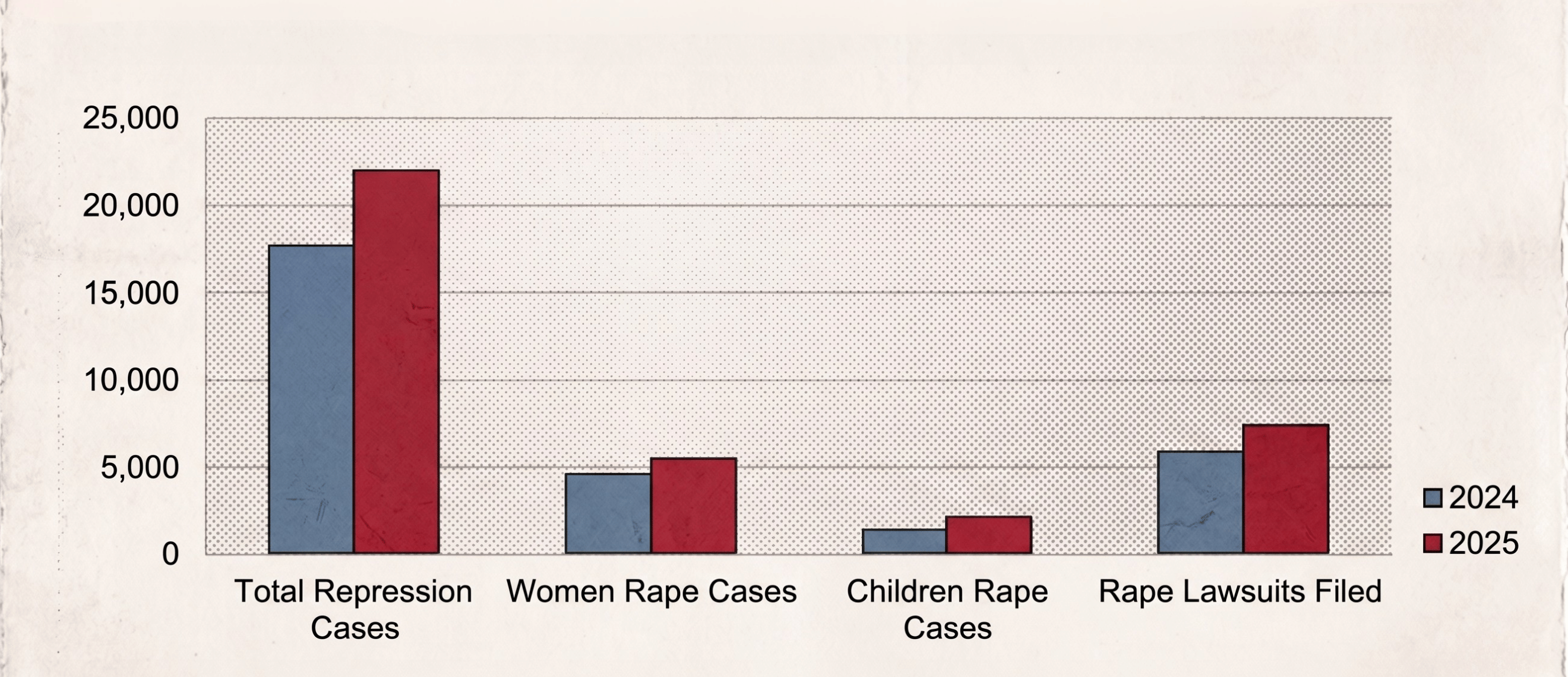
The judicial system currently faces a massive backlog that functions as a denial of justice. Official data from the High Court shows that by December 2025, 30,365 cases had been stuck in the system for more than 5 years. Moreover, Ain or Salish kendra reports suggest that at least 56 girls under the age of 12 were raped in the first four months of 2026, with 16 of them being under six years old. The Rape Law Reform Coalition estimates an even higher figure of over 10 lakh pending cases, including 10,000 rape cases that have remained unresolved for over half a decade. In 2025 alone, police logged 7,068 rape cases nationwide involving 5,171 adult and 1,897 child victims. This data reflects a systemic failure to deliver verdicts, forcing survivors to navigate a process that often feels designed to defeat them.
Deadlines Lack Real Enforcement Power
Bangladesh's legal framework is built on a foundation of promised speed that it cannot sustain. While the interim government has attempted to shorten the mandatory trial period from 180 to 90 days, the change remains largely symbolic without structural enforcement. Advocate Fahmida Akther of Dhaka Medical College and Hospital's One Stop Crisis Centre emphasises that current legal provisions already mandate completion of the trial within 180 days, yet these rules remain largely ignored.
In reality, we see that trials are rarely completed within the 180 days," Advocate Akther says. "Even though the law says 180 days, it often takes years. There are many reasons for this. First, there is the issue of the investigation report. Then there is the issue of witnesses." She argues that shortening the timeframe on paper will not bring real justice without a proper witness protection law. This legal failure occurs against a backdrop of a massive judicial backlog. According to the High Court's official data, 132,107 cases remain pending across 99 Women and Children tribunals nationwide.
Advocate Salma Ali, a human rights activist and adviser to the Bangladesh National Women Lawyers' Association (BNWLA), maintains that accountability and willpower are the primary engines of a functional justice system. She asserts that the law's implementation is the true hurdle, not its wording. "Everything is possible if there is accountability and willpower," Advocate Ali states. "Specifically, the trial system is not gender sensitive, and we must fix the implementation of the Nari o Shishu Nirjatan Daman Ain." She argues that without a monitoring mechanism to track case progress, these new 90-day deadlines will fail just as the 180-day limits did. Justice is not a matter of changing digits on a page. It requires a specialised environment in which judges and lawyers are held accountable for the timelines they are sworn to uphold.
The fundamental problem lies in the disconnect between paper laws and courtroom practice. While the Women and Children Repression Prevention Act promises quick resolutions, the reality is a backlog so immense that it effectively functions as a denial of justice.
Advocate Akhther points out that when the state reduces a timeframe without adding judges or courtrooms, the pressure simply shifts onto the victims. "Shortening the timeframe on paper will not bring real justice without a proper witness protection law and a more sensitive court environment," she explains. She insists that for a 90-day deadline to be realistic, the government must first double the number of tribunals. The case of Ramisa in Pallabi serves as a reminder that the speed of the crime is never matched by the speed of the court. For a 90-day deadline to be realistic, the government must first double the number of tribunals.
Broken Investigation and Forensic Links
The collapse of a rape case often begins long before it reaches a judge. It starts with a flawed investigation and a lack of forensic integrity. Advocate Ali observes that in many sensitive cases, evidence is compromised or lost during medical examinations due to an unprofessional environment. "In many places, there are no proper facilities to conduct medical tests or collect DNA," Advocate Ali asserts. "I have seen many cases where the evidence is often compromised or lost during the medical examination because of a lack of accountability."
When a victim is moved back and forth between facilities without a secure chain of custody, scientific proof vanishes. This gives the defence a massive advantage in higher courts. Advocate Fahmida Akther highlights that the investigation report is the first point of failure. She explains that investigators are often overworked or succumb to undue pressure from influential suspects. "The investigation report is a primary issue," Advocate Akther notes. "The police investigation is often flawed because of a lack of training or because the accused influences the process," she says. "When an investigation is incomplete or tampered with, the prosecution has very little chance of success."
She asserts that the state must move beyond simply changing laws. She argues that the entire system requires a cultural shift in how it treats survivors. "Sensitivity training for everyone involved, including the police, prosecutors, and even judges, is essential," she maintains. Without this training and a proper witness protection law, shortening the timeframe on paper will not bring real justice to the victims.
Advocate Salma Ali adds that the lack of infrastructure in smaller medical colleges creates a significant challenge. "Moving the victim back and forth while trying to preserve evidence is very difficult," she explains. "We need competent, skilled, and sensitive people involved in the implementation of these medical tests." She argues that the state must ensure that medical tests are conducted in a gender-sensitive atmosphere. Doctors must be trustworthy and accountable for the samples they collect.
Politics Cripples the Prosecution Service
A significant loophole in the justice system is the politicised nature of the prosecution. In Bangladesh, Public Prosecutors (PPs) are typically political appointees rather than career specialists. This creates a systemic environment that often results in weak prosecutions. These appointments are often viewed not as recognition of merit, competence, or integrity, but rather as rewards for political loyalty. This is a major failure because the loyalty of these officials often lies with their political identity rather than with the victim. When a new government takes power, the previous prosecutors are frequently replaced with party loyalists. This churn interrupts the continuity of trials and ensures that many prosecutors lack the necessary expertise to handle sexual violence cases.
The state must create a permanent, independent, career-based prosecution service. Appointments must be made on merit, not on political affiliation. Until the prosecution is independent, trials will continue to be derailed by incompetence or political interference. A professional prosecutor must stay with the case from the start to provide a stable bridge between the victim and the court. The incompetence of state-appointed lawyers is a primary barrier to justice. The state must take a more active role in overseeing the people it hires to represent the vulnerable. The government should ensure that public prosecutors are competent and provide effective legal support to victims.
Advocate Ali also identifies the incompetence of state-appointed lawyers as a primary barrier to justice. She observes that the current system lacks the accountability necessary to ensure that victims receive high-quality legal aid. The state provides public prosecutors, but the government's role needs to be much larger and more professional.
Courtrooms Traumatise Instead of Healing
The environment within the tribunal often mirrors the violence the victim is trying to escape. Despite legal provisions for private trials, they are rarely practised. Advocate Fahmida Akther describes the experience as a form of mental torture. "Often, the victim has to stand in a crowded courtroom and describe the incident in front of the accused," she explains. "This is another form of mental torture for the survivor." She asserts that the absence of a witness protection act leaves victims and their families vulnerable to threats.
A professional prosecutor must stay with the case from the start to provide a stable bridge between the victim and the court. The incompetence of state-appointed lawyers is a primary barrier to justice.
"We do not really have a specific Witness Protection Act in Bangladesh yet," Advocate Akther says. "As a result, witnesses feel insecure about coming to court because the accused are often influential people who threaten them." Without state-sponsored protection, witnesses frequently deviate from their statements. This leads to the total collapse of the case. Advocate Ali stresses that the behaviour of defence lawyers contributes significantly to the trauma.
"Defence lawyers should not make derogatory comments about the victim in court," Advocate Ali argues. "This happens a lot, and it breaks the victim's spirit." She asserts that lawyers often use derogatory questioning to break a victim's spirit. This tactic must be stopped through strict judicial control. She argues that the Bar Association must play a role in disciplining lawyers who use victim-shaming as a defence strategy. Furthermore, she identifies the illegal practice of out-of-court settlements, or shalish, as a major barrier.
"Perpetrators are often powerful, and they try to suppress the case through money or influence," Advocate Ali explains. "The victims are often poor, and they face barriers like the culture of compromise or Shalish." She calls for a heavy crackdown on these out-of-court settlements. She argues that perpetrators use money to save face while the victim is left without legal recourse. Advocate Salma Ali insists that the judiciary must strictly enforce in camera proceedings for all sexual assault cases. She suggests that the court should utilise modern technology to allow the victim to testify from a separate room. This would prevent direct eye contact with the perpetrator, which often causes victims to freeze.
Strengthening Oversight and Protection Systems
A critical topic that is often overlooked is the need for consistent judicial oversight. Advocate Ali highlights a forgotten but effective mechanism. She recalls that when an active monitoring system was in place, cases moved significantly faster. "We need to return to the system where a committee monitors these cases to ensure the courts are performing their duties." She argues that courts should be audited regularly to ensure they are adhering to mandated timelines.
This lack of oversight is a primary gap in the justice system. Research into the Victim and Witness Protection Act reveals that while a draft was prepared by the Law Commission in 2006, it has never been enacted. Without this legislation, the state cannot provide the security a survivor needs. Victim-sensitive support services are very necessary, and this includes counselling and mental support because the victim faces so many barriers after the incident.
Advocate Akther argues that the shalish culture is deeply rooted in the lack of faith in the formal judiciary. She explains that because families know a trial will take ten years, they feel forced to take a compromise settlement. "Informal settlements in rape cases are illegal, but they happen frequently in rural areas," she points out. "Influential people force the family to accept money so the perpetrator can save face." She asserts that if the state can prove it can deliver a verdict in six months, the power of these informal mediations will vanish.

The failure of rape trials in Bangladesh is not the result of a single flaw but a systemic collapse at every link in the judicial chain. From the initial filing of a complaint to the final cross-examination, the survivor faces a combination of professional incompetence and political interference. Establishing court accountability through regular audits is essential to ensure these cases proceed according to the law, rather than being left to the whims of political interference. The state must increase the number of DNA labs and ensure that medical evidence is strictly protected throughout the legal process. Beyond these forensic upgrades, the system requires three fundamental structural reforms. The government must establish a permanent, independent, merit-based prosecution service to prevent political interference from stalling cases.
Furthermore, the enactment of a specific Witness Protection Act is essential to ensure that survivors and witnesses can testify without fear of retaliation. Finally, mandatory sensitivity training for police, prosecutors, and judges must be implemented to address the systemic hostility victims face in court. As long as the prosecution remains a political tool and these safeguards are missing, justice will remain an accidental outcome.
If these gaps are not addressed through a permanent prosecution service and a comprehensive witness protection act, the cycle of impunity will continue. The laws exist, but they are hollow shells without the willpower to enforce them. True reform requires the state to treat sexual violence not as a social issue but as a criminal crisis that demands a specialised and entirely independent response. For Ramisa in Pallabi, the 11-year-old in Netrokona, and the thousands of others whose names are lost to statistics, justice remains a missing link in a chain that continues to break.
Tagabun Taharim Titun is a content executive at The Daily Star who writes to bring overlooked issues to light. She can be reached at taharimtitun@gmail.com
Send your articles for Slow Reads to slowreads@thedailystar.net. Check out our submission guidelines for details.

Interview / Why the Padma Barrage will be a disaster for Bangladesh

How secular is the orna?

Haor crisis turning into a national crisis: Is the government aware?

Photo Story / The Mro children who could not reach the vaccine

The slow death of the haors and their swamp forests

‘Development’ tragedy in haor: Ami jamu hourbari pakka rasta chai

How Asia negotiated with Washington while Bangladesh lost out

The disagreements over presidential power and state religion

West Bengal’s election shift: Can it unlock the Teesta impasse?