


Why does a gender wall still exist within our major political parties?

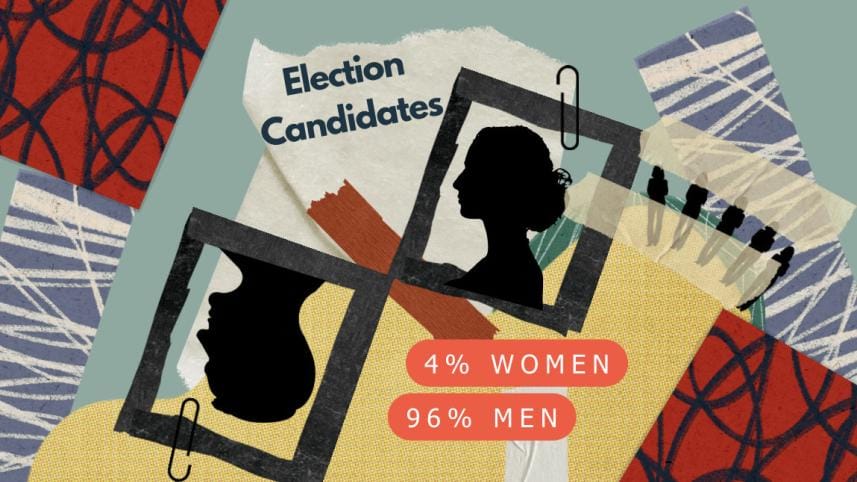
A quilting metaphor, unique to our nakshi kantha, aptly describes Bangladesh's politics today. The intricate needlework that underpins the beauty of our nightly wrap-on continues to be a revered tradition, often ignoring the actual individuals who recycle worn-out cloths to infuse it with new vitality. The presence/absence of the women weaver's story in this tapestry is telling of our gendered reality. In theory, half the country is female. They lift trophies in football and cricket, they climb mountains, and they outperform their male peers in classrooms, laboratories, clinics, marketplaces, and factories. Yet, when the time comes to claim spaces of real political power, their role starts becoming scarce. The submission of candidatures by 110 women for the forthcoming election is one such example.
The figure constitutes a little over four percent of the 2,582 candidates for the directly elected seats. Although the number of women contestants increased compared to the 12th parliamentary election—when 92 women out of 1,891 total candidates vied for 300 seats—the percentage remains low. The entrenched gender gap is glaringly obvious, notwithstanding the fact that the Election Commission has yet to declare the number of valid candidates. Many of these candidates are running independently without the blessings of mainstream parties. The Bangladesh Nationalist Party (BNP) has more women on their list, but the number may drop following the recent death of its chairperson, Khaleda Zia and internal shuffling. While the left-leaning parties seem more inclusive, Jamaat-e-Islami decided not to field any women for general seats. Such an arrangement is a tell-tale sign of a gender wall that exists within major political parties.
 For all latest news, follow The Daily Star's Google News channel.
The provision of 50 reserved parliamentary seats allows the parties to claim formal representation of women, but they are never given the equivalent of direct electoral wins to serve the constituencies. While the country has already achieved gender parity in primary and secondary education, political leadership roles do not reflect the value of female capital. Women also remain under-represented in executive positions. Most women are employed in low-paid, informal, or precarious jobs. For over three decades, we took pride in the fact that two powerful women shared the political sceptres, but their struggles reflect the wider political realities of South Asia. They achieved power through dynastic politics and political crisis and emerged as unifying factors within their parties. Today, a void in the political field can be felt due to the absence of Sheikh Hasina, who fled the country after her ousting in 2024 and the demise of Khaleda Zia just ahead of the 2026 elections. The vacuum and the consequent marginalisation of female candidates in the next election remind us how much women's political representation has relied on exceptional individuals rather than systemic inclusion.
The vigorous presence of women in the past pro-democracy movements proved that many of the women leaders are parliament-ready. From anti-dictatorship struggles in the 1980s to the 2024 Monsoon Uprising, women participated in the politics as activists, media influencers, and organisers. Why the political parties do not capitalise on their street capital remains a mystery.
We have seen female members resign from the National Citizen Party (NCP), protesting the party's alliances with Islamist parties. Yet, these were literally avant-garde women (advanced guards in infantry terms) facing the first round of attacks during the uprising. Some of them returned from abroad to join the movement, leaving behind their prospective careers. Not only that, but the decision by the NCP to merge with a Jamaat-led alliance came so late that most of the women leaders did not have enough response time to float as independent candidates. This incident is another instance of the electoral glass ceiling. Women are staged where politics is messy and unmediated by elite gatekeepers, but they are forced to take a backseat where nominations are controlled by party hierarchies.
To further exacerbate the situation, some parties are advocating for reduced work hours for women. This patronisation exemplifies benevolent patriarchy, which is supposedly intended to alleviate the dual burdens of home and employment for women. Instead of pursuing gender equality, we are once again thinking of women as a category of fragility, rather than as political equals and economic agents. Such attitudes solidify stereotypes instead of dismantling them. Once again, we discover ourselves relegating the powerful rule of two of our former prime ministers to mere tokenism.
Despite their contribution to female education and female participation in the economy and politics to some extent, Bangladeshi women are under-represented in direct electoral politics. They are not allowed to look past platitudes and into the political culture and structural obstacles that perpetuate exclusion.
The gatekeeper within the party and their patronage networks ensure that the political structure remains male-dominated. Candidate lists are chosen through internal elite bargaining, keeping familial ties in mind. Even when women are made MPs, the party does not expect an intellectual contribution from their reserved MP. They demand loyalty to forward party policies. If somehow women leaders step forward with credentials equal to or surpassing men's, their competitiveness is often trimmed through character assassination or slandering. Social norms impose pressure on these candidates to conform to societal expectations. Political parties' unwillingness to invest in women candidates further confirms this phenomenon.
Virginia Woolf has long warned that a woman can only create a room of her own when she has a financial support base. Female space is not a male gift. Running a political campaign requires financial capital. Women, due to their lack of access to capital or financial networks, seldom have the solvency to vie for a public post.
Last week, millions showed up at the funeral of Khaleda Zia. The respect that she garnered was extraordinary in the context of broader female political exclusion. Her rise to prominence stemmed from unique circumstances. The absence of a gradual institutional path for women in politics further underscores this uniqueness. It is a shame that in the past 55 years, we have failed to create a healthy democratic ecosystem that routinely produces and places women leaders.
The next government should recognise this void as an opportunity and undertake true structural reforms in this area. Otherwise, the next generation of women leaders will continue to face the same barriers. We need to go beyond the same routine of rhetorical affirmations of gender equality and the well-rehearsed practice of shrinking the female role in public offices.
Also, the parties participating in the election must clarify women's representation in their electoral manifestos. We are tired of cosmetic solutions that either glorify women as angels or portray them as monsters. It's time we implement affirmative actions for institutional quotas in general seats. There have to be public or party-level financing provisions to reduce economic barriers for women candidates. Women's wings within the party need to be nurtured to create leadership pipelines and decision-making authority. And above all, there have to be educational campaigns that reshape public perceptions of political leadership and normalise women's participation in formal politics. Women are instrumental in creating our social fabric. It's high time we acknowledge their significant role in not only telling but also creating stories.
Dr Shamsad Mortuza is a professor of English at Dhaka University.
Views expressed in this article are the author's own.
Follow The Daily Star Opinion on Facebook for the latest opinions, commentaries, and analyses by experts and professionals. To contribute your article or letter to The Daily Star Opinion, see our guidelines for submission.
Comments