


When mobs decide who can speak, what happens to democracy?

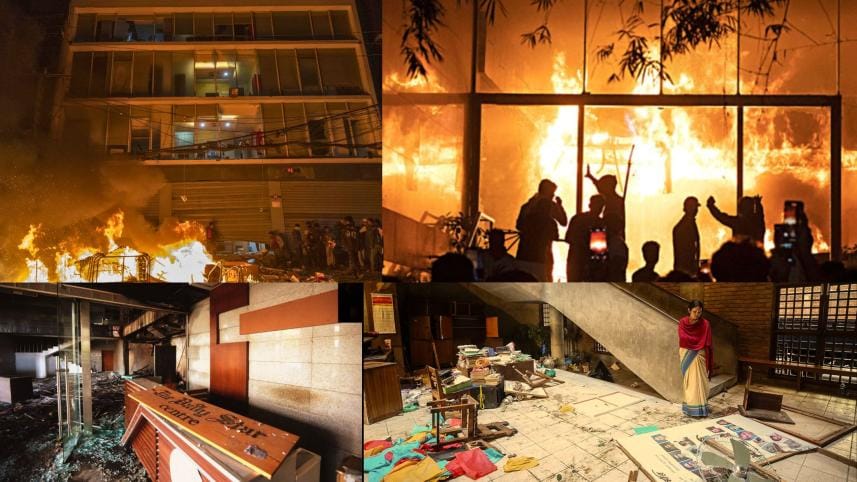
The night The Daily Star building was set on fire by mobs incited by known right-wing political figures and social media influencers, at least 28 journalists and staff were trapped on the rooftop. One of them wrote on Facebook: "I cannot breathe." Anyone who has worked in a newsroom in Dhaka can imagine the scene—smoke filling the corridors, shouting from below, the sound of glass breaking, and the quiet panic of not knowing whether the stairs are still safe. Now add one very typical Dhaka detail. In many buildings, the rooftop door is often kept locked. If that had been the case that evening, we would probably not be discussing a Facebook status. We would be talking about bodies.
I cannot remember any other moment in our 54 years of independence when, at a time officially described as "peaceful," so many journalists came this close to being burned alive or mortally wounded inside their own office. This was not a protest that went a little too far. The way the fire was set and the way some people tried to block the fire service from reaching the building make it hard to escape one conclusion: someone deliberately wanted the journalists to suffer, or worse.
 For all latest news, follow The Daily Star's Google News channel.
 What makes this episode even more disturbing is that the attackers did not know the people they were trying to burn. They had no personal quarrel with a particular reporter or editor. In many cases, they probably never noticed the bylines of those trapped on the rooftop. Their real target was not individuals; it was two institutions: The Daily Star and Prothom Alo. For months, parts of our public conversation have described these newspapers and some cultural centres as "anti-national," "foreign agents," or "serving Indian interests." These are serious accusations, yet they are usually made without evidence. Still, they are repeated on TV talk shows, at rallies, and on Facebook Live videos. Gradually, a picture emerges in which certain media houses are no longer seen as legitimate subjects of criticism, but as enemies.
Sociology offers a useful lens here. When a group is constantly painted as traitorous, some begin to feel that violence against them is acceptable, even if regrettable. In other words, they become "killable" in the public imagination even before a single match is lit. Once that mental line is crossed, setting fire to a newsroom can start to feel like a form of justice.
This pattern is not unique to Bangladesh. In the United States, years of loose talk about "fake news" helped normalise hostility towards journalists. The language came first; actions followed later. Dhaka is now witnessing a similar script, accelerated by social media. After the brutal attack on Osman Hadi, speeches at public meetings spoke of "blood for blood" in reference to alleged India–Awami League connections. Social media posts listed specific addresses: Dhanmondi-32, the Indira Gandhi Cultural Centre, Chhayanaut, Prothom Alo, and The Daily Star. Anonymous pages, and even well-known political figures, singled them out repeatedly. None of this was hidden. Anyone following events could see that a climate was being created in which attacks on these institutions could be framed as righteous acts.
Scholars of political communication sometimes describe this process as "stochastic violence." Leaders do not issue direct instructions like "Go there at 7pm and burn the building." Instead, they consistently describe certain people as enemies, use emotional language, and hint that "the people" will one day rise against them. It is then left to someone in the crowd, or to groups with vested interests, to take the final step. That is what happened here. One evening, a mob appeared in front of two newspaper offices and a cultural centre. They were not carrying placards or petitions. They arrived with the confidence that what they were about to do had already been justified through weeks of speeches and social media posts.
There is another question we cannot avoid: where did the state stand in all this? When inflammatory speeches are made in public, when such addresses are openly shared and promoted, and when pages fantasise about burning institutions, it is reasonable to expect intelligence agencies and law enforcement to take notice. It is also reasonable to expect that once an attack begins, rescue services will reach the victims quickly. Instead, journalists trapped inside their own building had to ask for help—help that was delayed anyway—while some in the crowd tried to stop firefighters. The message is chilling: if enough people are turned against you, there is no guarantee that the state will reach you before the flames do.
Some readers say they do not always agree with the editorial positions of these newspapers and therefore struggle to feel sympathy. That is a dangerous misreading of what is at stake. The same crowd that can be mobilised today against a newsroom can be turned tomorrow against a university, a theatre group, a human rights organisation, or even a religious institution that does not fit a particular narrative. This was not merely an attack on two media houses; it was a warning to every institution that produces ideas, culture, or independent knowledge. We have already seen how fluidly mobs shift targets. Similar patterns have played out elsewhere in South Asia, where campaigns that begin with slogans and rumours against one group end with attacks on shops, homes, and places of worship. Once the habit of settling disagreements by targeting institutions and individuals takes hold, it rarely stops with the first target.
In Bangladesh, much of this is now wrapped in the language of "India" and "anti-India." Here, a careful distinction is necessary. Bangladesh has real disagreements with India, from water sharing to border violence. Citizens have every right to criticise unjust Indian policies and to demand that their government protect national interests. That debate is healthy. The danger begins when "anti-India" becomes a flexible label used to attack anyone who does not support a particular agenda. A newspaper that questions a movement, a cultural centre that invites diverse voices, or an activist who calls for institutional reform can suddenly be branded "pro-India" or an "Indian agent" without evidence. Once labelled this way, they are treated as less deserving of protection. Violence against them starts to resemble a patriotic duty in the eyes of some. This is not nationalism. It is a narrow and fragile identity politics that weakens society and places slogans above constitutional commitments.
So what can be done? The first step is straightforward, even if politically inconvenient. There must be a serious investigation into the attacks on media houses and other institutions and sites targeted recently. The question is not only who lit the fire, but who spent days and weeks preparing the emotional ground for it. That trail can be traced through speeches, posts, and organising networks—if there is genuine political will, that is. The second step concerns parties that claim to stand for democracy. They may disagree with media coverage and feel unfairly treated, but they have a responsibility to tell their supporters clearly that arson and intimidation are not a form of political participation. A party that cannot restrain its own angry followers will struggle to convince anyone that it is ready to govern a diverse and noisy society.
The next election will not magically resolve these problems, but it will signal what kind of Bangladesh we want. If we imagine this country as a pluralist state, guided by the constitution and the rule of law rather than by mobs, we have to organise and vote with that vision in mind. The questions are simple: are we as a nation prepared to live with media and institutions that challenge dominant narratives, or do we quietly long for a landscape where only one story is told?
Asif Bin Ali is doctoral fellow at Georgia State University. He can be reached at abinali2@gsu.edu.
Views expressed in this article are the author's own.
Follow The Daily Star Opinion on Facebook for the latest opinions, commentaries, and analyses by experts and professionals. To contribute your article or letter to The Daily Star Opinion, see our guidelines for submission.
Comments