


Clean air must be prioritised
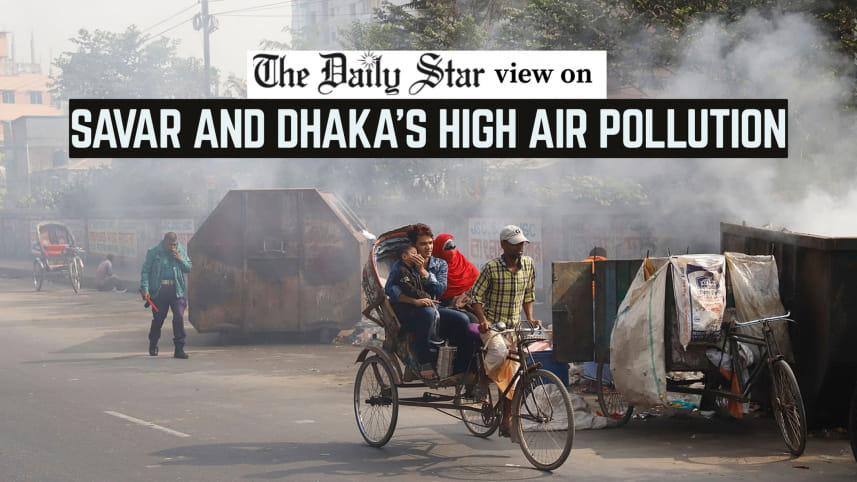
We are alarmed by reports that Savar’s Air Quality Index (AQI) soared to 537 on Sunday, surpassing the “hazardous” threshold of 500 and ranking it among the most polluted places in the world. On the same day, Dhaka’s AQI stood at 220, in the “very unhealthy” category. With safe air quality generally measured between 0 and 100, these figures underscore the severity of the crisis unfolding in and around the capital.
Savar, located some 20 kilometres from Dhaka, has been a significant source of pollution affecting the capital. Last year, the government declared the area a “degraded airshed” and restricted the operation of brick kilns. Considering that brick kilns account for nearly 58 percent of the region’s air pollution, the move appeared sensible; however, weak enforcement and non-compliance by kiln owners have rendered the decision largely tokenistic. Additionally, northwesterly and northeasterly winds during the dry season carry polluted air from Savar into Dhaka, further deteriorating the capital’s already unhealthy air.
 For all latest news, follow The Daily Star's Google News channel.
 According to 2024 data from the Bangladesh Road Transport Authority (BRTA), over 25,000 older vehicles are running in Dhaka, emitting toxic gases. Emissions of airborne lead particles from battery rickshaws are putting a significant number of children at risk of irreversible neurological damage. Furthermore, chemical fumes from fog machines—used to spray medicines to prevent mosquito breeding—are hazardous for humans when inhaled. Other sources of PM2.5 in the country include solid waste burning, dust from construction sites, and transboundary pollution, etc.
The consequences of persistent air pollution are deadly. According to a study by the Centre for Research on Energy and Clean Air (CREA), some 48 percent of those who die due to air pollution in Bangladesh are residents of Dhaka and Chattogram. The study—conducted on data from 2022 to 2024—found that controlling the presence of PM2.5 in the air could prevent over one lakh deaths in the country. Furthermore, air pollution increases the overall healthcare costs in Bangladesh, reducing the overall quality of life.
The persistence of such toxic air and its repercussions on citizens reflects years of weak enforcement and political complacency. Therefore, the elected government must treat air pollution as a public health emergency and move beyond just simple declarations. This requires strict implementation of existing laws, transparent monitoring, and holding polluters accountable. Without sustained political will and regulatory integrity, hazardous air will remain a recurring crisis rather than a solvable one.
Comments