


Tarique Rahman’s return, and the Kundera-esque weight of expectations

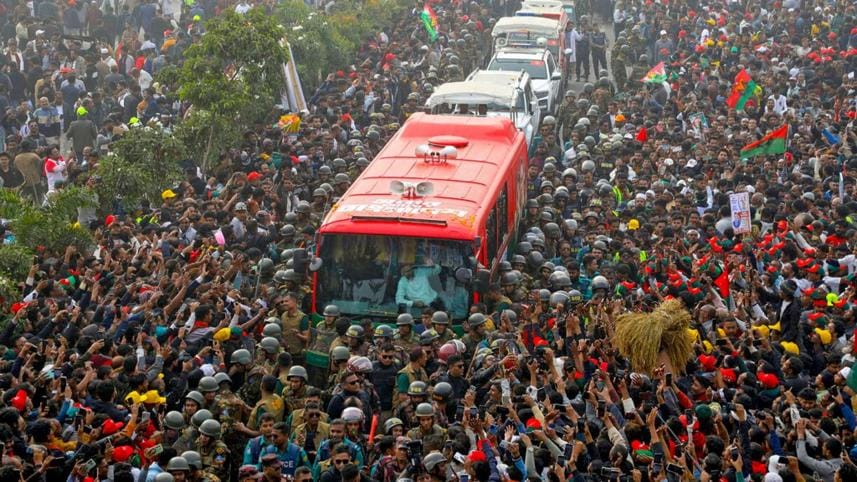
Tarique Rahman's return to Bangladesh after 17 years in exile has been greeted with a scale of emotion that is understandable. There were crowds, chants, tears, symbolism layered upon symbolism. In a country starved of political closure, it felt, to many, like a long-awaited homecoming. But in 2025, we are not a nation that can afford to confuse emotion with resolution. The country is in a stage where it can completely fall apart as well as heal, depending on the political trajectory. And this condition demands discipline—from leaders, such as Tarique Rahman, as much as from those who follow them.
When talking about Tarique Rahman's "homecoming," it becomes essential to clarify one point: he did not return to Bangladesh politically unformed or disconnected. From London, especially in recent years, he remained a persistent presence in the country's political conversation through statements, video addresses, party directives and policy documents. In a way, he shaped the BNP's oppositional posture and kept himself visible as its central figure. His critiques of democratic erosion, calls for accountability, and insistence on electoral legitimacy were not occasional, random interventions; they were part of a sustained narrative. His exile, therefore, was physical rather than political. What has changed now is not his relevance to the nation's politics, but his proximity to consequences.
 For all latest news, follow The Daily Star's Google News channel.
 That distinction matters.
From a distance, political language has a certain freedom. It can be sharp, even uncompromising. It can draw clear moral lines and name injustice without having to manage the fallout. On the ground, words can have different consequences. They address volatile public sentiments, weakened institutions, and a political culture where public trust has been worn thin over time. In Bangladesh today, very little is neutral. Silence is often interpreted. And rhetoric, even when well-intended, can move crowds in directions no one can quite control.
This is why Tarique Rahman's return should be assessed with a cautious optimism at best, not over-glorification. There is an understandable urge to see this as a historic turning point. But our recent history suggests that such moments, when overburdened with expectations, can just as easily unravel. When leaders are pushed into the spotlight as saviours rather than participants in a fragile political system, politics begins to resemble theatre. Brittle societies like ours can hardly endure that for very long.
Tarique Rahman's speech on the day of his return offered important clues as to how he understands the weight of this moment. His tone was reasonably mature and restrained. There was an emphasis on peace and unity—elements the country is in dire need of right now. Violence was condemned. Elections were framed as the legitimate route to change. There were gestures towards inclusivity and a visible effort to lower the national temperature rather than raise it. In a country where political language has often normalised excess, this restraint was not insignificant and has not gone unnoticed.
The speech was also revealing in where it fell short of the expectations. It did not offer specificity. It did not articulate priorities; it did not chart out a roadmap. It invoked vision more than pathway. Unsurprisingly, it is a familiar feature of political homecomings everywhere, where leaders talk about vision rather than specifics. But in Bangladesh's present condition—where trust in politics and politicians is thin and patience thinner, thanks to its bitter political legacy—the absence of detail matters. People are no longer just listening for reassurance. They are listening for structure, for understanding of how the future will be shaped.
Which again brings us to the question of expectations, the central tension of this moment.
Tarique Rahman returns not just with popularity, but with dockets, as back up. The BNP's 31-point outline on structural reforms is a serious attempt to respond to the institutional damage of recent years. It speaks to long-standing demands: restoring a non-partisan election framework, limiting executive overreach, reforming the judiciary, repealing repressive laws, and rebalancing the relationship between the state and the citizen. It signals an awareness that Bangladesh's crisis is perhaps not merely electoral, but constitutional.
Alongside this is the 19-point programme—the foundational vision articulated by Ziaur Rahman decades ago, and repeatedly invoked by his son. It is broader, more philosophical, concerned with sovereignty, self-reliance, social justice and national cohesion. Its strength lies in moral clarity rather than operational detail. It reminds supporters that BNP's claim to legitimacy has always rested on nation-building, not simply regime change.
Together, these frameworks suggest that Tarique Rahman is not returning empty-handed. There is ideological intent. There is an attempt—at least on paper—to move beyond grievance, rhetorical politics.
But we must understand that intent is not implementation.
Neither the 31 points nor the 19 points function as roadmaps. They tell us what should change, but not how that change will be shaped, financed, legislated, or politically negotiated where required, and who will be its owner and ultimately see it through. They talk about commissions, reforms, and principles, but stop short of outlining timelines or accountability mechanisms. This does not make them meaningless. It does, however, place a responsibility on their author and the BNP's leader—now returned to the country—to translate these well-articulated outlines into processes.
This is where expectations start to become uncomfortable.
And then there is also the expectation of restraint that goes beyond mere rhetorical condemnation of violence. In a political environment where mob violence is seemingly becoming substitute for institutional accountability, leadership requires repeated, unambiguous signalling that disorder is not a legitimate political instrument and will not be accepted as such. This is not about silencing protests; this is about refusing to legitimise disorder. Words must be chosen with an awareness of how quickly they can travel, and how easily they can be twisted to serve the purpose of vested quarters. As I said before, now Tarique Rahman does not enjoy the leverage of distance, now he has to shoulder the weight of his words in a Milan Kundera–esque style.
In addition, there is the inevitable and more prominent expectation of electoral anchoring from Tarique Rahman. Having long argued that elections are the only legitimate pathway to change, Tarique Rahman is now expected to bind his political project firmly to that process—perilous and imperfect as it may be. This means discouraging disruption, resisting brinkmanship, and committing to outcomes that are not predetermined. In a country scarred by boycotts and flimsy mandates, it is a basic expectation.
However, and most critically, there is an expectation of temperature management. Bangladesh is not only polarised; it is at the boiling point. Years of repression, economic strain, and civic space shrinkage have resulted in a public mood that vacillates mostly between rage and outbursts. Leadership in such a context is not only about discouraging violence, but also creating space: for institutions to regain public trust, for politics to come to a steady pace, for disagreement to exist without becoming violent and for the people to heal.
This will perhaps be Tarique Rahman's most critical test of political acumen.
Tarique Rahman's return is therefore not a conclusion, but a test of his political maturity. He arrives with a powerful legacy, a solid, mobilised base to a country watching and hoping for stability, justice and a new era that will decide the nation's trajectory for the next leap to progress. Having said all these, he also arrives at a moment where miscalculation carries unforeseen risks.
Therefore, assessing Tarique Rahman's homecoming with cautious optimism is justified.
Bangladesh does not need another myth. It needs politics that can tolerate difference of opinion, navigate ambiguity, create unity and resist the urge to relent to chaos. Whether Tarique Rahman can meet all the expectations should be decided not by the scale of his welcome, but slowly, in how he handles power and formally holds it, when the time comes, regardless of the role he occupies in the next parliament.
The much-awaited return has happened. Expectations now carry weight—and the country will witnesshow they are borne.-
Tasneem Tayeb is a columnist for The Daily Star. Her X handle is @tasneem_tayeb.
Views expressed in this article are the author's own.
Follow The Daily Star Opinion on Facebook for the latest opinions, commentaries, and analyses by experts and professionals. To contribute your article or letter to The Daily Star Opinion, see our guidelines for submission.
Comments