


From Jihad to Sajid: Why Bangladesh needs tort law

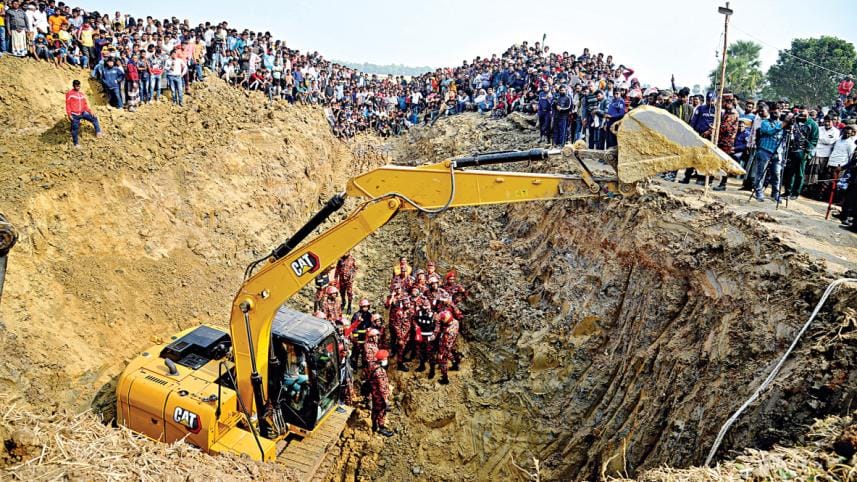
Two-year-old Sajid from Rajshahi was found dead on December 11, after more than 30 agonising hours trapped inside a narrow shaft, approximately 30 feet deep. Rescuers worked day and night tirelessly, while the country watched helplessly. When Sajid was finally pulled out, the doctor declared him dead. This incident once again exposed the shortcomings of our rescue institutions and the legal system. A similar tragic incident occurred back in December 2014 in Shahjahanpur, Dhaka, where a four-year-old boy named Jihad fell into an unsealed deep well shaft. His death shocked the nation. The High Court intervened and, after two years of legal battle, ordered compensation for his family in 2016. Bangladesh Railway and the Department of Fire Service & Civil Defence were each ordered to pay Tk 10 lakh, an acknowledgment that negligence has consequences. The appeal, however, took two more years to reach its final decision. Unfortunately, that judgment did not lead to any meaningful reform.
These incidents are not accidents. An open tube-well shaft is a visible, deadly trap. Leaving such structures uncapped is pure negligence. And when negligence repeatedly causes the death of children, the problem is not individual oversight—it is a systemic failure of legal accountability, most specifically the application of tort law. Bangladesh lacks a strong system of tort law—the set of civil rules that make wrongdoers pay victims and push institutions to prioritise safety. Without the fear of civil liability, negligence becomes normal, hidden, and unquestioned.
 For all latest news, follow The Daily Star's Google News channel.
 In most cases of negligence-related deaths and damages, victims and their families primarily seek justice through criminal cases. However, in instances of institutional and individual negligence, it is very difficult to establish criminal liability for a specific person, and punishing an individual is often unlikely, but this does not address the broken systems. In such cases, the appropriate remedy is the effective application of tort law: by turning harm into financial accountability, compelling institutions to adopt safer practices because the cost of negligence becomes too high to ignore.
Families like Sajid's face difficulty in filing a writ petition before the High Court Division without a suo-moto ruling from the High Court or NGO-led public interest litigation, as it involves financial expenses, travel to Dhaka, and hiring a lawyer. Besides this, civil courts, although having the jurisdiction to award compensation, lack laws regarding civil negligence and the measurement of damages. Therefore, filing a tort claim in Bangladesh is uncertain, prolonged, and practically inaccessible for ordinary citizens.
This lack of civil accountability also influences how buildings are constructed, roads are maintained, medical services are delivered, and public infrastructure is managed. When hospitals know they will never face serious malpractice lawsuits, safety protocols remain weak. When transport companies understand wrongful death suits are unlikely, reckless driving continues. When municipalities realise they will not be sued for leaving hazards in public spaces, those hazards stay until someone is harmed or dies. It is not about money; it is about creating a system where safety costs less than carelessness. An effective tort system would compel authorities to seal abandoned wells, conduct regular inspections of public spaces, enforce safety standards, and maintain infrastructure properly. It would provide parents with legal acknowledgment for the wrongful loss of their children. It would push institutions to act proactively before tragedy happens, not after.
The emotional impact of Sajid's tragic death should not fade into another news cycle. His death— and Jihad's before him—should force a national reckoning. Bangladesh urgently needs a modern tort law that clearly defines negligence, imposes strict liability for public hazards, allows quick compensation, and establishes a civil justice pathway that victims can actually access. Without it, we will keep seeing lives lost to hazards that everyone knew existed, everyone knew were dangerous, and yet no one bothered to fix.
Mst Asma Mahmud is a senior civil judge, currently doing her MPhil research at the Institute of Bangladesh Studies at the University of Rajshahi. She can be reached at asmamahmud301@gmail.com.
Views expressed in this article are the author's own.
Follow The Daily Star Opinion on Facebook for the latest opinions, commentaries, and analyses by experts and professionals. To contribute your article or letter to The Daily Star Opinion, see our guidelines for submission.
Comments