


‘I don't want justice’: The deeper danger behind one father’s words

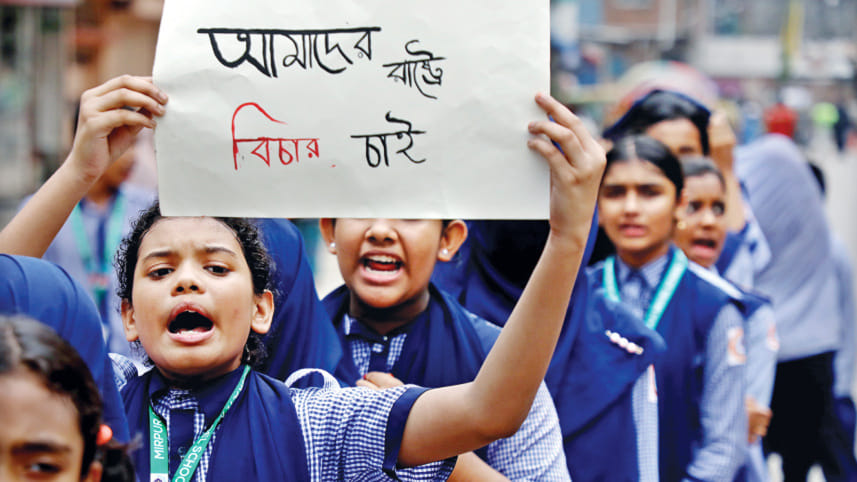
In Dhaka’s Pallabi, an eight-year-old was raped and murdered inside a neighbouring flat on May 19. Her body was dismembered in an attempt to conceal the crime. The brutality horrified the country, but what lingered more painfully was her father’s response. Standing before reporters, Abdul Hannan Molla said, “I don’t want justice because you cannot deliver it. You have no record of delivering justice.” He predicted public outrage over his daughter’s death would fade within 15 days at best.
These words no longer shock people the way they should. Families of murder victims, rape survivors, or parents of abused children increasingly speak with disillusionment. Many no longer believe police investigations, courts, prosecutors or political leaders can meaningfully protect them or punish offenders. Some openly say they are leaving justice to the Almighty because the state has failed them. This erosion of trust may be one of Bangladesh’s gravest institutional crises.
 For all latest news, follow The Daily Star's Google News channel.
 The statistics explain why. In the first four months of this year alone, at least 1,142 murder cases were filed, up from 1,017 in 2025 and 1,006 in 2024. Murders rose from 250 in February to 317 in March before slightly declining to 288 in April. Rights organisation Ain o Salish Kendra reports that at least 115 children were killed during the same period, including 12 after alleged rape or attempted rape, 59 following torture, and 20 who had been missing.
Nevertheless, the country’s criminal justice system remains buried under an enormous backlog. More than 45 lakh cases were pending in June last year, later rising to over 47 lakh, with lower courts alone carrying over 40 lakh. Trials stretch for years. Witnesses disappear. Victims exhaust their savings attending hearings that are repeatedly postponed. In rape and violence-related cases, conviction rates remain shockingly low. Recent police statistics indicate conviction rates of just 2.61 percent in cases involving violence against women and 0.52 percent in children-related cases in the first eight months of last year, far below the overall criminal conviction rate of around 28 percent. A joint study by the Supreme Court and BRAC further found that 15 districts recorded zero convictions between January and June last year.
So, thousands of rape and murder cases are filed every year, yet only a fraction end in punishment. Many accused secure bail quickly, especially if they possess money, and can leverage local influence or political connections. Meanwhile, victims, their families and witnesses face intimidation, social pressure, and financial ruin. Some abandon cases entirely because continuing becomes impossible.
The problem runs through the entire justice chain. Bangladesh still lacks a comprehensive victim and witness protection law. There are no reliable safeguards for families who fear retaliation. Poor people, particularly day labourers or working-class families, cannot afford repeated visits to court, missed wages, or years of legal uncertainty. In some cases, local power brokers discourage them from pursuing justice altogether. Police investigations often remain weak, under-resourced, or vulnerable to outside influence. Forensic capacity is limited. Delays become routine. Consequently, Bangladesh is ranked 125th out of 143 countries in the 2025 World Justice Project Rule of Law Index.
But numbers alone cannot capture the emotional damage. For many families, the trauma deepens through the slow realisation that the state may never respond meaningfully. Endless hearings consume money, energy, and mental stability until some conclude that pursuing justice only creates further suffering. Communities absorb the lesson, too. When influential suspects repeatedly avoid consequences while ordinary victims struggle for years, people begin seeing the system as selective rather than dependable.
In such an environment, informal alternatives replace formal justice. Village arbitration, political mediation, personal networks, and social pressure fill the vacuum left by weak institutions. Sometimes, this produces quiet settlements, sometimes intimidation, sometimes public appetite for extrajudicial punishment. Support for “crossfire” and similar shortcuts emerged partly from frustration with a judicial system many view as slow, selective, and inaccessible. If people stop believing that courts can deliver justice, harsh alternatives appear attractive. Once due process weakens, abuse becomes easier, not harder.
The deeper crisis is what this does to the relationship between citizens and the state. A functioning state rests not only on laws but on the belief that institutions will protect the vulnerable, punish wrongdoing, and treat citizens fairly, regardless of power or wealth. When that belief collapses, cynicism fills the space. People disengage. Public outrage becomes a temporary spectacle rather than a sustained demand for reform. Sensational crimes dominate headlines for days before fading into collective fatigue because few expect meaningful closure.
Criminologists and legal scholars argue that the country’s justice system still carries the architecture of colonial control rather than citizen-centred accountability. Police, prosecution, and prisons have seen piecemeal reform but little fundamental transformation. Laws alone cannot solve the crisis if institutions remain understaffed, politicised, and disconnected from ordinary citizens.
The consequences of continued failure are ominous. A society where the poor gradually abandon the justice system while the powerful manipulate it cannot sustain trust indefinitely. Perpetrators become emboldened when punishment appears uncertain. Victims become reluctant to report crimes. Witnesses retreat. Fear grows quietly, especially among women, children, and marginalised communities. Over time, impunity stops appearing exceptional and starts feeling normal.
It will take far more than public outrage to rebuild. Fast-track tribunals and reactive promises cannot substitute for structural reform. Bangladesh urgently needs a functioning victim and witness protection framework, stronger forensic capacity, faster and more transparent investigations, and meaningful accountability for negligence in policing and prosecution. Judicial vacancies must be filled. Case management systems need modernisation. Public reporting on case progress and conviction rates should become routine. Equally important is political will. When citizens believe outcomes depend on influence rather than evidence, institutional legitimacy erodes rapidly.
The eight-year-old victim’s father spoke from grief and observation. His refusal to seek justice was not simply emotional despair; it was an indictment of a system too many Bangladeshis no longer trust. That may be the most alarming part of all. When citizens stop expecting justice altogether, the damage extends far beyond any single crime scene. It reshapes the moral foundations of society. If that distrust continues deepening, the country risks drifting towards a dangerous equilibrium where perpetrators grow bolder, victims grow quieter, and faith in the rule of law slowly gives way to resignation.
Jannatul Naym Pieal is a writer, researcher, and journalist. He can be reached at jn.pieal@gmail.com
Views expressed in this article are the author's own.
Follow The Daily Star Opinion on Facebook for the latest opinions, commentaries, and analyses by experts and professionals. To contribute your article or letter to The Daily Star Opinion, see our guidelines for submission.
Comments