


How Bangladesh can use its geo-economic advantage to sustain development

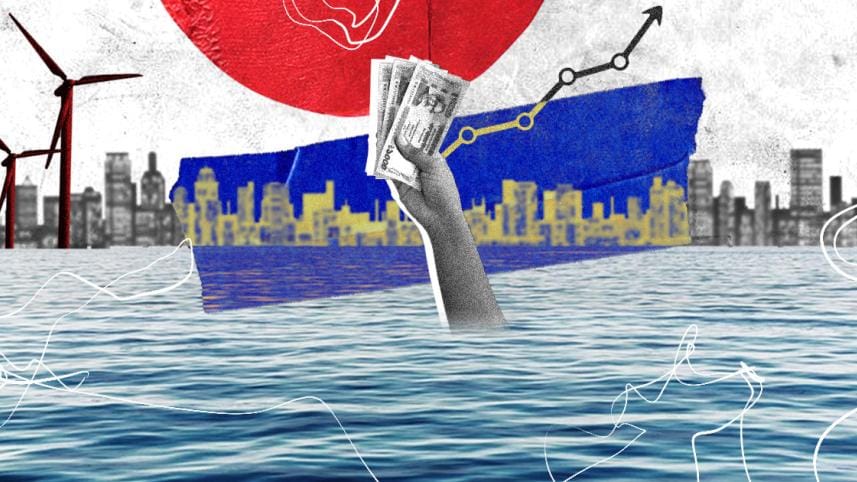
Geo-economics is not just maps and borders; it is about understanding how geography turns into economic power, and how trade routes, coastlines, and neighbours shape what a country can become. For Bangladesh, located neatly between South and Southeast Asia and on the shores of the Bay of Bengal, geography is both a challenge and a gift. The question is: how well can it use this position to secure long-term growth?
Let's start with the big picture. Despite political unrest and the authoritarian regime, over the past few years, Bangladesh has been one of Asia's economic success stories, averaging around seven percent growth. It didn't happen by accident. Remittances from abroad, steady exports—especially garments—and a wave of infrastructure investments kept the momentum going. However, to move from a "developing" to "developed" country, Bangladesh needs a different game plan, one rooted in geo-economics, given the world's current economic and strategic situation.
 For all latest news, follow The Daily Star's Google News channel.
 Here's the thing: more than 90 percent of Bangladesh's trade flows through the sea. Its ports—Chattogram, Mongla, and the more recent Payra—are lifelines. After the 2014 maritime arbitration, Bangladesh gained over 118,000 square kilometres of sea territory. That was a huge win. Though critics may argue, opening the door to what analysts call a "blue economy" will potentially add about one percent to our GDP every year, if it is managed right. We're talking fisheries, offshore gas, marine tourism—the kind of industries that can cushion the country from overdependence on textiles.
To make sense of all this, some classic theories help. First, Paul Krugman's "New Economic Geography", from his book Geography and Trade (1991), argues that economic activity tends to cluster where trade costs are low and connectivity is high. In simple terms, countries that master logistics and linkages can punch far above their weight. Bangladesh fits that description if it fixes its inefficiencies. For instance, transporting goods from Dhaka to Chattogram costs more than shipping them from Chattogram to Singapore. That's not just inconvenient; it's a geo-economic handicap.
Another framework comes from Nicholas Spykman's "Rimland Theory" in America's Strategy in World Politics (1942). Spykman believed that the areas bordering the great seas—the rimlands—would shape global power. Bangladesh sits right on such a rimland, at the Bay of Bengal, the very zone connecting the Indian Ocean with the Pacific. That makes it a connector state, a bridge between South and Southeast Asia, and a player in the wider Indo-Pacific balance. The more it uses this geography strategically, the more leverage it has in both regional and global affairs.
Maritime leverage is the first big piece. Turning Chattogram and Payra into regional transshipment hubs could attract foreign investment and bring down the high logistics costs that hold back exports. Developing deep-sea ports and better hinterland connectivity would position Bangladesh as a trade gateway for Bhutan, Nepal, and India's northeast. In Krugman's terms, this is about reducing "distance friction," thus making economic gravity work in Bangladesh's favour.
Regional integration is the next frontier. The South Asia Subregional Economic Cooperation (SASEC) transport corridors could boost annual exports to India and Bhutan significantly. Add the Bay of Bengal Initiative for Multi-Sectoral Technical and Economic Cooperation (BIMSTEC) and you've got a path to connect South Asia with ASEAN. That's where the "bridge economy" idea comes in: Bangladesh linking two economic regions and benefiting from both. The BCIM (Bangladesh-China-India-Myanmar) corridor could also reduce intra-Asian transport costs by up to 30 percent, which is massive. But it requires coordination, which Bangladesh currently lacks.
The blue economy is another untapped resource. A World Bank report shows Bangladesh's ocean economy added $6,192.98 million (3.33 percent of GDP) in 2014–15, driven by tourism (25 percent), fisheries and aquaculture (22 percent), transport (22 percent), oil and gas (19 percent), shipbuilding/breaking (nine percent), and minerals (three percent). At that time around three crore people, nearly 20 percent of the 2015 population, depended on the blue economy. With its expanded maritime zone, Bangladesh can develop fisheries, seabed minerals, and offshore hydrocarbons—industries that add resilience to growth. However, this requires clear regulation, environmental safeguards, and technological partnerships. Otherwise, the "blue" opportunity could quickly turn into a "grey" liability.
Then there's the question of the industrial corridor and the small and medium enterprises (SME). SMEs, particularly in light engineering, are crucial to regional value chains. As industrial clusters form across borders, these SMEs can move from local workshops to export-oriented suppliers. In several studies, these sectors have shown strong potential for job creation and regional competitiveness. Thus, it all comes down not just to creating better policies but to building better roads and ports and enhancing customs efficiency.
Of course, geo-economics also means politics. Bangladesh is walking a tightrope between China's Belt and Road Initiative (with plausible $26 billion in investment) and the US-led Indo-Pacific framework. The smart move is to stay balanced, using both relationships to serve national goals. Too much tilt either way could limit autonomy. This balancing act, as Spykman would remind us, is what keeps a rimland state relevant and respected.
The final focus should be on the tech side. Services like ICT and telecom are growing fast, but manufacturing still needs a revival. Otherwise, employment generation will lag behind growth. Diversification, both in exports and in technology, is the only way to sustain momentum.
Bangladesh has the potential to carry out all the tasks discussed above. Reducing trade transaction costs by just a few percentage points could add 2–3 percent to GDP. Regional integration could create millions of new jobs. The blue economy could bring in billions in new revenue. These aren't wild projections; they come from hard data and real trends. Therefore, to capture this opportunity, Bangladesh first needs to fix internal issues such as congested ports, inconsistent regulations and slow digitalisation. The payoff for getting it right is huge. Imagine a future where Chattogram rivals Colombo as a shipping hub, where coastal tourism thrives, and where Bangladeshi firms supply parts to ASEAN manufacturers. That's not fantasy; that's geo-economics in action.
Geography doesn't guarantee prosperity; it offers a chance. Countries that understand this—Singapore, Vietnam, even the UAE—turned location into leverage. Bangladesh can do the same if it invests wisely, connects boldly, and negotiates smartly. The Bay of Bengal is a corridor of opportunity and Bangladesh's future depends on how well we facilitate it.
Alauddin Mohammad is joint member secretary of National Citizen Party (NCP) and executive director at Institute of Policy, Governance and Development (IPGAD).
Views expressed in this article are the author's own.
Follow The Daily Star Opinion on Facebook for the latest opinions, commentaries, and analyses by experts and professionals. To contribute your article or letter to The Daily Star Opinion, see our guidelines for submission.
Comments