


Green of my motherland, red of my blood

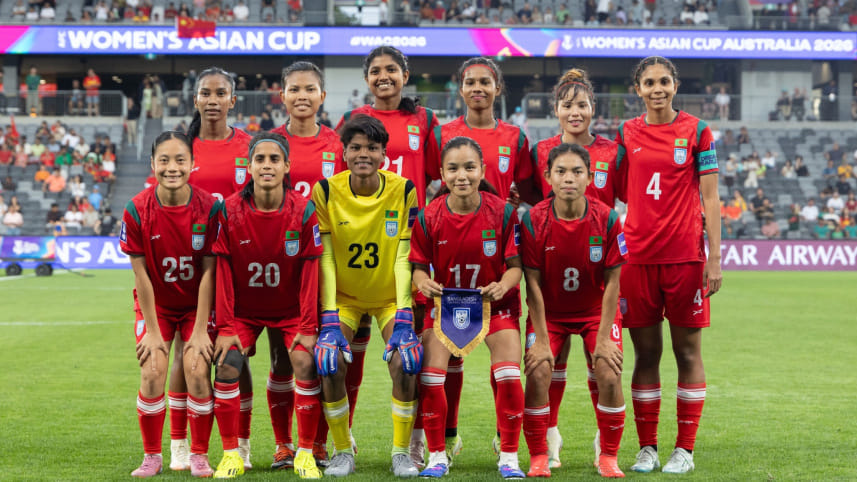
Pride is too often reduced to slogans, to something worn on a scarf or murmured through an anthem without being fully inhabited. Yet, yesterday morning, as Bangladesh’s women prepared to face China at the AFC Women's Asian Cup, pride did not feel rhetorical. It felt weighty, almost anatomical, lodged somewhere between the chest and the throat where identity resists easy language.
I tuned in at seven in the morning: ill, half-conscious, my body heavy and uncooperative. It was not the hour for clarity or emotion. And yet by 8am, when the players assembled in the dugout, lined shoulder to shoulder in the colours we so instinctively associate with home, something in me shifted. The green of my motherland, the red of my blood. There is an intimacy in those colours that resists explanation. They are not merely aesthetic; they are ancestral. When the national anthem began, it did not simply accompany the moment, it consecrated it. I found myself sitting in bed, crying in a way that surprised me, not because of a naïve expectation of victory, but because I had never before seen my country arrive at a stage like this in my lifetime.
 For all latest news, follow The Daily Star's Google News channel.
 No reasonable observer entered the match anticipating dominance. Peter Butler’s description of the contest as David versus Goliath was accurate. Bangladesh went into the tournament as the lowest ranked side, appearing in the Asian Cup for the first time, fielding a squad in which not one player was born before 2000. The captain, 19 years old, was tasked with leading her country into what is arguably the most significant chapter of its modern footballing history.
China began as expected, composed and physically imposing, comfortable in possession and assured in their control of territory, stretching the pitch with the authority of experience.
Bangladesh’s response was not reckless enthusiasm, but structured defiance. They held a high line with an assurance that belied their inexperience, compressing the vertical space between midfield and defence in order to deny China the comfort of operating between the lines. Pressing was not sporadic but coordinated, triggering the moment a Chinese player received under limited orientation. The midfield collapsed inward to protect central corridors, consciously forcing play wide where support was ready. It was not simply effort; it was tactical literacy.
Shamsunnahar, operating as wingback, balanced defensive diligence with transitional ambition, tracking runners with tireless concentration while remaining alert to the possibility of advancing pace. Mile Akter’s composure in goal anchored the side psychologically as much as technically, while Afeida Khandaker embodied a final line of resistance that refused to concede inevitability. Their collective positioning on second balls, timing in recovery, and refusal to be overawed by reputation created a quiet steadiness behind the press.
What struck me most was not merely their capacity to absorb pressure, but the intelligence with which they selected their moments to break it. From deep positions there were sudden vertical progressions, sharp carries that exploited temporary disorganisation in China’s midfield structure. Ritu Chakma’s diagonal runs repeatedly targeted the seam between full-back and centre-back, a space that even elite sides struggle to defend when transitions are executed cleanly. On one such surge she outran the defensive line and lifted the ball goalward with calm audacity.
As the ball left her foot, there was a brief suspension in time. In that instant, it felt neither romantic nor improbable; it felt earned. The fingertip intervention from Chen Chen denied the scoreboard its alteration, but it did not erase what the chance represented: Bangladesh were not present by accident. They had engineered the opportunity through discipline and conviction.
You could hear it in the commentators’ shifting tone, the surprise that accompanied Bangladesh’s refusal to dissolve under pressure. For too long we have internalised a narrative that our athletic limitations predetermine our competitive ceiling. Physicality undeniably matters; elite sport rewards it. Yet what this match revealed is that tactical coherence and psychological resilience can narrow physical gaps more effectively than we often admit. Every contested duel carried intent. They fought for second balls, pressed after being bypassed, tracked runners even when fatigue was visible. The belief was collective, and it altered posture.
I have watched hundreds of women’s matches over the years, and few have moved me like this one did. It was not flawless, nor was it triumphant in the conventional sense, but it carried a rare and unmistakable dignity. The final scoreline read 2-0 to the reigning champions, and even that margin felt like a statement. It felt like the beginning of a recalibration in how we perceive ourselves on the continental stage.
The green of our motherland and the red of our blood are not ornamental. They signify inheritance and responsibility. That morning, watching these young women stand unflinchingly against one of Asia’s established powers, I understood pride not as nostalgia but as obligation. They have shown that we can organise, that we can compete with intelligence, and that we can stand with intention. They have shown that belonging at this level is not a fantasy.
And once a nation glimpses itself as capable, the burden shifts. Pride ceases to be a feeling and becomes a demand for continuation.
Raiyan Binte Rafiq is a sports columnist for The Daily Star. She works in Sports Media in the UK and manages recruitment at Next Level Sports Management.
Views expressed in this article are the author's own.
Follow The Daily Star Opinion on Facebook for the latest opinions, commentaries, and analyses by experts and professionals. To contribute your article or letter to The Daily Star Opinion, see our guidelines for submission.


Comments