

Bangladesh’s inverted pesticide tariffs need to be fixed
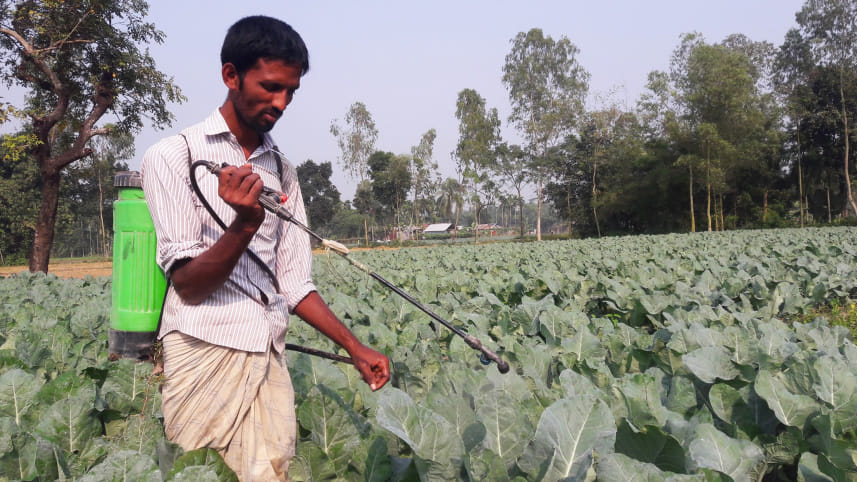
Bangladesh has long promoted domestic manufacturing as the cornerstone of its development strategy. Yet in the agrochemical sector—essential to feeding the country’s population of nearly 18 crore—policy appears to be pulling in the opposite direction, as tariff structures, regulatory rules, and administrative delays continue to favour imported pesticides over local production.
Manufacturers say the country’s tariff structure now makes it significantly cheaper to import finished pesticides than to produce them locally. According to industry calculations, raw materials used in domestic pesticide formulation—including emulsifiers, solvents, stabilisers, and other formulation agents—fall under different chemical tariff headings where customs duties can reach 25 percent. When value added tax and additional charges are added, the total tax on these inputs can reach about 58 percent. Meanwhile, finished pesticide—including insecticides, fungicides, and herbicides—enter the country with customs duties of about five percent and limited additional taxes. In effect, the tax system penalises domestic value addition while rewarding imports. Trade economists have a term for this phenomenon: an inverted tariff structure.

Government officials often note that technical-grade active ingredients (TGAI) are imported duty-free. In practice, however, this exemption has limited impact. In most pesticide formulations, active ingredients account for a very small proportion of the composition, while the auxiliary chemicals that stabilise, dilute, and deliver the product constitute the bulk of the formulation and bear the highest duties. A further distortion arises because finished pesticides are exempt from VAT, whereas many excipients and auxiliary inputs used by domestic manufacturers remain subject to VAT despite already incurring import duties. The result is a misleading perception that pesticides face minimal taxation. In reality, industry estimates suggest that local manufacturers bear an effective duty burden exceeding 40 percent, creating a cost structure that discourages domestic production and favours the finished goods imports.
What makes the issue unusual is that the distortion has already been recognised within the government. In the FY2025–26 national budget speech, then Finance Adviser Salehuddin Ahmed announced that duties on pesticide raw materials would be reduced to support domestic manufacturers, however, months later, the tariff schedule has not changed and no public explanation has been issued for the delay.
Tariffs are only part of the policy framework shaping the industry. Manufacturers also point to a regulatory requirement informally known as “single country, single source.” Applied through the Pesticide Technical Advisory Committee (PTAC) under the agriculture ministry, the rule restricts manufacturers to importing specific raw materials from a single approved supplier in a single approved country. Changing suppliers can require fresh regulatory approval, including laboratory testing and field trials. Industry executives say the policy prevents companies from sourcing lower-cost chemicals from alternative international suppliers. Trade specialists note that Bangladesh’s pesticide regulatory framework, derived largely from the Pesticide Ordinance of 1971, does not explicitly mandate single-source procurement restrictions. Government regulators defend the rule as a safeguard designed to ensure product safety and prevent substandard inputs entering the market.
The sourcing restriction raises potential issues under global trade rules. Bangladesh is a member of the World Trade Organization and therefore subject to the national treatment principle under Article III of the General Agreement on Tariffs and Trade (GATT). That provision requires imported goods to be treated no less favourably than domestic goods once they enter the market. Trade lawyers say a regulatory requirement that restricts manufacturers’ access to imported inputs could potentially raise questions if it disproportionately affects domestic production. A second relevant provision is Article XI of the GATT, which prohibits quantitative restrictions on imports unless justified under specific exceptions. If the “single source” rule functions in practice as a limitation on import channels, it could be scrutinised under those provisions. No WTO dispute has been filed on the issue. But similar sourcing restrictions in other sectors have been challenged internationally.
Even when raw materials are approved, manufacturers say they face delays in clearing them through customs. Each shipment requires a No Objection Certificate (NOC) from agricultural authorities before customs release. Industry participants say obtaining these certificates can take 15 to 20 days, during which containers remain at port and incur demurrage charges. Finished pesticide imports face fewer procedural steps. For chemical manufacturers operating on tight supply chains, such delays can disrupt production schedules and increase costs.
Bangladesh’s status as a Least Developed Country (LDC)—scheduled for graduation in November 2026—provides a policy opportunity. Under the WTO agreement on Trade-Related Aspects of Intellectual Property Rights (TRIPS), LDC members are not required to enforce pharmaceutical product patents until 2033. Bangladesh’s pharmaceutical sector used that flexibility to build a thriving generic drug industry that now supplies almost the entire domestic market and exports to more than 150 countries. The agrochemical industry has not followed the same trajectory. Manufacturers argue that regulatory decisions have sometimes restricted local production of pesticide formulations despite the broader TRIPS exemption. Government officials say regulatory approvals are based on safety considerations rather than patent protection.
The stakes extend beyond industrial policy. Bangladesh’s pesticide market is estimated at roughly Tk 7,500 crore, with a significant portion supplied through imports. Industry leaders say eliminating excessive duties on raw materials could reduce pesticide prices by around 30 percent, lowering costs for farmers. Approximately 16 million farmers depend on crop protection chemicals to safeguard harvests. Lower input prices could directly affect agricultural productivity and rural incomes. The timing is also significant as when Bangladesh graduates from its LDC status, several policy flexibilities and trade preferences will gradually disappear. Developing domestic manufacturing capacity before that transition could strengthen economic resilience.
Bangladesh has demonstrated before that coherent policy can transform an industry. The pharmaceutical sector stands as one of the most prominent examples in the developing world. The agrochemical sector appears to possess similar ingredients: investment, technical capability, and domestic demand. What it lacks is policy alignment. For now, the reforms exist in meeting minutes and official letters. On the factory floor, the machines often remain quiet. In Dhaka’s ministries, the decision to support domestic pesticide manufacturing has already been made—at least on paper. The question is whether it will move beyond the paperwork any time soon.
Md. Arifujjaman is deputy solicitor (additional district judge) at the Solicitor Wing of the Law and Justice Division under the Ministry of Law, Justice and Parliamentary Affairs. He can be reached at arifujjaman.md@gmail.com
Views expressed in this article are the author's own.
Follow The Daily Star Opinion on Facebook for the latest opinions, commentaries, and analyses by experts and professionals. To contribute your article or letter to The Daily Star Opinion, see our guidelines for submission.
 For all latest news, follow The Daily Star's Google News channel.


Comments