


Amid a dangerous rise in child rape, we must confront our failures

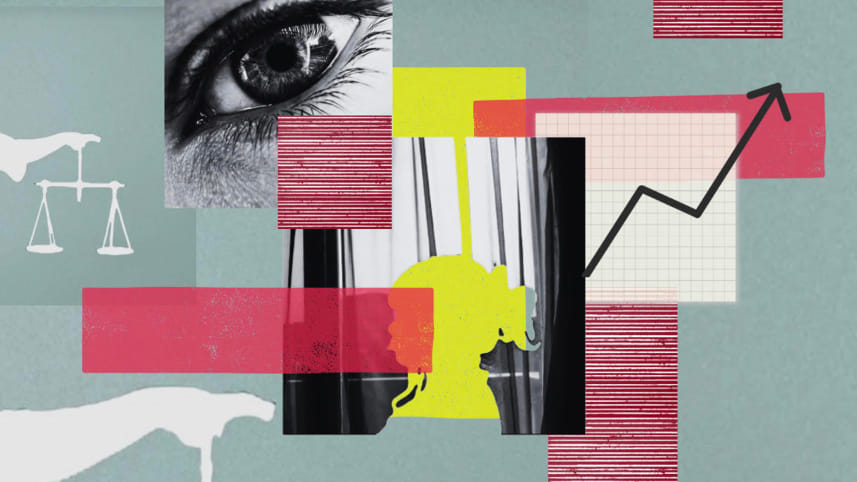
Rights organisation Ain o Salish Kendra (ASK) recently reported that at least 118 children were raped between January and May 20 this year, while 46 others faced attempted rape. According to another human rights organisation Odhikar, some 5,942 underage girls were raped across Bangladesh between January 2016 and March 2026. The latest among these crimes that has caused widespread outrage was the rape, murder, and dismemberment of a second grader in Dhaka’s Pallabi area. The alleged perpetrator, who has “confessed” to the crime, is a next-door neighbour who lured the child to his flat and carried out this heinous act.
Clearly, we, as a society, are failing to protect the most vulnerable among us. Children are no longer safe in their homes. A recent survey by child rights organisation Shishurai Shob, prepared by compiling published news reports from 2025, revealed that around 66 percent of child murders and some 59 percent of sexual abuse cases occurred in familiar settings by those known to the victims.
 For all latest news, follow The Daily Star's Google News channel.
 They are not safe in public places, as street children regularly fall prey to various forms of brutality, including sexual assault. Nor are they safe in educational institutions, including madrasas. Sexual assault within families or religious institutions remains a taboo subject that no one wants to talk about or address; meanwhile, offenders thrive under a culture of silence, fear, and false honour.
Each such case is a grim reminder of the extreme brutality faced by our children. Last September, an eight-year-old child from Magura was raped by the father-in-law of her sister, who later died. There were widespread protests all over the country, but that did not change much, as sexual violence against women, girls, and children continues unabated. There have been hundreds of similar cases, from Magura to Pallabi, most of which are under trial.
Those of us working for decades on the prevention of violence against women and children are reduced to a state of helplessness, with no solution or recourse in sight. The question that haunts us is: how did we come to this, and what can we do to prevent the spiral of cruelty and violence against children?
Lack of justice is cited as one reason. More than 10 lakh cases are currently pending before the country’s Women and Children Repression Prevention Tribunals, while over 10,000 rape cases have remained unresolved for more than five years. The conviction rate in child rape cases is also alarmingly low, remaining close to zero. Offenders enjoy a sense of impunity, knowing they will get away with it, as there is little fear of retribution or punishment.
The arduous process of seeking justice starts with insensitive attitudes at police stations. Delays in dispensing justice force most survivors, especially those with limited incomes, to give up halfway, feeling humiliated, exhausted, and drained of resources. On the other hand, survivors of rape, even children, are stigmatised, forcing many to leave their village or community. Adult survivors are blamed for being in the wrong place at the wrong time or for wearing “unacceptable” clothes. Those who have the resilience to pursue their cases till the end often see offenders walk away through money or muscle power. Authorities cite case backlogs, inadequate staffing, and shortages of judges as reasons for the low conviction rate. Meanwhile, long delays cause witnesses to lose patience or withdraw out of fear of retribution. A victim and witness protection law is yet to be enacted. Out-of-court settlements are also cited as a reason behind the low conviction rate.
There is no doubt that the lack of justice for victims and survivors and the failure to hold perpetrators accountable, is one of the most important reasons behind rising violence. But perhaps we need to look beyond that for a broader understanding. The present scenario depicts a harrowing picture of moral decay that has permeated every segment of our society. What is fuelling such behaviour? Is it innate hatred and disrespect for women, or has misogyny reached such an extent that even children are perceived as sexual objects?
There seems to be a complete breakdown of the social fabric that once bound communities together. There was a time when each member of the traditional “para” was considered like family, and people felt a responsibility to look out for and protect one another. We no longer know our neighbours, and people, especially women, fear that if they are attacked in public, even within their own neighbourhood, nobody will come forward to rescue them.
There is also an absence of discussion around social cohesion and empathy. We do not teach our children to respect others, accept differences, and celebrate diversity. Basic principles of human rights and their universality do not feature prominently in our education system, resulting in a generation of youth growing up socially isolated, alienated, and detached from social responsibility or respect for others. In a culture of entrenched patriarchy, women and children become victims of the failure of both the state and society to provide a harmonious and peaceful environment.
Another important factor to consider is the unchecked use of social media, drugs, and pornography, all of which are available with little restriction or monitoring. In the absence of sex education in schools, young people resort to unhealthy and distorted ways of imagining and practising sex. Social media is full of violent and degrading imagery depicting women as sex objects. Drug abuse is rampant, and government efforts to curb this scourge have largely failed. Many crimes, including sexual crimes, are reportedly committed under the influence of drugs.
None of the above is meant to excuse heinous crimes such as the rape and murder of children. Rather, this is an attempt to understand the underlying issues contributing to the recurrence of such brutalities. We need to look deep within ourselves and ask whether we are doing enough individually to protect the most vulnerable among us, and how far we are willing to go to stand beside someone in distress. Unfortunately, we have failed to harness our collective strength. We need to remember that those of us who reject violence and believe in human rights for all are still in the majority, and the offenders who prey on vulnerable children are a minority. How can we let them prevail over us, then? We have to strengthen our collective movements and stand up against every violation of rights and every act of violence as if the victims and survivors were our own.
I will end by recounting a story. A lawyer was making his final statement on behalf of his client, whose eight-year-old daughter was raped and left to die. He asked the judges to close their eyes and picture a little girl playing happily in a field before being picked up by three grown men. He then asked them to imagine her terrified face and hear her screams as these men brutalised her frail little body until she lay lifeless.
I ask those reading this article to do the same. Close your eyes and picture a little girl you love and ask yourself, could she end up like Ramisa or any of the other unfortunate children that we failed to protect?
Shaheen Anam is executive director at Manusher Jonno Foundation (MJF).
Views expressed in this article are the author's own.
Follow The Daily Star Opinion on Facebook for the latest opinions, commentaries, and analyses by experts and professionals. To contribute your article or letter to The Daily Star Opinion, see our guidelines for submission.
Comments