


We need to rethink how we respond to haor floods

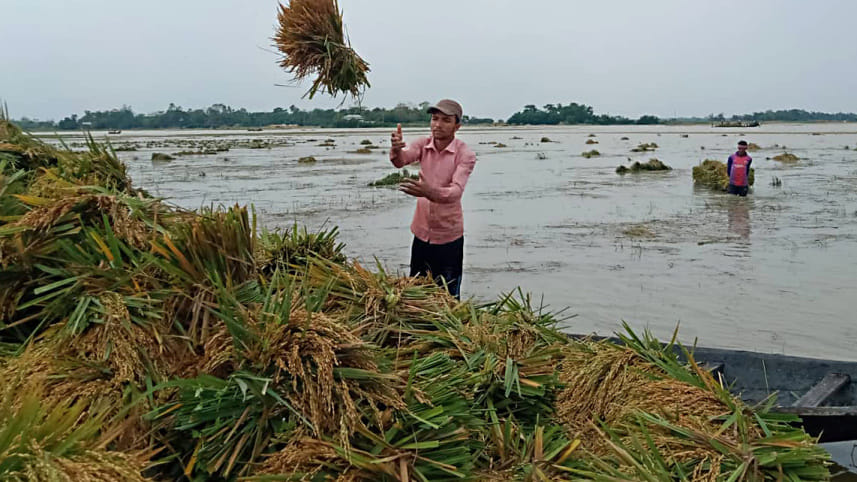
In the haor basin, floods have a way of sneaking up on you. They often come overnight with sudden currents that fully submerge ripening paddy, turning harvest into a race against rot. In late April and early May, continuous rain and hill runoff from Meghalaya pushed water into Netrokona’s beels and Sunamganj’s lowlands, drowning ripe and semi-ripe Boro and leaving harvested grains to be spoiled due to a lack of sunlight. What followed later was a brutal arithmetic: labourers refused to work in deep water, machines could not operate in waterlogged fields, and whatever could be salvaged had to be dried quickly or sold wet at a discounted price.
This is not merely a regional inconvenience; it has deep implications for the national economy.
 For all latest news, follow The Daily Star's Google News channel.
 Reuters reports Bangladesh may face a rice shortfall of over 200,000 metric tonnes after pre-monsoon rains and upstream inflows damaged the main crop in the northeastern haor wetlands, with more than 46,000 hectares of standing crop submerged. Boro harvested in April and May supplies roughly 55 percent of national rice output, and the haor belt is central to that supply. Farmers have already reported selling paddy at Tk 650-Tk 800 per maund (37.32kg) while production costs are far higher.
A 2022 study found that flood exposure reduces per-capita income and pushes households to adjust expenditures in ways that are developmentally corrosive, especially with cuts to education and health. The study explored why the haor shock travels far beyond the flooded field using the Household Income and Expenditure Survey (HIES) 2016-17 of Bangladesh Bureau of Statistics (BBS). There was a “spillover” effect too, according to the study, where households that did not self-report flood damage but lived in government-identified flooded upazilas experienced income losses comparable to, or larger than, self-reported flooded households.
We can see those spillovers in the haor right now. Flooded fields result in fewer workdays and uncertainty for those working the fields and the existing labour shortages and rising costs exacerbate the problem. According to a report in by this daily, even traditional emergency arrangements, like offering a share of the crop to anyone who harvests during disasters are failing as risk rises and lightning fear grows. Meanwhile, post-harvest bottlenecks continue to spread the shock: the directorate general of food has discussed using private rice mills and warehouses for drying so procurement and milling do not stall. These are the mechanics of spillover: disrupted value chains, delayed payments, and shrinking local commerce.
Spillover also moves through livestock, which is why “crop loss” is an incomplete metric. Rotten straw and fodder shortages can follow crop loss, forcing farmers to consider distress sales of cows after losing grain and straw. Farmers calculating debts, considering cattle sales, and fearing exclusion from aid lists—signs that the shock is turning into a balance-sheet crisis at household level. The HIES evidence shows why that matters: households cope through asset depletion and reduced human-capital spending, converting a climate event into long-term poverty.
Targeting relief is where spillovers are often missed. Prothom Alo estimated that nearly 53,000 hectares of boro across five districts were destroyed and about 230,000 farmers affected, while assistance depending on lists still being verified amid fear of genuine victims being left out. This is precisely the policy risk our research flags: when identification relies on incomplete reporting, we undercount indirect victims and misallocate support. In a haor economy where sharecropping and seasonal labour are common, the “affected” category must include people whose income falls because the market around them stalls, not only those whose plot was submerged.
Bangladesh has strengthened one crucial capability that can reduce such losses: anticipatory action. ReliefWeb reports that the Flood Forecasting and Warning Centre (FFWC) issued a seven-day outlook on 23 April indicating high flash-flood risk in the northeastern haor basin from 28 April onward, triggering preparedness measures. Reports also noted that multiple rivers were flowing above the danger level and warned that conditions could worsen and spread to new areas over the following days. Early warning is no longer the missing piece; turning warning into protection is.
So, what would an economy-minded flood response look like?
First, treating post-harvest rescue as a public good by expanding mobile dryers, raising community drying floors, and having emergency procurement that pays a fair, quality-adjusted price so farmers are not pushed into distress sales.
Second, designing relief around livelihoods, not only land ownership. It can include sharecroppers and wage labourers in cash support and the list can be verified through field checks to reduce exclusion.
Third, protecting human development during recovery. Floods displace health and education spending so temporary school fee waivers, health outreach, and targeted top-ups can prevent a short shock from becoming an intergenerational setback.
A fourth step could be shock-responsive finance. Reports capture a familiar chain of crop loss, debt calculation, and talk of selling cattle or mortgaging land. We should formalise relief beyond one-off grants through automatic rescheduling of agricultural loans in declared flash-flood windows, low-interest bridge credit, and pilots of area-based crop insurance that pay out when FFWC triggers are met. Early warnings should unlock early liquidity, not only early messages.
Finally, we must stop manufacturing waterlogging through poor infrastructure choices. In the 2022 study on economic impact of monsoon flood, it was noted that roads, railways and embankments can interrupt floodplain connectivity and turn a natural hydrology into human-induced harm; some other analysis echoes this through the lens of blocked drainage and inadequate culvert openings. “Living with water” in the haor requires restoring flow pathways, enforcing cross-drainage standards, and aligning development with wetland ecology rather than against it.
Bangladesh will always live with water. The question is whether we will keep paying the same hidden bill: lost incomes in flooded villages, lost workdays in nearby towns, and lost futures when families cut health and education to survive. The haor flood of 2026 is an economic lesson in spillovers: if we plan for the spillover, we protect more than a crop, we protect the country’s development trajectory.
Altaf Russell is a PhD researcher in economics at the University of Glasgow. He can be reached at altafstat71@gmail.com.
Views expressed in this article are the author's own.
Follow The Daily Star Opinion on Facebook for the latest opinions, commentaries, and analyses by experts and professionals. To contribute your article or letter to The Daily Star Opinion, see our guidelines for submission.
Comments