


Urgently address contraceptive crisis
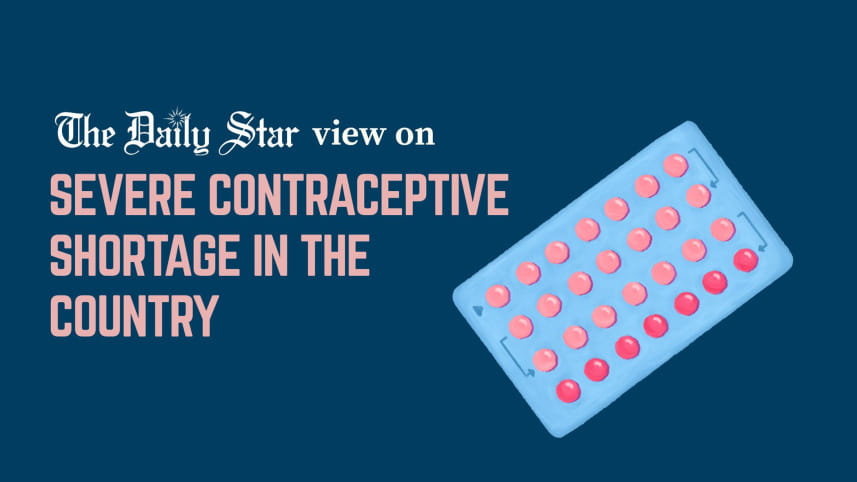
It is deeply concerning that more than one-third of upazilas in the country have run out of all types of government-supplied contraceptives. According to data from the Directorate General of Family Planning (DGFP), condoms are out of stock in 397 of 487 upazilas, while at least 220 upazilas have run out of oral pills. Meanwhile, implants in all upazilas, intrauterine devices (IUDs) in 353, and injectables in 169 are out of stock. At a time when the country is seeing a rise in the total fertility rate (TFR) for the first time in five decades, this crisis could have implications for fertility control.
Condom supplies reportedly fell to just 7.49 lakh in January this year, down from 53.31 lakh in January 2025—an 85 percent drop. Stocks of oral pills, injectables, IUDs, and implants have also plummeted compared to previous years. Family planning was reportedly deprioritised during and after the Covid pandemic, while contraceptive procurement stalled after 2023. The expiry of the 4th Health, Population and Nutrition Sector Programme (4th HPNSP) in mid-2024 further deepened the vacuum. The consequences are already visible in an increased TFR from 2.3 in 2019 to 2.4 in 2025, according to the Multiple Indicator Cluster Survey conducted by the Bangladesh Bureau of Statistics in collaboration with Unicef. The survey also found that access to modern contraception has declined significantly.
 For all latest news, follow The Daily Star's Google News channel.
 Although the DGFP has initiated emergency procurement of 1.2 crore condoms and 30 lakh oral pills, the quantities are not enough to meaningfully ease the crisis. Meanwhile, a Tk 1,664 crore procurement project, approved last November, is still at an early stage and will take months to complete. This means the crisis could deepen further, with the consequences borne disproportionately by poorer households who cannot afford to purchase contraceptives from private markets. A prolonged disruption will inevitably lead to more unplanned pregnancies, increased financial strain on families, and setbacks for women’s health and decision-making power. Experts warn that, over time, a sustained rise in fertility could undermine the country’s prospects of harnessing its demographic dividend.
Bangladesh once stood as a global example in family planning. The disruption in contraceptive supply chains and the absence of timely contingency planning indicate systemic weaknesses that must be addressed urgently. The new administration should treat this shortage as a public health emergency and fast-track procurement, ensure transparent and efficient tendering, and redistribute supplies from overstocked to critically understocked upazilas without delay. Above all, the government must reaffirm its commitment to family planning as a pillar of public health, gender equality, and sustainable development.
Comments