


Security lapses ahead of polls disturbing
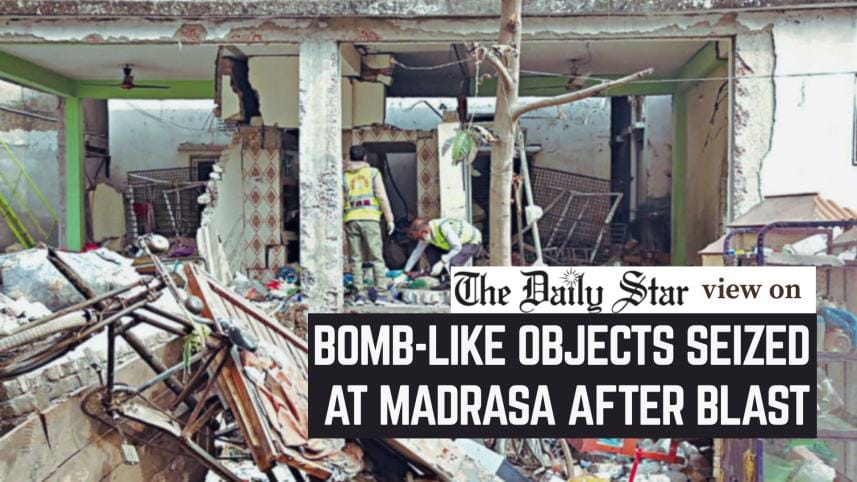
We're alarmed by the reported discovery of an explosives cache in a place of learning as well as the killing of a pedestrian in a flyover bomb blast. Both incidents, occurring within a span of 48 hours in Dhaka, have come as warnings that the stability of the pre-election period is far more fragile than the government would like to admit. In South Keraniganj, a madrasa erupted on Friday, injuring two children. When police sifted through the ruins, they unearthed something sinister: four bomb-like objects and 400 litres of chemicals, believed to be hydrogen peroxide, stored in drums.
 For all latest news, follow The Daily Star's Google News channel.
The key suspect, Al Amin Sheikh, is a man of varied identities: a madrasa director, an Uber driver and, according to police, a figure with a history of terror charges linked to the banned Jama'atul Mujahideen Bangladesh. That a known crime suspect, previously arrested in 2017 and 2020, could quietly stockpile industrial accelerants in a residential building raises uncomfortable questions about the government's surveillance of extremists. Police suspect the chemicals were intended for "sabotage" ahead of the upcoming elections. Just two days prior to this blast, Siam Majumder, a 21-year-old shop worker, was killed on the New Eskaton Road when a crude bomb was hurled from the Moghbazar-Mouchak flyover. As Siam's father asked, "Why do bombs fall on the heads of ordinary people?"
It is a question that resonates uneasily across the capital. The two incidents, though distinct, paint a gloomy picture of the country's security apparatus, just as the hazards are multiplying. On the ground in Keraniganj, a crime den operated under the nose of a landlord who believed she was renting her house to an orphanage. On the flyover, authorities have admitted, a large section of the lights had been turned off, and CCTV cameras were absent.
Meanwhile, police have later confirmed that six individuals have been arrested with ties to the madrasa blast in a widening dragnet. A formal case has now been registered against seven named people—with the absconding suspect, Al Amin Sheikh, at the top of the list—alongside a shadowy cohort of unidentified accomplices.

Whether the danger is stockpiled in the capital's periphery or dropped from a city flyover, such violence suggests that the road to the February elections will be perilous. The government must, therefore, pivot from reactive containment to proactive vigilance. The intelligence failure in Keraniganj about the existence of bombs indicates that the government's gaze is not firmly fixed on public safety threats. Law-enforcement agencies must urgently recalibrate their priorities, ensuring that surveillance tracks criminals on the loose. It is all the more urgent because, ultimately, a successful election rests on the peace of the streets.
Comments