


Healthcare workers’ strikes cannot continue
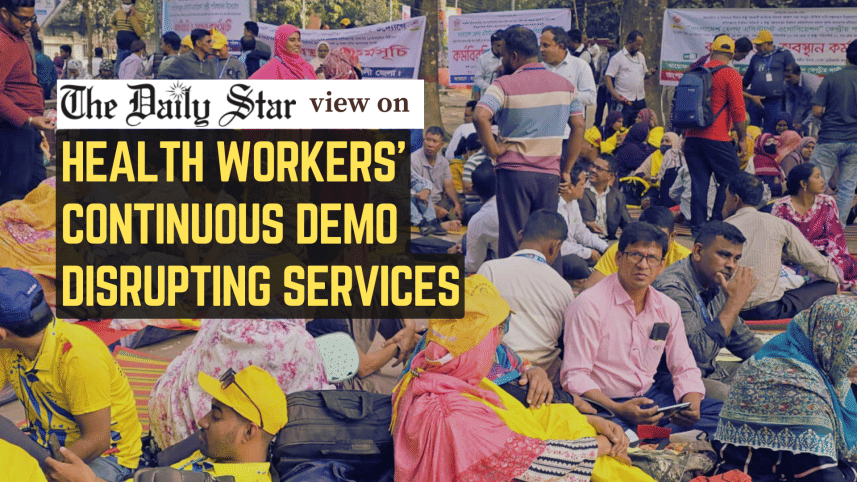
For two weeks, essential health services and routine vaccination programmes have been disrupted as several groups of health workers, including government nurses, medical technologists, pharmacists, and health assistants, continue demonstrations to press long-standing demands. The consequences of such disruptions will be delayed treatment for critical patients, cancellation of basic health services and suspension of newborn registrations and vaccinations, which are essential for preventing disease outbreaks. Such disruptions are unacceptable in any functioning health system.
So why has the health ministry failed to resolve this dispute? The Directorate General of Health Services (DGHS) claims that most of the workers' demands have been accepted in principle and that implementation is "in progress." Yet, the workers are not convinced and allege that earlier promises were never fulfilled. This loss of trust has become the core obstacle.
 For all latest news, follow The Daily Star's Google News channel.
The demands themselves highlight long-standing structural issues. Health assistants seek amendments to recruitment rules, an upgrade of their entry post from grade 16 to grade 14, elimination of salary disparities, and recognition as technical staff. Medical technologists and pharmacists want their entry grade raised from 11 to 10—reforms they say have been promised before but never delivered. Nurses are also demonstrating over career progression and pay inequities. These demands merit careful consideration. However, prolonged work stoppages in essential services directly endanger lives and violate service regulations designed to protect patients. The threat of a complete shutdown of hospitals, clinics, diagnostic centres, and educational institutions underscores how vulnerable the health system is to administrative delays and inadequate labour-management mechanisms. Healthcare cannot be held hostage to stalled negotiations. This crisis exposes a larger weakness in public administration: a reactive approach that waits for public pressure instead of addressing these issues early, transparently, and with fixed timelines. When negotiations extend indefinitely and commitments are vague, workers lose faith. When health workers walk out, patients suffer.
The government must therefore act swiftly and decisively. If the demands are financially and structurally logical, the relevant ministries should publish a clear implementation roadmap with dates, responsible officials, and measurable steps. If some reforms require budget adjustments or longer timelines, those realities must be communicated openly. Only visible progress can restore credibility. At the same time, health workers must uphold their duty to ensure continuity of essential services. Many countries allow health-sector strikes only under minimum-service requirements. Bangladesh needs similar safeguards to prevent complete shutdowns of critical care and vaccinations. This crisis can be resolved quickly if the government demonstrates clear action and workers respond in good faith. Ultimately, a functional health system relies on trust between authorities, providers, and the public. Rebuilding that trust must begin now.
Comments