


Expedite the CMCH burn unit project
In a country where over 12 lakh people sustain burn injuries annually, a single, fully equipped burn institute in the capital is clearly not enough. People with burn injuries from outside Dhaka are especially disadvantaged in this regard, as they must travel for hours on unpredictable roads, battling traffic to reach the 500-bed National Institute of Burn and Plastic Surgery (NIBPS). The journey often costs lives, as seen in the case of a family from the Halishahar area in Chattogram.
Nine members of the family suffered 25 to 100 percent burn injuries in the early hours of February 23, when a gas leak inside their flat in the port city caused an explosion. The victims were rushed to Chattogram Medical College Hospital (CMCH) but then had to be transferred to Dhaka, 250 kilometres away, because the burn unit there lacked a specialised intensive care unit (ICU) and high-dependency unit (HDU) for severely burned patients. Even that transfer was not easy, as moving critically burned patients requires ICU ambulances, which are limited in both availability and affordability.
 For all latest news, follow The Daily Star's Google News channel.
 While ICU ambulances at public hospitals often suffer from manpower shortages, hiring a private ICU ambulance for a trip from Chattogram to Dhaka costs between Tk 25,000 and Tk 30,000. In some areas, a patient’s fate is further complicated by the presence of ambulance syndicates. Although friends and relatives of the Halishahar family managed to hire an ICU ambulance within a few hours, two of the severely burned patients died before reaching the gates of NIBPS.
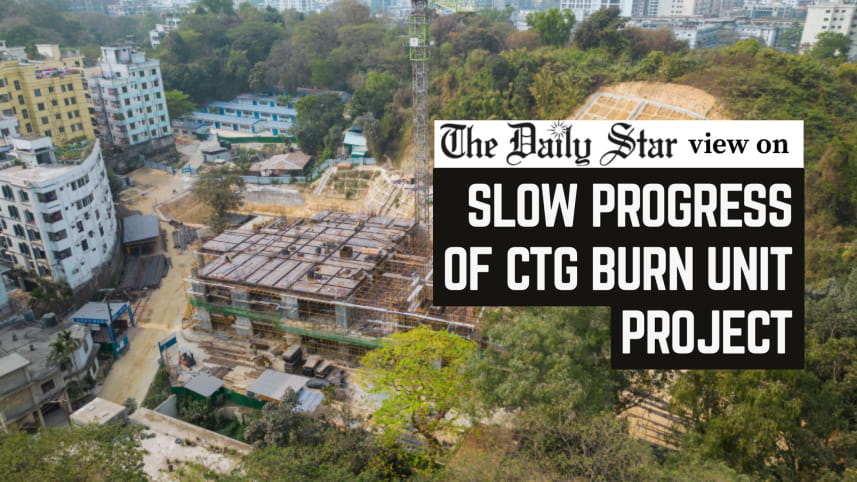
This tragedy raises the question of why, nearly a decade after its establishment in 2016, NIBPS remains the only fully equipped burn treatment facility in the country. Work is reportedly underway to build a 150-bed burn unit with modern equipment in Chattogram, funded by the Chinese government. However, as with many infrastructure projects in Bangladesh, completion is certain to be delayed. The agreement for the Tk 285 crore project was signed in 2023, with completion initially set for June 2026. The fall of the Awami League government in August 2024 delayed the process, and physical construction did not begin before June 2025.
The new government must expedite this crucial project, which will serve four crore people in the Chattogram region. At the same time, initiatives to establish additional burn institutes or fully equipped burn units in public hospitals nationwide should proceed. The shortage of specialised healthcare professionals in this field must also be addressed. Finally, measures are needed to make ICU ambulances more accessible and reliable. Such action is urgent, particularly as the risk of fire incidents rises alongside increased seismic activity in the country.
Comments