


Delhi, Dhaka must dial down the heat
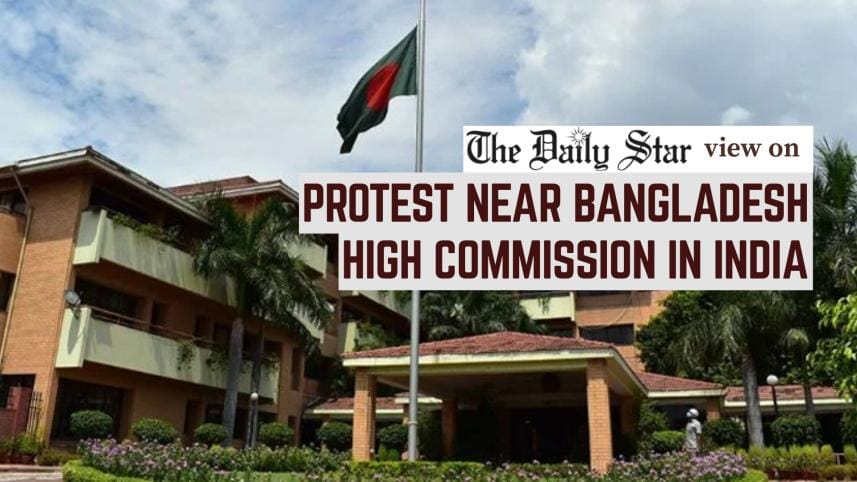
We share our foreign ministry's concern over the recent breach of the diplomatic zone housing the Bangladesh High Commission in New Delhi. To our surprise, India's external affairs ministry characterised the incident as a trifling affair involving 20 to 25 people protesting the killing of a worker in Mymensingh. To the diplomats inside the Bangladesh mission, who witnessed the slogans and the thinness of the security cordon, the incident appeared not as a minor nuisance but as a considerable lapse in protection.
Foreign Adviser Touhid Hossain has rightly asked how a band of activists from a Hindu extremist organisation managed to penetrate deep into one of New Delhi's most fortified areas without permission, particularly when the building is not located on the outskirts? The protesters issued death threats to the high commissioner who resides there with his family. This incident has added a fresh layer of tension to the already fraught relationship between the two nations.
 For all latest news, follow The Daily Star's Google News channel.
It bears repeating that for many years, the bond between India and Bangladesh was cemented by New Delhi's unwavering backing of Awami League. With the party now overthrown and its leader issuing incendiary comments from exile in India, that foundation has taken a serious hit, giving way to a void filled with mutual suspicion. Dhaka views New Delhi as a sanctuary for fugitives conspiring against Bangladesh. The interim government recently pointed to the killing of Sharif Osman Hadi, a leader of the 2024 uprising, by a suspect who reportedly slipped across the border. New Delhi, meanwhile, sees a neighbour sliding into majoritarian chaos. It views the interim government's handling of minority safety with scepticism, dismissing Dhaka's assurances as inadequate.
Last week, this diplomatic estrangement played out through reciprocal summonses. On December 14, the foreign ministry in Dhaka called in the Indian high commissioner to issue a rebuke regarding "anti-Bangladesh activities" allegedly orchestrated by fugitive Awami League figures on Indian soil. Having summarily rejected Dhaka's assertion, India's external affairs ministry waited just three days before summoning the Bangladeshi high commissioner in New Delhi. There, Indian officials registered their own concerns over a "deteriorating security environment" across the border.
Although a report presented by India's parliamentary standing committee on external affairs on December 18 identified the political shift in Bangladesh as New Delhi's "greatest strategic challenge" since 1971—calling for an immediate "recalibration" of ties—the Indian government appears to be heading in the opposite direction.
The economic fallout of this crisis is already tangible. India has drastically restricted shipments through land ports and curbed general visa issuance since August 2024; for its part, Bangladesh has imposed curbs on Indian yarn imports. Such decoupling is painful for businesses and individuals on both sides. Geography dictates that the two countries cooperate on everything from commerce to security. Yet the rhetoric is hardening, and the danger is that it is crowding out pragmatic diplomacy. Bangladesh's demand for an explanation regarding the security breach in Delhi is legitimate, so too are India's concerns about the safety of its missions in Bangladesh.
To prevent this downward spiral, New Delhi must look beyond the prism of its deposed allies. Normalisation requires acknowledging that the political landscape in Dhaka has fundamentally shifted. India needs to do far more than issue statements on minority safety—it must engage constructively with the new power centres.
Comments