


A civilised society cannot allow this
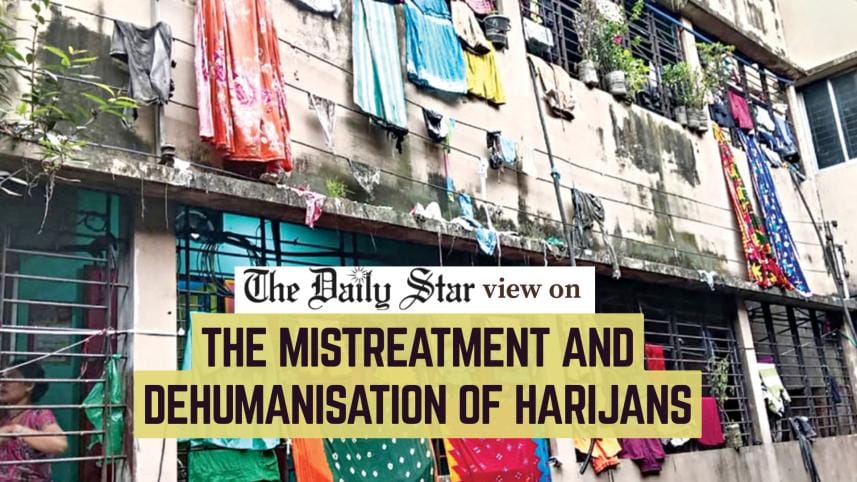
There is, perhaps, no starker example of discrimination in Bangladesh than the treatment of its Harijan community. Two hundred years after the British brought them to this land to work as sweepers, we shockingly continue to treat them no better. According to a report in this daily, around 200 Harijans live in damp 10-by-12-foot rooms at the Harijan Colony in Kulaura Upazila, Moulvibazar with their families of five to six people. And although that alone paints an unliveable picture, it barely scratches the surface.
Across the country, Harijan people, who spend hours cleaning our cities and municipalities, have been reduced to living lives that would be intolerable in any civilised society. Take, for instance, Rekha Basfor of Sreemangal in Moulvibazar. She leaves for work in the morning after drinking only a glass of water. She cannot afford even the simplest breakfast, as a bun and half a cup of tea cost about Tk 15, while her daily wage is only Tk 33. For her family, she often cooks nothing more than rice and, occasionally, mashed potatoes. Fish and meat are never part of their meals except on rare special occasions, when she manages to gather a little extra money. Reportedly, this "extra income" often refers to earnings from drug peddling, as many are being forced into the trade simply to cope with rising living costs.
 For all latest news, follow The Daily Star's Google News channel.
According to the Bangladesh Harijan Oikkya Parishad, the lowest monthly municipal salaries are alarmingly inadequate: Shariatpur pays Tk 3,000; Madaripur Tk 2,000; Kumarkhali Tk 1,800; Rajbari Tk 2,300; Akhaura Tk 1,500; Kushtia Tk 2,700; Natore Tk 2,100; Bogura Tk 3,300; and Santahar Tk 1,200; Sylhet City Corporation Tk 3,200 (up from Tk 2,200 last July), Sreemangal Tk 1,000 (previously Tk 550), while Kulaura provides the highest rate at Tk 3,800. Despite the variations, what remains glaringly obvious is that none of these amounts constitutes a living wage.
On top of this, the discrimination Harijan children face at school, where other students refuse to sit beside them, and in hospitals, where doctors decline to examine them properly, considering them somehow "contaminated," should shame not the Harijan community but us, as a society. This prejudice is also evident in how we expect them to do their work. According to the book Study on the Wages of Urban Cleaners, published by Nagorik Uddog in January this year, 75 percent of workers do not receive protective equipment, and only eight percent have access to healthcare.
There are even more damning data illustrating how thoroughly we have failed the Harijan community. It is high time that the government—and society at large—focused on transforming the conditions in which the Harijan community is forced to live a life of continuous deprivation and struggle.
Comments