


Remembering Khaleda Zia, her legal ordeal, and the courts that failed her

The immense gathering on the final day of 2025 for the janaza prayers of Begum Khaleda Zia marked a historic moment as millions came to pay their last respects to her. Overflowing the Jatiya Sangsad Bhaban grounds, mourners filled surrounding neighbourhoods, streets, rooftops, and even the subway. It was a spontaneous, unchoreographed expression of love and grief for a leader who had sacrificed her life for democracy. Standing in the lush green fields adjacent to the South Plaza, I found myself reflecting on Khaleda Zia’s life of public service, firm resolve, and quiet sacrifice, and on the dignity with which she had endured years of struggle against autocracy.
As a practising member of the bar association, I witnessed—and participated in—numerous politically charged legal proceedings during the 15 years of Awami League’s authoritarian rule. I was familiar with Khaleda Zia’s cases and had the opportunity to discuss them with the late former attorney general, A. J. Mohammad Ali, who had represented her in all major legal proceedings. A neighbour of ours, Mr Ali often shared details of these cases, particularly his harrowing experiences during the Bakshibazar trials. It was clear that the system was rigged against her. Once the executive decided to prosecute, her fate was sealed. Yet Mr Ali remained resolute, once telling me, “We will keep going to court. We will keep knocking on their doors. They may turn us away, but we will come back again.”
 For all latest news, follow The Daily Star's Google News channel.
 The Zia Orphanage Trust case was perhaps the most high-profile case against Khaleda Zia, yet a review of the facts reveals its tenuous foundation. She was accused of misappropriating funds from the “Prime Minister’s Orphanage Fund” during her tenure from 1991 to 1996. The defence argued that the fund had never been entrusted to her and that, absent such entrustment, no charge of criminal misappropriation could stand. Evidence showed that the funds were donated by the Emir of Kuwait directly to the trust—facts fatal to the prosecution. Despite this, she was convicted and sentenced to seven years’ imprisonment. On appeal, the High Court Division, in an unprecedented move, enhanced the sentence to 10 years. The judges involved were later rewarded: the trial judge was elevated to the High Court Division and the presiding appellate judge to the Appellate Division.
The Zia Charitable Trust case followed a similar pattern. It concerned a private trust—the Shaheed Ziaur Rahman Charitable Trust—with Khaleda Zia as the managing trustee and her two sons as trustees. Khaleda Zia was charged under section 5(2) of the Prevention of Corruption Act as a “public servant,” despite the trust being a private trust within the meaning of the Trust Act. Ordinarily, such proceedings would have been quashed as an abuse of process, as the admitted facts disclosed no offence against her. Yet Khaleda Zia was tried, convicted, and sentenced to seven years’ imprisonment by a special court.
The Niko graft case further illustrated how the legal system was weaponised against her. In 1998, after failing to secure a tender, the Canadian company Niko Resources submitted a proposal to then Prime Minister Sheikh Hasina to extract gas from Bangladesh. In 2001, the Hasina government directed that a joint venture agreement with Niko be finalised and placed before the government. After the change of power, and in continuation of these decisions, Bapex and Niko signed an agreement on October 16, 2003, permitting Niko to extract gas from Bangladesh’s gas fields.
During the Fakhruddin Ahmed-led 1/11 government, the Anti-Corruption Commission, pursuing the so-called “minus-two formula,” initiated separate proceedings against Sheikh Hasina and Khaleda Zia over the Niko deal. In 2010, the High Court quashed the corruption proceedings against Sheikh Hasina. Yet in 2015, in broadly similar proceedings against Khaleda Zia, the High Court held that there was no legal bar to prosecuting her. A few years later, the presiding judge of the relevant High Court bench was elevated to the Appellate Division, superseding several senior judges.
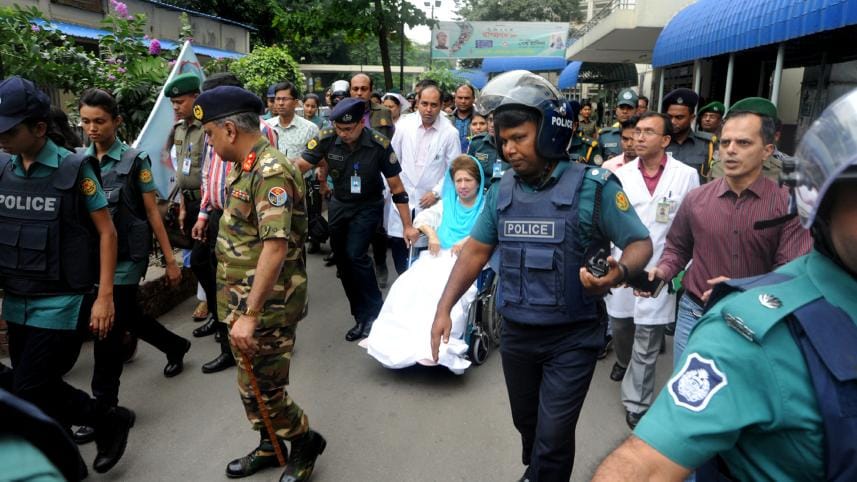
As these proceedings dragged on, Khaleda Zia was repeatedly denied bail. In the Zia Orphanage Trust case, a medical board report was placed before the apex court stating that “her rheumatoid arthritis (RA) is highly active, with advanced deformities and marked functional decline.” Despite the seriousness of her condition, the Appellate Division denied her bail, observing instead that “she should cooperate with the (Bangabandhu Sheikh Mujib Medical) University authorities for appropriate treatment.” The court did not even address the proviso to section 497(1) of the Code of Criminal Procedure, which allows preferential bail treatment for women and infirm persons accused of non-bailable offences.
It ultimately took a revolution, the loss of over a thousand lives, and the reconstitution of the Supreme Court to correct these injustices. In November 2024, the High Court Division set aside Khaleda Zia’s conviction in the Zia Charitable Trust case. Shortly thereafter, in January 2025, the Appellate Division allowed her appeal in the Zia Orphanage Trust case, holding the proceedings to be a “manifestly contrived misapplication of the law” amounting to “malicious prosecution.”
By the time Khaleda Zia was released, the damage to her health was irreversible. Years of incarceration, isolation, and denial of proper medical care had taken a devastating toll. The judiciary, constitutionally bound to protect fundamental rights, had instead acted at the behest of the executive, aided by a complicit Attorney General’s Office and Anti-Corruption Commission. Judges lacking moral courage and prosecutors driven by political loyalty ensured that she remained imprisoned and unable to seek treatment abroad for what was once a manageable condition.
There is no doubt that the legal system had failed Khaleda Zia. It is difficult to comprehend how a former prime minister—elderly and gravely ill—was denied bail while her appeal remained pending before the Supreme Court. Those who relentlessly pursued her conviction displayed a lack of professional judgement and a readiness to serve partisan interests. The apex court’s handling of her case, clearly shaped by the then prime minister’s determination to politically eliminate Begum Zia, marks one of its darkest chapters. Its inability to deliver justice in a fair, impartial, and dispassionate manner is a sobering reminder of how far Bangladesh still has to go to achieve true judicial independence.
Imran A Siddiq, Barrister-at-Law, is a senior advocate. He served as a member of the Constitution Reform Commission (2024-2025) and a member of the expert legal panel of the National Consensus Commission (2025).
Views expressed in this article are the author's own.
Follow The Daily Star Opinion on Facebook for the latest opinions, commentaries, and analyses by experts and professionals. To contribute your article or letter to The Daily Star Opinion, see our guidelines for submission.
Comments