


New school year begins with a lesson in disorder
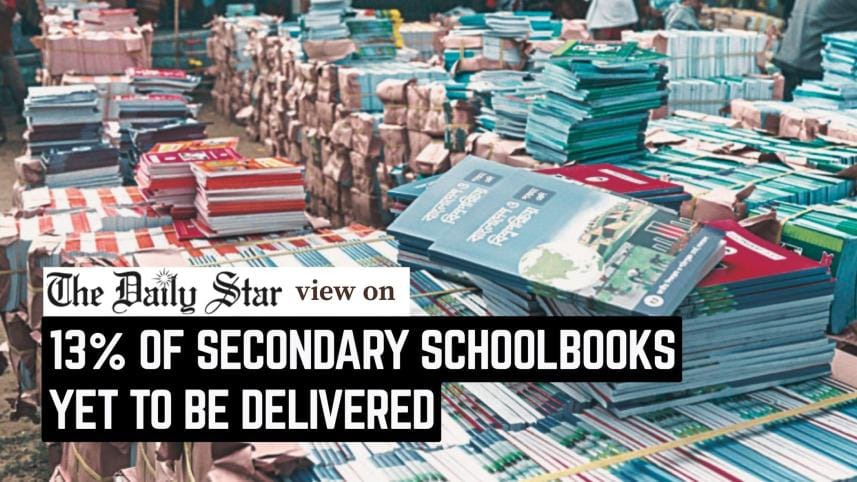
January is a stressful month for students and parents. It is the time when the promise of a fresh academic year often collides with a shortage of books and extortionate admission fees. As of January 11 this year, some three crore secondary textbooks—roughly 10 percent of the total required—had yet to reach the classrooms. The shortage is most acute in classes 7 and 8, where a new curriculum has rendered older, second-hand books obsolete, according to a Prothom Alo report. The National Curriculum and Textbook Board (NCTB) officials claim deliveries will be complete “within a few days,” a phrase that can mean anything from a week to several weeks. Printing is reportedly close to finishing, and the binding and inspection remain undone. For NCTB, however, the inability to move books from press to pupil has been a persistent failure.
If the book shortage is a failure of supply, the inflated fee is a failure of oversight. Technically, the government caps admission fees for state-subsidised schools. According to the admission policy for the current academic year, the maximum admission fee for MPO-listed educational institutions in the Dhaka metropolitan area is Tk 5,000. For partially MPO-listed institutions, the limit is Tk 8,000, while for the English version, it is Tk 10,000. In practice, these rules are often treated as mere suggestions. A report by Samakal describes the fee frenzy as “extreme anarchy.” Institutions appear to be tacking on “development charges,” “session fees,” and other vaguely defined fees to extract sums far beyond the legal limits. Parents at a Dhaka-based school complained that they faced bills of Tk 40,000 for nursery admission—eight times the regulated cap. At another school with 28,000 students, total admission fees are estimated to have amounted to crores of taka.
 For all latest news, follow The Daily Star's Google News channel.
 The authorities appear to be acting as silent spectators. When confronted with evidence of extra fees at a government primary school in Mohammadpur, the local education officer offered the passive defence of waiting for a “written complaint” before acting. This regulatory inertia leaves the middle class squeezed. Parents are desperate to secure spots in perceived “good” schools to guarantee their children’s future, giving these institutions monopolistic pricing power they are all too happy to exploit.
It’s an irony that the government promises free textbooks to democratise education but fails to deliver them in time. Simultaneously, it mandates affordable tuition, yet refuses to police the price. Students and parents are thus left in a costly limbo. To restore credibility, the government must first meet its own Janu-ary 15 deadline for book distribution. Beyond that, it must confront the fee anarchy. If top schools insist on charging premium rates, they must be forced to justify them through transparent, standardised financial reporting. Breaking the pricing power of these institutions requires the government to firmly enforce its own rules, ensuring that the academic year does not begin with a lesson in disorder.
Comments