


Gas crisis fuels sufferings, extra costs

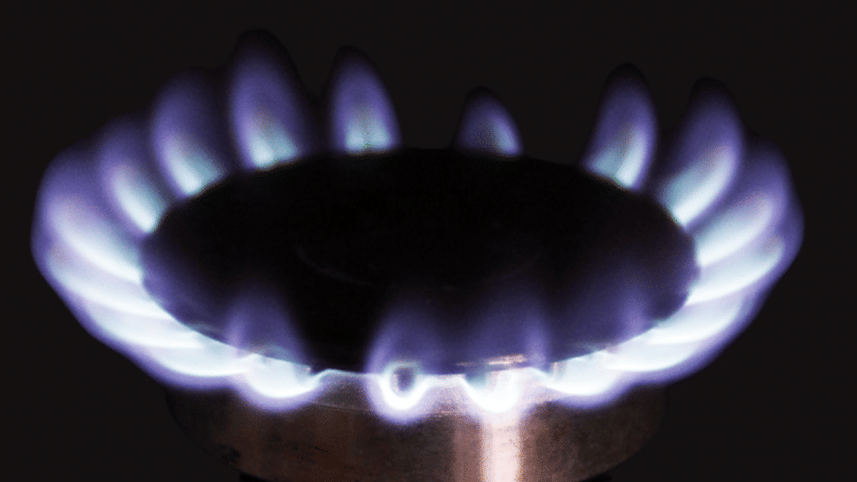
Dhaka residents are struggling to cook daily meals amid a worsening gas crisis affecting both pipeline supplies and bottled liquefied petroleum gas (LPG).
Thousands of households in areas including Dhanmondi, Mohammadpur, Shyamoli, New Market, Hazaribagh, Gabtoli, Khilgaon and adjacent localities have experienced little to no piped gas for days, forcing many to rely on electric stoves, high-cost LPG cylinders or outside food.
 For all latest news, follow The Daily Star's Google News channel.
 Most pipeline users report receiving gas for only a couple of hours a day, often late at night or early in the morning. For the rest of the time, kitchens remain cold.
Take the case of Mir Hojaifa Al Mamduh, a resident of Mohammadpur, who said his household had no gas supply at all since Tuesday.
Although a technician worked on the pipeline on Saturday night, he said only a brief flame appeared the next morning before the supply dropped again, making cooking impossible. The family managed to cook just one meal using a rice cooker.
With LPG cylinders both scarce and costly, Hojaifa said he was forced to buy breakfast and dinner from outside almost every day.
The past few days have been mentally distressing. My salary is limited and most of it goes toward rent and daily expenses. The additional cost of buying an electric stove would be a heavy burden.
The long queues at eateries made the situation even more difficult, as he struggled to find time to wait in line between office hours and returning home exhausted at night.“I have lived in Kathalbagan since 2018, and this is the first time I am facing such a severe problem. I had to throw away half-cooked rice,” said Tamim Hasan, who gets a scanty gas supply for a couple of hours early in the morning.
West Dhanmondi resident Fahim Reza Shovon said his household’s two-burner pipeline gas stove has remained cold since the night of January 7.
Gas returned briefly at low pressure around 10:00pm on January 8. Some supply resumed the following morning but pressure remained weak before stopping again from Saturday morning.
As the outages persisted, his wife began urging him to buy an electric stove.
“The past few days have been mentally distressing. My salary is limited and most of it goes toward rent and daily expenses. The additional cost of buying an electric stove would be a heavy burden,” Shovon added.
Khilgaon resident Sadekun Nahar Dilruba said her household depends on LPG cylinders, which are close to running out.
At present, a 12-kg cylinder is selling for Tk 2,400–2,500, nearly double the regulated price of Tk 1,350.
Dilruba also described the situation at her mother-in-law’s residence, where the piped gas supply was completely cut yesterday. Pipeline gas usually flows only after midnight and disappears before 7:00am, but even that limited supply has not been available in recent days.
They are now cooking entirely on electric stoves, she said, adding that breakfast is often brought in from outside, while evening cooking -- previously dependent on trickling gas -- has not been possible for days.
“Even during the usual late-night window, there has been no gas at all. The stove is completely shut,” she added.
Mogbazar resident Rafsan Jani has been unable to refill his 45-kg LPG cylinder for three days now and is barely getting by with the little gas left.
The gas distributor, Titas Gas Transmission and Distribution PLC, has attributed the ongoing severe shortage to damage to a major pipeline beneath the Turag River and a burst valve in the Sher-e-Bangla Nagar area, incidents that further reduced pressure in an already strained distribution network and disrupted supply across large parts of the capital.
Data from Petrobangla show that the capital’s average daily gas supply has declined compared with previous years. Between January 1 and 10, the average supply fell from 2,826 million cubic feet per day (mmcfd) in 2022 to 2,596 mmcfd in 2026.
Although the import of liquified natural gas -- which needs to be blended with the local gas production -- have increased over the years, a drop in local production has kept overall supply constrained, limiting pipeline distribution to households.
However, Fouzul Kabir Khan, adviser to the power, energy and mineral resources ministry, did not agree with the statistics. The pipeline gas supply has increased during his tenure, he said.
In 2025, the government imported a total of 109 cargoes of LNG, up from 94 in 2024.
As a result, despite a shortfall in domestic production, gas supply has not decreased, he said.
The adviser blamed the pipeline problem and valve disruptions for the ongoing crisis.About the volatile LPG situation, he said the government is exploring imports on a government-to-government basis, as nearly 98 percent of the fuel is currently imported by the private sector.
“The government has taken various measures, including approval of larger capacities sought by some private sector firms, and the situation will ease,” he added.
Comments