


A festival of greens: Thakurgaon celebrates Shak Pitari Festival

The Shak Pitari Festival, a community-led rural gathering featuring communal dining, art, songs and film screenings, was held yesterday at Sonapatila village in Thakurgaon Sadar upazila, aiming to transmit elderly women’s knowledge of wild leafy greens to the young generation.
The day-long celebration, centred on showcasing dishes prepared from foraged wild greens and related artworks, brought together elderly women and children.
 For all latest news, follow The Daily Star's Google News channel.
 The event was initiated by Gidree Bawlee Foundation of Arts in association with the British Council, aiming to preserve fragile inter-generational knowledge of edible plants -- a traditional food culture now under threat from environmental stress and increasingly industrialised agriculture.
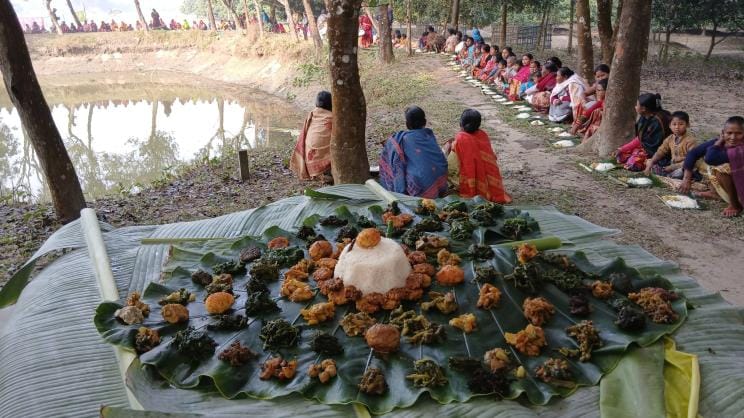
At the communal feast, women of all ages from nearly every household at the village contributed dishes prepared with foraged wild greens and ingredients that grow naturally in homesteads and surrounding areas.
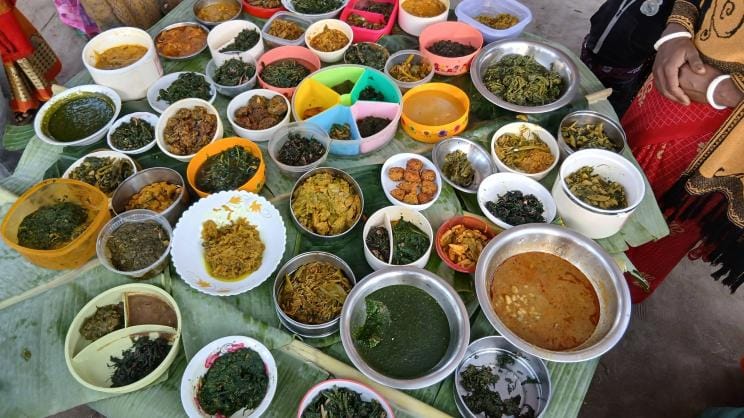
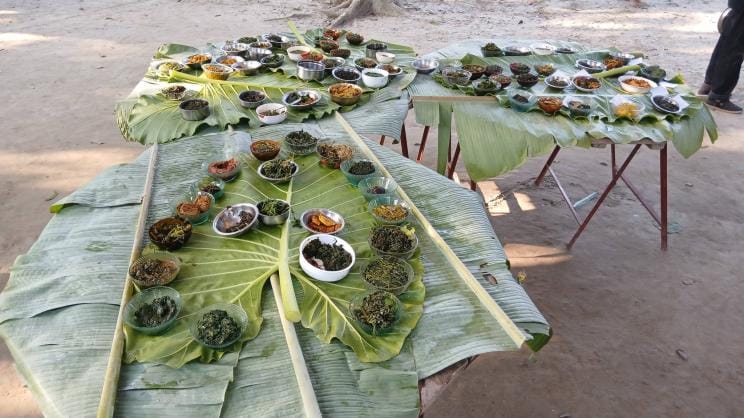
After bringing the dishes to the venue, participants displayed them and explained to visitors the cooking methods as well as the nutritional and health benefits of the ingredients.
During a visit to the event yesterday afternoon, it was seen that rural women arrived carrying small dishes of cooked shak (wild leafy greens), displaying more than 40 different items.
Paintings by rural children, inspired by the wild leaves used in the dishes, were also exhibited. The artworks highlighted the wide variety of wild greens and illustrated their nutritional and health benefits.
Parboti Rani of Sonapatila village attended the event with six different dishes and said that Bengalis once widely preferred consuming wild leafy greens. Before the celebration of Kali Puja, members of the Hindu community in rural areas traditionally consumed as many as 14 varieties of foraged greens, she added.
However, the practice has gradually declined, particularly in urban culture.
According to Ayurveda, the practice of consuming these leafy greens dates back generations. The greens are traditionally eaten after the monsoon -- a period when seasonal transitions often lead to various illnesses -- and are believed to help prevent and cure such ailments.
Joba Rani, 28, of the same village took part in the event with six dishes prepared from leafy greens, including Ghima Tita, Bathua, Dhekia, Dulfi, Hengsha and Kolmi. She said she collected the leaves from around her house and nearby barren lands.
She said she has attended the event every year since the festival began in 2022.
Nosiman Begum, 50, and Rejina, 45, of the village also attended the event with several dishes, saying it gave them a chance to meet others and sample each other’s cooking.
Pointing to the prints displayed at the event, Joyoti Rani, a Class VII student, said rural children from the area created the artworks based on leafy greens grown in homesteads, surrounding areas and croplands, highlighting their names as well as their nutritional and health benefits.
Chowdhury Fardin, a student from Sarkarpara in Thakurgaon municipality, who visited the event, said, “It is hard to imagine an event centred solely on leafy greens. I counted the dishes, and there were 80 different preparations of cooked greens, most of which I did not recognise. This was the first time I tried several greens, including Ghechu, Shushni, and Shulkas.”
Apart from displaying the dishes and artworks, several groups of rural women performed “Choral Geet” (spontaneous songs based on the event), narrating the benefits of consuming traditional food.
Later, the women and children sat together around a pond and enjoyed the food.
In the concluding session, a film showcasing activities such as picking edible plants, cooking, printing on handmade paper, and musical performances was screened at the event.
Speaking about the event, Salma Jamal Mousum, research and planning director of Gidree Bawlee Foundation of Arts, said the festival started on a small scale four years ago.
“We pay little attention to the leafy greens that grow naturally around our homes. Today, the use of herbicides is destroying these valuable plants.
“To raise awareness about preserving them and to safeguard rural traditions, we initiated this event, where women from each household at the village collect wild greens from around their homes, cook them, and bring the dishes to the festival.
“The current generation does not know the names or benefits of many of these greens. Through various activities at the festival, that knowledge is being passed on and promoted,” she added.
Comments