


‘Solar-man’ Soleman stirs up a green revolution

In Molani village under Thakurgaon Sadar upazila, a self-taught innovator is harnessing solar power to help Boro paddy farmers with a low-cost solution to irrigate their cropland.
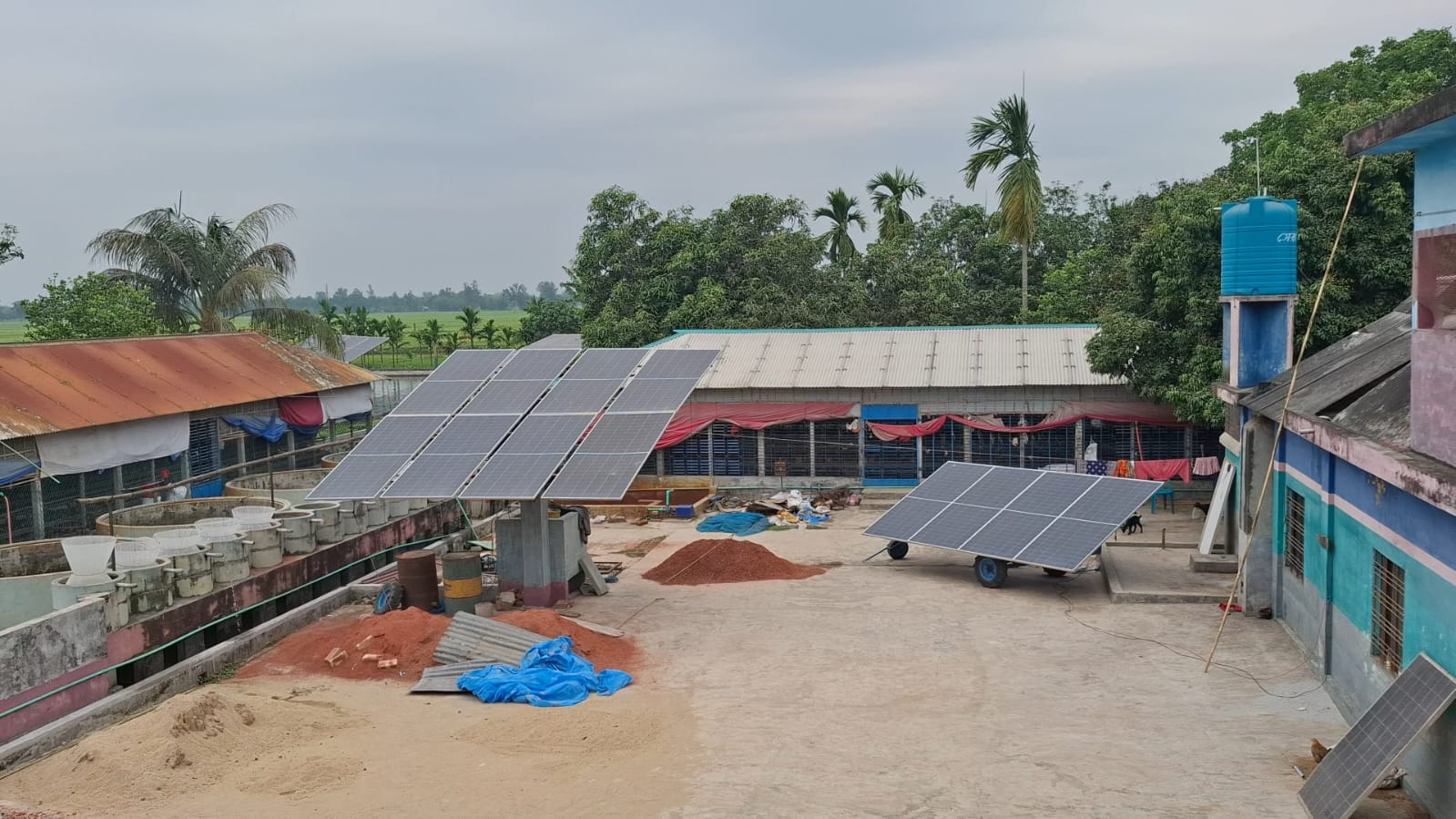
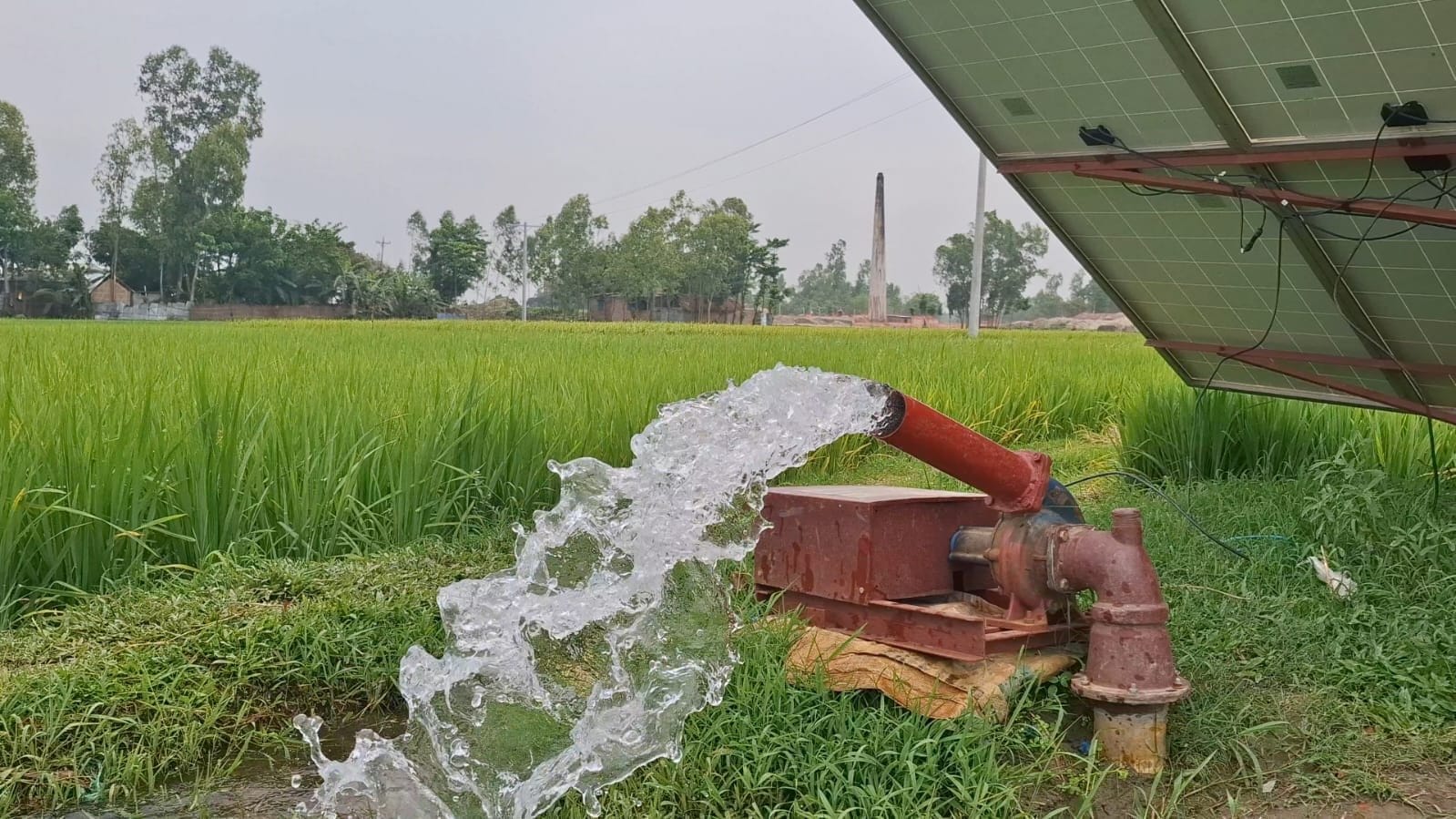
Relying on his own technical expertise, curiosity, and persistence, Soleman Ali, a villager, developed a solar-powered mobile irrigation device that can be easily transported from one field to another and lift water from deep underground for irrigation.
 For all latest news, follow The Daily Star's Google News channel.
 The device offers a practical, affordable, and portable alternative to commonly used irrigation pumps amid rising fuel prices and frequent power outages.
While local farmers are already benefiting from using the device, those from other areas have also started purchasing it, while others are expressing interest in adopting the innovation.
Soleman could not study beyond first grade due to financial hardship. At a young age, he took up work as a bicycle mechanic to support his family.
Gradually, he became involved in assembling instant power supply (IPS) systems, which sparked his interest in using solar energy in electrically powered devices.
Without any institutional or industrial support, Soleman began working on a solar-powered irrigation system in 2013. He initially experimented by collecting solar panels and other components from the market. Through continuous trial and error, he eventually developed a prototype of the device.
He later upgraded the system by adding a gearbox to the pump to regulate water flow and also introduced a mechanism that allows the solar panels to be adjusted according to the sun’s position.
To enhance its usability, he mounted the entire structure on wheels, making the system fully mobile.
During a recent visit, Soleman demonstrated how the device operates on solar energy.
The device ranges from 1,220 to 4,400 watts and is priced between Tk 60,000 and Tk 2,10,000. The widely used variant is a 2,440-watt model with a three-horsepower pump powered by four 610-watt panels that can lift about 700 litres of water per minute — enough to irrigate 8-10 acres of Boro fields in a season — and costs around Tk 1.5 lakh.
Soleman also earns roughly Tk 36,000 annually by renting out each unit. Compared to conventional irrigation costs of Tk 7,000-8,000 per bigha, his system reduces the cost to around Tk 2,500-3,000.
Soleman has built and sold over 100 devices so far, including 25 this year.
He now struggles to meet growing demand, operating six units himself while 20 more are being used on a rental basis.
Farmers said they have benefited from using Soleman’s solar irrigation units.
Md Babar Ali, 53, of Thakurgaon’s Baliadangi, has been using a 2,440-watt unit for nearly four years, irrigating about four bighas of Boro field every season and supplying water year-round to his fish hatchery without additional costs after an initial investment of around Tk 2 lakh.
In Haripur, Md Shaheen, 30, purchased two units last year and is now irrigating around 65 bighas of land at a much lower cost than conventional methods.
The affordable technology has also drawn interest from farmers beyond Thakurgaon, including in Panchagarh, Sunamganj’s Chhatak, Natore, and Rangpur’s Gangachara.
Soleman’s use of solar energy, however, extends far beyond irrigation — from welding machines to livestock and poultry farm equipment, as well as electrical appliances including fans, lights, refrigerators, and air conditioners. In fact, his home runs extensively on solar power.
His innovation and widespread adoption of solar power have drawn significant local attention, earning him the nickname “Solar-man Soleman”.
He has also secured financial stability for his family. His four sons are now self-reliant in businesses, and his two daughters have been married off.
Soleman said a non-government organisation, Eco-Social Development Organisation (ESDO), has distributed his solar-powered irrigation pumps among 18 beneficiaries under its agriculture-related projects, with 16 more units in the pipeline for delivery.
He urged the government to step forward in promoting his low-cost solar irrigation system to improve irrigation facilities for small and marginal farmers.
Dr Muhammad Shahid-Uz-Zaman, executive director of ESDO, said Soleman’s irrigation device enabled beneficiaries to irrigate their croplands at significantly lower cost.
Mazedul Islam, deputy director of the Department of Agricultural Extension, said scaling up the technology could reduce pressure on fuel and electricity while ensuring affordable and accessible irrigation for farmers.
Comments