


Quinoa brings promise to Thakurgaon but leaves farmers in limbo


Ruhul Amin invested about Tk 40,000 to cultivate quinoa on one bigha of land leased at Charol village in Thakurgaon's Baliadangi upazila. At harvest, he produced eight maunds.
But when it came time to sell, there were no buyers he could turn to.

With no alternative market and little information on where else to go, he was forced to sell his produce at Tk 5,000 per maund to a local trader. “I had no other buyers,” he said.
His experience reflects a broader uncertainty surrounding the first-ever cultivation of quinoa in Baliadangi.
Quinoa, a grain native to South America, is widely regarded as a “superfood” due to its high nutritional value. It is rich in plant-based protein containing all nine essential amino acids, along with iron, magnesium, vitamin E, potassium and dietary fibre. The crop is typically sown in mid-November and harvested by mid-March.
Its growing global demand has recently drawn interest from Bangladeshi farmers as a potential alternative crop. However, farmers say the market has not developed as expected.
In Patilavasa and nearby areas, a small group of farmers cultivated quinoa on an experimental basis this season after being encouraged by seed supplier Saiful Islam of Bogura and local trader Dabirul Islam.
At the initial stage, farmers said they were told the crop could fetch between Tk 1,000 and Tk 1,500 per kilogram in international markets, meaning Tk 40,000 to Tk 60,000 per maund.
The crop performed well in the field. Most growers have already completed harvesting, reporting yields of eight to 10 maunds per bigha.
After the harvest, several growers alleged that the same traders who promoted the crop showed little interest in buying it, often citing quality concerns. With no organised market and limited access to alternative buyers, many were left with little bargaining power.
Some farmers, including Ruhul Amin, said they sold their produce to Dabirul at Tk 4,500 to Tk 5,000 per maund, while others are yet to find buyers.
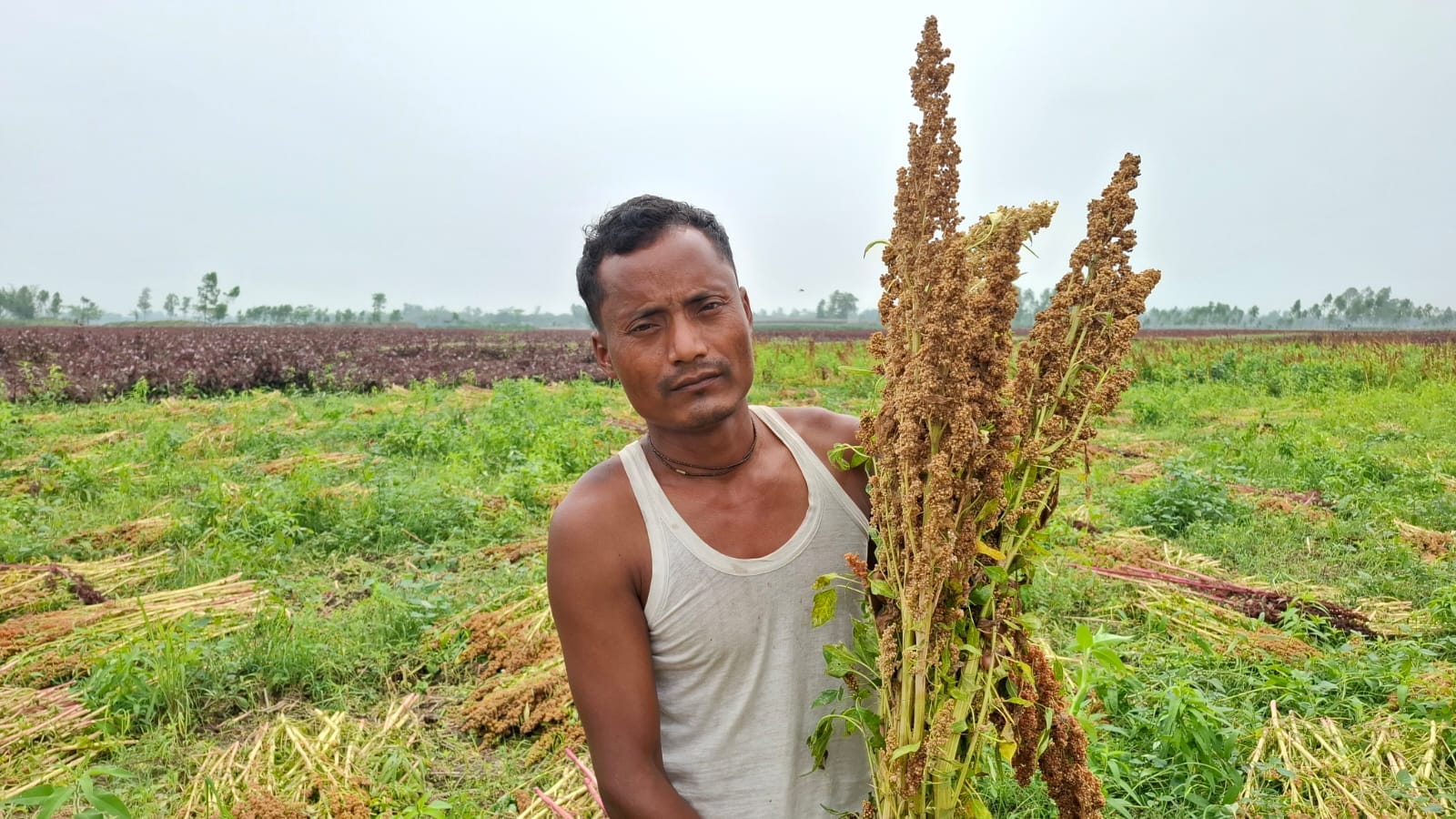
Nazrul Islam, a seed farmer who cultivated quinoa on one bigha out of curiosity, said he remains uncertain about marketing the crop, as there is no assurance that buyers will purchase it despite initial interest.
Several farmers said they would have made a profit even at Tk 500 per kilogram, and now feel they were misled.
Traders, however, attributed the situation to processing and quality issues.
Dabirul said farmers were unable to properly prepare the grain for market. He noted that quinoa requires processing — similar to milling paddy into rice — at a specialised husking mill in Nilphamari, which is not available in nearby areas.
He said unprocessed quinoa is being purchased at Tk 4,500 to Tk 5,000 per maund, while processed grain can sell for Tk 7,000 to Tk 8,000 per maund. It is also being marketed through online platforms at Tk 12,000 to Tk 14,000 per maund, a margin he claimed he does not receive.
But at one stage during the conversation, he acknowledged that the grain is being marketed online through a page owned by them.
Meanwhile, seed supplier Saiful Islam denied setting any fixed purchase price, saying rates were meant to be finalised through discussions. He added that he had previously sourced quinoa from Chapainawabganj and Rajshahi at Tk 500 to Tk 700 per kilogram for personal use and for diabetic patients, as he is involved in a clinic business.
Agricultural experts say quinoa has strong potential in Bangladesh, particularly in the context of climate change, but stress that market development is essential.
 For all latest news, follow The Daily Star's Google News channel.
 Upazila Agriculture Officer Gulzar Rahman said the crop can be cultivated and processed using methods similar to mustard at relatively low cost, and its dried plants can also be used as fuel.
He noted that the grain is beneficial for diabetic patients due to its nutritional properties.
Alamgir Kabir, additional deputy director (crops) of the Department of Agricultural Extension in Thakurgaon, said ensuring a stable market will be crucial for its expansion.
“Without a stable market, farmers will not continue cultivation, regardless of the yield,” he said.
Comments