


Electric cooker sales soar as gas crisis worsens
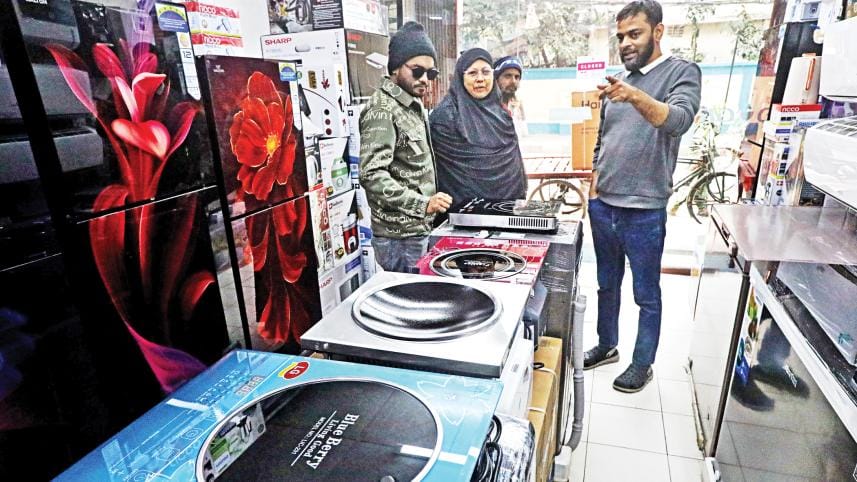
Mousumi Mirdha, a resident of Mohammadpur in Dhaka, recently bought an induction cooker to cope with the ongoing gas shortage.
“I bought an induction cooker because we hardly get gas during the day. At night, there’s some supply, but it’s very inconsistent, which makes cooking difficult,” she said.
 For all latest news, follow The Daily Star's Google News channel.
 She added that the appliance has become a helpful alternative. “With the induction cooker, I can cook or reheat food anytime I need. It’s especially useful during emergencies or for quick meals. This has been a practical solution amid the severe gas shortages.”
Electric cookers from brands such as Walton, Vision, Vigo, Kiam, Gazi, Miyako, and Philips are dominating the market. Lesser-known models from Nova and Prestige are also available.
Market insiders say infrared cookers are slightly more expensive than induction models, with prices generally ranging from Tk 3,500 to Tk 6,000. Premium models are priced higher.
R N Paul, managing director of RFL Group, said demand for electric cookers -- particularly infrared and induction models -- has surged in recent weeks. “We have seen a significant spike. Our stock of infrared and induction cookers has nearly sold out within just two weeks,” he added.
He highlighted the efficiency of induction cookers, which use electromagnetic energy to heat cookware directly, unlike infrared cookers that function like traditional coil heaters.
“Induction cookers are highly energy efficient and save about 30 percent power compared to traditional heating methods. If the power supply is stable, these can become mainstream. Abroad, most people use induction cookers to avoid the risks of gas cylinder-based cooking,” Paul said.
On affordability, he said that entry-level electric cookers cost around Tk 5,000. For a family of four, the monthly electricity bill for regular use is about Tk 2,000, comparable to or even less than cylinder costs.
Currently, a 12kg gas cylinder sells for Tk 2,200, up from Tk 1,306 last month, due to supply shortages, rising transport costs, and dealers selling above the official price.
“Electric cookers are also safer and more sustainable. Globally, this is a trending product,” Paul said.
He added that RFL’s annual sales of electric cookers now reach nearly Tk 100 crore, with about 20,000 units sold per month. He estimated RFL’s share in the segment at around 40 percent, with the total market size at Tk 250 to Tk 300 crore annually.
Augustin Sujan Barai, assistant director at Walton, said monthly sales of electric cookers have reached 7,000 to 10,000 units due to rising cylinder prices and ongoing shortages. “Demand is clearly on the rise. Consumers are looking for alternatives, and electric cookers are proving to be a reliable solution,” he added.
Barai added that Walton offers 10 to 12 models of induction and infrared cookers, priced between Tk 3,700 and Tk 5,700. Walton’s induction cookers feature up to 2,000 watts of power, adjustable wattage settings from 200W to 2,000W, touch-screen controls, multiple temperature sensors, intelligent cooking systems, auto safety shut-off, and timers up to three hours.
Its infrared cookers feature modern designs, a power range from 300W to 2,000W, high temperature-resistant glass, touch controls, timers, safety shut-off features, and compatibility with all flat-bottomed pans, he added.
Matiar Rahman Haider, managing director of Kiam Metal Industries, said sales have risen in the past two weeks due to higher cylinder prices and low gas pressure in many areas. “These issues have pushed more consumers to look for alternative cooking solutions, boosting demand for electric cookers,” he said.
He added that while Kiam produces both induction and infrared cookers, their market share remains relatively low.
Haider explained that consumers tend to prefer infrared cookers because they work with any flat-bottomed cookware, unlike induction models that require compatible pots and pans.
He added that demand for electric cookers is steadily growing, particularly in urban areas where households are choosing modern, energy-efficient appliances.
Dhaka is currently facing a severe household gas shortage caused by a major pipeline leak under the Turag River and declining domestic production. Residents are turning to gas cylinders, induction cookers, or firewood, which is raising costs and disrupting daily life. Officials said reduced imports and higher winter demand are worsening the situation, particularly in areas like Mirpur, Mohammadpur, and Uttara.
Comments