


Brushstrokes Across Generations: Inside a father-daughter exhibition
 For all latest news, follow The Daily Star's Google News channel.
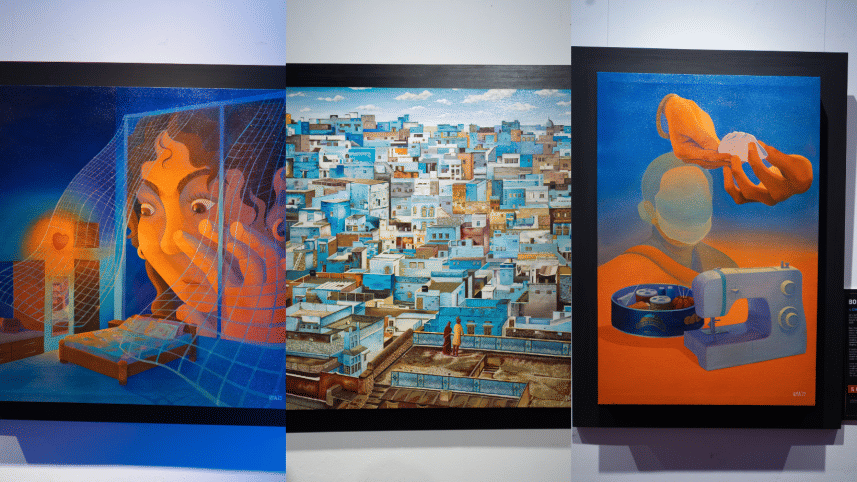
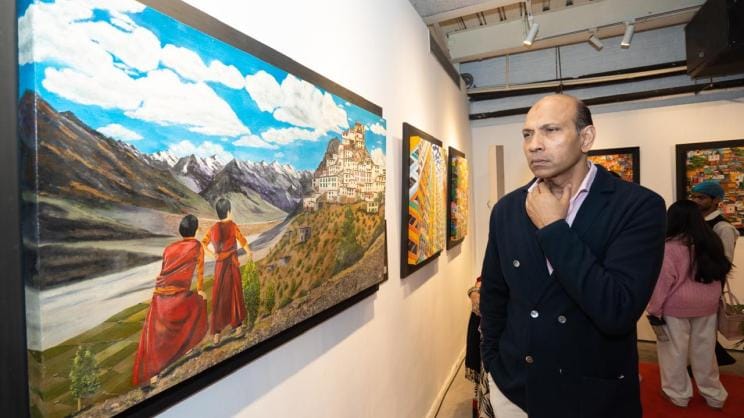
 At the heart of the exhibition, there are two distinct yet complementary artistic approaches. Noman Anwar’s paintings depict places and human habitats with a bright palette and a controlled precision. Working in oil and acrylic, he builds scenes that feel both luminous and exact, with careful strokes that hold detail without losing atmosphere. His subjects extend across cultures and geographies, including Portugal and Morocco in 2023, the Netherlands in 2023, Old Dhaka Lane in 2022, Italy in 2021, and Jodhpur Couples in 2021. There is an observational clarity in these works that suggest a photographer’s sensibility, and the frequent use of elevated perspectives recall an aerial understanding of space, consistent with his experience as a commercial pilot.

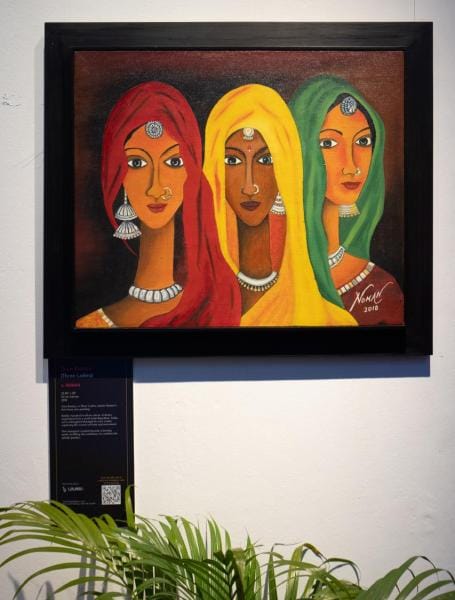
Noman’s entry into painting began with an uncomplicated commitment to art. Early works such as Teen Konna, Rajasthan’s women, and Colourful Pottery (2019) represent an origin story defined less by formal training and more by curiosity, affection for colour, and the willingness to learn through practice. His work has since found recognition beyond Bangladesh. On February 22, 2024, his paintings were showcased at the India Art Meet at the Nehru Centre in Mumbai, where he was the only Bangladeshi among seventeen participating painters and exhibited three artworks. He has credited the poet Purnima Dayal as an important source of inspiration in taking that step.

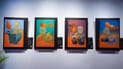
Facing Noman’s wall is Izma’s work, which turns decisively toward the human interior. Her paintings capture people not only as subjects but as presences, shaped by intimacy, memory, and the emotional truths that outlive a moment. The exhibition’s physical arrangement makes this relationship legible. Two opposite walls are assigned to father and daughter, and moving from one end of the room to the other makes the title increasingly persuasive. What emerges is not a comparison in the competitive sense, but a conversation between two ways of seeing, one anchored in place and the other rooted in personhood.
Izma’s practice is supported by both training and professional experience. She studied at the Savannah College of Art and Design and currently works as an illustrator at Maritimus magazine in the United States. Her collaborations include work with UNDP, projects for Dhaka Makers, and illustration for Bangladeshi brands including Starship. Yet the most compelling feature of her work in this exhibition is the depth of narrative that underpins each piece.
Her artistic statements, in particular, operate like short literary portraits, each shaped by sensory memory and the ethics of attention. In “Lotus Head”, she returns to a childhood moment of near drowning, a scene of sudden fear and helplessness in deep water. Over time, the water becomes a recurring metaphor, but it transforms.
She has a clear sense of what makes a person feel unmistakably themselves. For her, identity is preserved in the small, faithful details that outlast time. In “Dadu”, it is the cigarette, the newspapers, and the persistent instruction to “read the news”. In “Boro Nanu”, it is the nimble hands shaping pitha and a sewing machine. In “Ekram Sir”, it is the harmonium. In “Chachi”, it is a packet of Maggi noodles and the unending stack of ungraded copies.
These texts are the architecture of the art. They explain why Izma’s figures feel inhabited, and why the gaze in her work is so often gentle. They also shed light on the intensity of preparation that preceded the exhibition. For the past three months, the family’s home became a studio in disorder, marked by scattered materials and late-night arguments about colour theory, to the point that their mother, Anila, noted they were not allowed to bring anyone home until the exhibition was complete.
Yet the respect and love they have for each other and their work was so evident. As Izma said “We often forget that it’s our parents’ first time in the world too. They will make mistakes and it’s important to meet each other halfway.” The warmth of that statement is answered by the pride Noman expresses when speaking about his daughters, and it truly formed the emotional undertone of the show.
The exhibition also invites visitors into the process. All paintings are available for sale, and each work includes a QR code that leads to a timelapse of its creation, accessible through Noman’s YouTube channel under the same name. This detail reinforces the exhibition’s central idea, that art is not only an outcome but a passage, and that what passes between generations is not a single style but a shared commitment to making. In this room, one wall offers the world as it looks when rendered through light, place, and precision. The other offers the world as it is remembered, felt, and carried. The movement between them makes the title feel accurate, formal, and earned.

Comments