


8,780 polling centres ‘most vulnerable’



With the 13th national election and referendum approaching, the interim government has placed the most vulnerable polling centres under heightened security, tightened controls on firearms and ordered law enforcers to take swift legal action against anyone attempting to disrupt the vote.
Of the country’s 42,761 polling centres, 8,780 have been categorised as “most important”, 16,548 as “important” and 17,433 as general centres.Home Affairs Adviser Jahangir Alam Chowdhury said they were describing the vulnerable centres as important ones. “Important means those that are risky from a security standpoint,” he told the media yesterday.
 For all latest news, follow The Daily Star's Google News channel.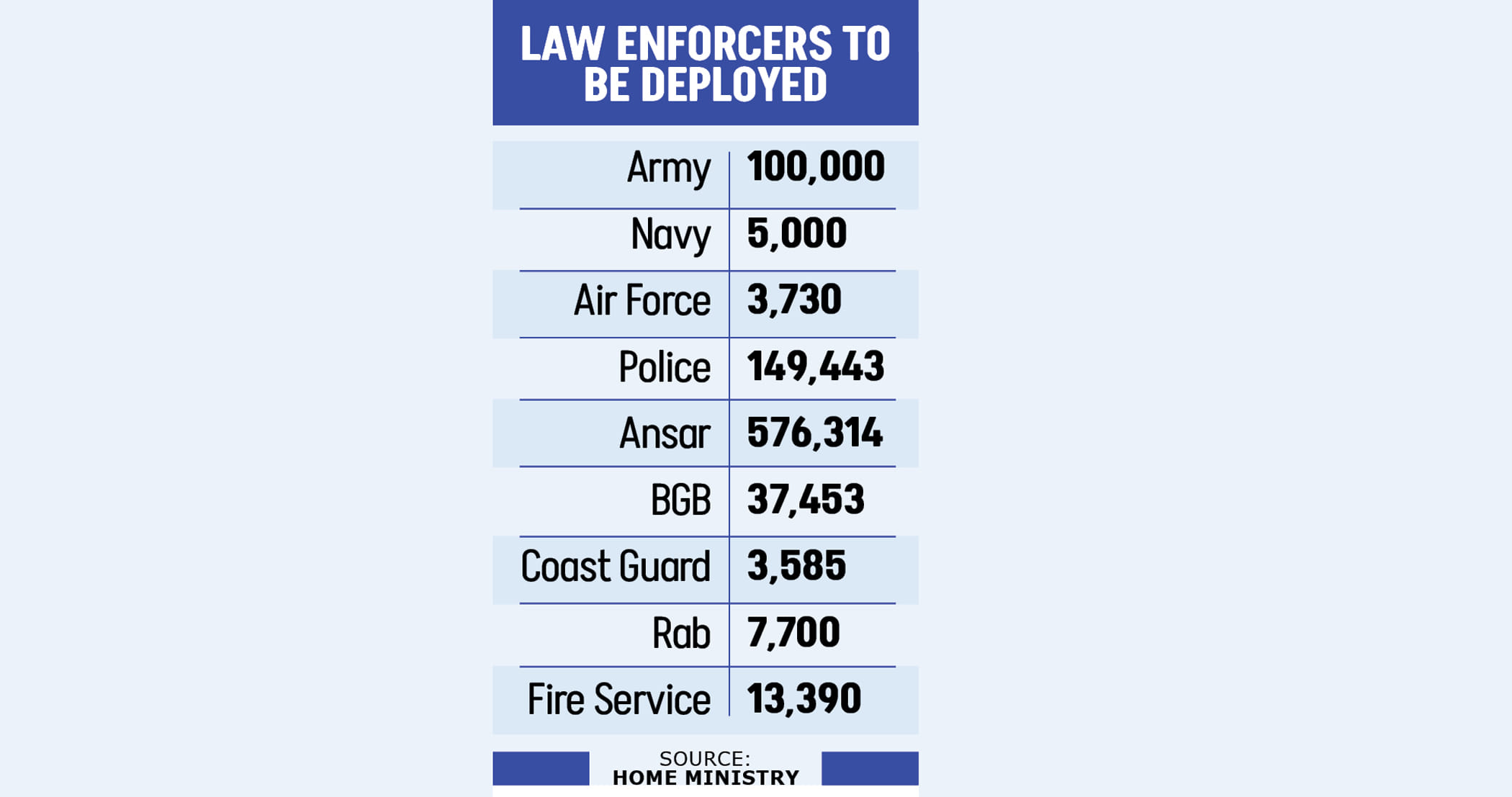
Meanwhile, a total of 8.97 lakh members of law enforcement agencies, including security forces, will be deployed for seven days from February 8 to maintain law and order.
As part of the measures, police will use 25,000 body-worn cameras at the “most important” and “important” centres.
The decisions were taken at a law and order advisory council meeting held at the home ministry yesterday.
“We are working in an integrated manner to prioritise maximum security to hold the election in a free, fair, neutral, peaceful, acceptable and festive manner,” said the adviser.
Addressing the media, he said CCTV cameras would be installed at every polling centre and necessary preparations are underway.
Drones will also be deployed, with a total of 418 drones to be used by different agencies: 200 by the army, 16 by the navy, 100 by the Border Guard Bangladesh, 50 by the Bangladesh Police, 20 by the Coast Guard, 16 by Rab and 16 by the Bangladesh Ansar and Village Defence Force.
Dog squads will be used by various forces to support security and protection measures, he added.
An election law and order coordination cell will be formed with representatives from police, Ansar and Village Defence Party (VDP), the armed forces, BGB, Coast Guard and Rab.
A special team under the emergency service number 999 will also be formed and linked to the coordination cell to provide round-the-clock service.
The team will forward election-related complaints and information directly to the home ministry and area-based coordination cells for swift action.
Home ministry officials described the “Election Security App-2026”, developed by the National Telecommunication Monitoring Centre as a key tool for maintaining law and order during the polls.
For hard-to-reach polling centres, the Bangladesh Air Force will provide helicopters to transport ballots, election materials, and officials and staff assigned to election duty.
Separate security arrangements will be ensured for polling centres in metropolitan, non-metropolitan and remote areas, including the Chittagong Hill Tracts, according to a home ministry circular.
Outside metropolitan areas, each general polling station will have two armed police members and three Ansar personnel, including one armed section commander. Important stations will have three armed police members and three Ansar personnel, including one armed section commander.
In metropolitan areas, general stations will have three armed police members and three Ansar personnel, while important stations will have four armed police members and three Ansar personnel, including one armed section commander.
In the Chittagong Hill Tracts and other remote areas, each general station will have two armed police members and three Ansar personnel, while important stations will have three armed police members and three Ansar personnel, including one armed section commander. Every presiding officer in these areas will also be provided with one armed Ansar member for personal security.
In addition, every polling station nationwide will have 10 Ansar personnel -- four women and six men -- equipped with sticks to help maintain order.
Security deployment at centres will be calibrated to sensitivity, with police and Ansar and VDP supported by the armed forces, BGB, Coast Guard and Rab at vulnerable centres, in coordination with district- and upazila-level law and order coordination cells, Jahangir said.
Authorities also directed law enforcers to intensify the recovery of illegal arms, arrest criminals, conduct intelligence-based area operations and run checkpoint drives during the election period.
Home ministry data showed that Devil Hunt Phase-2, launched on December 13, 2025, led to the arrest of 19,854 people as of January 17, 2026.
Separately, the interim government has ordered all firearms licence holders to deposit their weapons at the nearest police station by January 31.
The directive was issued in a home ministry notification on Sunday, which said the carrying and display of firearms would be prohibited until February 15.
The restriction will not apply to firearms allocated under existing policy for politically important persons and parliamentary candidates. Law enforcers are also exempt from the directive.
For candidates, the ban will not apply where nomination papers have been lawfully submitted to the Election Commission and accepted, or for an armed retainer authorised for the candidate.
On December 14, the government issued policy guidelines on granting firearms licences and appointing retainers for politically important individuals and candidates. Under the policy, licences and retainers will be approved after scrutiny by district magistrates and intelligence agencies.
An approved licence issued under the policy will remain valid until 15 days after publication of election results, after which it will be automatically cancelled.
At least 100 candidates have applied for firearms licences, according to home ministry officials. At present, there are about 50,314 firearms licences.
Comments