


Why your favourite comedy clubs are closing down right now

Back in 2024, post-revolution, the stand-up scene in Bangladesh buzzed with electricity. Mics crackled on quotas, curfews, and this chaotic city. Comedy clubs packed crowds, while YouTube specials hit millions of views. Those hits landed on OTT platforms, signalling a fresh dawn. Regulars like Amin Hannan, Ahmed Ashik, Akhlaq Siddiqui, and Mahedi Toru ruled the stage.
However, that energy has now faded. Audiences dwindle, venues disappear, and the scene wobbles on repetition, exclusion, and that mix of conservative and societal judgment. Naveed's Comedy Club (NCC), the pioneer and only dedicated spot, a hub for open mics and gigs, recently closed its longtime location. Rents are higher than ticket sales.
 For all latest news, follow The Daily Star's Google News channel.
 Organisations like Stand Up Dhaka (SUD) keep things alive in borrowed spaces, restaurants and university auditoriums. But it's sporadic, volunteer-driven, and hard to sustain. Big names stay afloat with corporate gigs, tours, YouTube, TEDx, while rookies rely on open mics and small gigs where they recycle old material.

Women in comedy? Scarce. Women like Sara Zaman emerge as a rare voice in a male-dominated industry. She started a decade ago in Melbourne and, post-pandemic, ruled NCC and SUD spaces. She felt inspired by Taylor Tomlinson, Sindhu Vee and Jeff Acuri.
"The scarcity isn't because women aren't funny. It's about access, safety and representation. Female comedians are held to different standards; even posting a reel can trigger comments focusing on appearance rather than the content itself. Often, fuelled by societal and internalised misogyny, making it feel like we have to work twice as hard to prove ourselves," said Sara Zaman.
When meeting and talking to performers like Ahmed Ashik, Sara Zaman, Akhlaq Siddiqui, and Mahedi Toru, we got several insights into what's going wrong. They have different ideals in standup. Different ideals shape different comedians, from which, they generate different sets for their stand-up comedy.
Starting in 2008 in the UK, later performing in Singapore and Canada, and now, over a decade in Bangladesh, Ahmed Ashik is one of the longest-running and loudest Chatgaiyas,. He works on his writing, unlike the repetitive jokes in the industry. He admires George Carlin, Richard Prior, and Lois CK. No matter what the naysayers say, Ashik has high praise for the live audience of Bangladesh's stand-up comedy.
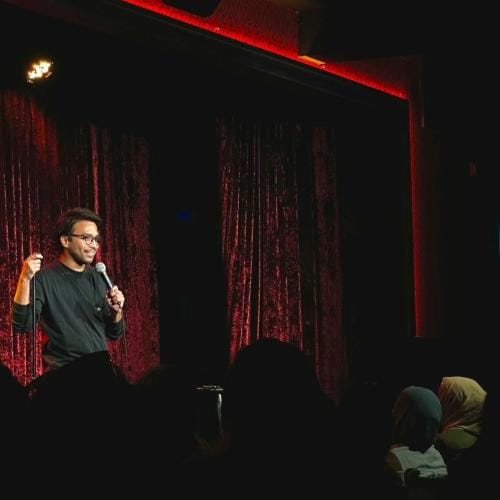
"The live audience is brilliant. They are flexible, liberal, and open to ideas. They allow you to go anywhere you want, and it doesn't even require laughing gas," he said.
English comedy in Bangladesh has been prevailing with young guns like Akhlaq Siddiqui, who started after his A Levels, left and came back for the love of it and has been consistent with his unique enunciation.
He looks up to Chris Rock, Adam Sandler, and Dave Chappelle. He credits his family's love for art to his career in music, voice acting and standup comedy, and thus understands why the lack thereof is in the careers of his colleagues.
"In a South Asian context, we were taught not to be ourselves. We are hardwired not to be us. There are so many layers of unlearning you have to do to be yourself, just so you can be better at speaking, better at projecting," said Akhlaq Siddiqui.
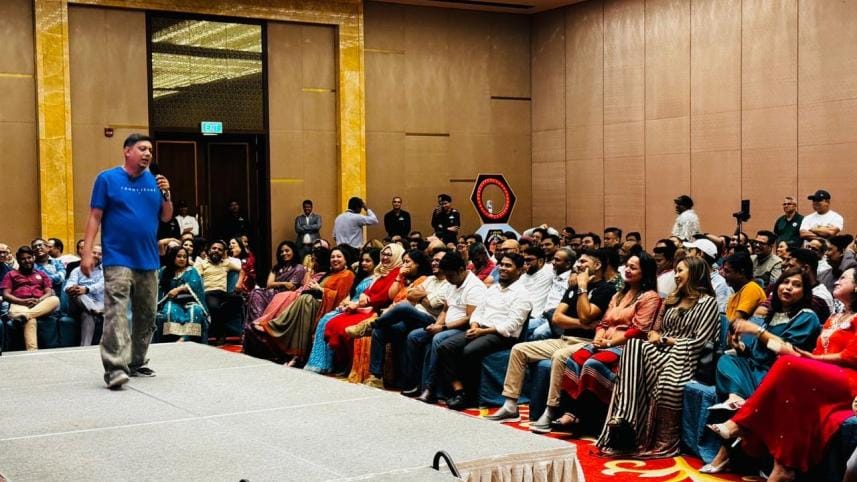
Mahedi Toru remains a rare example who found out about what standup comedy is in Bangladesh, watched shows regularly and bravely went up one day for an open mic. Then, several months of open mics, feature shows later, in just two years, he's a headliner for all shows he performs in.
Mahedi Toru said, "The joke often gets highlighted more than the serious issue the joke is about. Shouldn't more importance and attention be given to serious issues?"
Economy bites, inflation stings, "stability" brings subtle censorship of conservative audiences. Audiences are still reluctant to go out and laugh at certain issues. So, they dim the lights and focus the light on the comedian so the audience feels it's okay to laugh in a public setting amidst strangers. Once they start, there's no stopping them.
Dhaka's stubbornness breeds hope. Stand Up Dhaka's inclusive, accessible model could lead: all-gender mics, new faces, punches upward. The revolution proved laughter's power; if Naveed's Comedy Club finds a new spot, or Stand Up Dhaka grows with investments and collabs, a rebound is possible.
Photo: Courtesy
Comments