


Shahir Chowdhury on fixing education inequality through technology
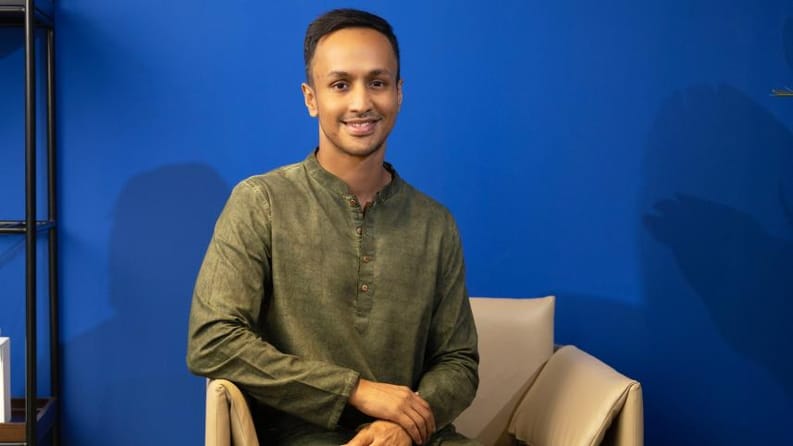
Bangladesh may not suffer from a lack of ambition, but when it comes to education, it certainly suffers from a lack of arithmetic. Too many students, too few teachers, too little money, and a system stretched thin long before the pandemic exposed its fault lines. Shahir Chowdhury, Founder and CEO of Shikho, doesn't romanticise this reality. He quantifies it.
 For all latest news, follow The Daily Star's Google News channel.
"We have many young and promising people," he says, "However, nowhere near enough high‑quality teachers, classrooms, or learning resources to serve them properly." That gap, predictably, is filled by private tuition. And that is where inequality hardens. Access becomes dependent on income, and outcomes are shaped by geography.
Shikho was not founded to be an app in this ecosystem. It was founded to challenge the equation itself.
"Our mission is to democratise access to high‑quality learning, using technology to scale great teaching and ensure that where a child is born does not determine the quality of education they receive," Chowdhury states.
Beyond emergency Zoom classes
If you zoom out from the app and into the ecosystem, you see why Chowdhury's work matters.
Before COVID‑19, online education in Bangladesh existed on the margins — supplementary at best, experimental at worst. The pandemic forced a national trial run. Schools closed, and screens replaced classrooms. Sceptical parents had no choice but to observe.
"What many families discovered was that online learning can work, and in some cases work better when it's designed properly," Chowdhury shares.
The caveat matters. He is clear-eyed about the limits of bad digital education. "If online education is reduced to recorded videos or emergency Zoom classes, trust will fade." Sustainability, he argues, depends on whether the country treats digital learning as infrastructure rather than a stopgap.
AI as a companion, not a crutch
Chowdhury's excitement around technology is notably restrained. He is interested in AI, but not as a shortcut or a replacement for teaching.
"What excites me most," he says, "is AI as a learning companion." Specifically, Bengali‑first, curriculum‑aligned systems that help students understand concepts, identify gaps, and learn from mistakes, especially in classrooms where teachers are overstretched.
"Done responsibly, AI doesn't replace teachers," he adds. "It gives every student personalised support at scale."
In a country where one good teacher often carries the weight of hundreds of students, that distinction matters. For Chowdhury, AI is not about efficiency alone. It is about fairness. About making high‑quality feedback, once a privilege, it's now a routine.

How he thinks is how he builds
Spend time with Chowdhury, and a pattern emerges. He dislikes noise, intellectual or visual. His workspace reflects this. "It's deliberately calm and structured," he says. "Clear thinking requires clarity in the environment."
Natural light, few distractions and space for long‑form thinking. The design is not aesthetic theatre. It's functional. He moves constantly between strategy and execution, and the room is built to accommodate that oscillation.
Ask him what objects matter most, and the answers are telling. A whiteboard "that's almost always full," where half‑formed ideas are allowed to exist without pressure. Books on education, systems, and design — heavily marked up, not displayed. And drawings from his children.
"They're a quiet but constant reminder," he shares, "Of why the work matters beyond growth metrics or scale."
Minimalism with warmth
Chowdhury describes his design philosophy as minimalism with warmth. Clean lines. Neutral tones. Never sterile. It mirrors how he thinks about systems: remove what is unnecessary; strengthen what compounds over time.
"Technology should be present but almost invisible," he asserts. "When tech becomes the focus, it usually means the fundamentals aren't strong enough."
This belief shapes Shikho's evolution. The platform is layered, but not cluttered. Complex, but not confusing. It respects the cognitive load of learners who are already navigating exam pressure, unstable internet, and family expectations.
The quiet stakes
Shikho's ambition is not to replace schools. It is to stabilise learning where schools struggle. To offer consistency where systems fracture.
Chowdhury frames it as a necessity. Bangladesh, he understands, will not fix its education challenges overnight. But it can redesign how knowledge travels, from the city to the village, from privilege to possibility.
And if that sounds understated, it's because he prefers it that way. In a sector crowded with slogans about disruption, Shahir Chowdhury is doing something rarer: building slowly, thinking structurally, and treating education not as content to be delivered, but as a system that must finally work for everyone.
Comments