


Lying about your age in Bangladesh? You’re not alone, we all do it!

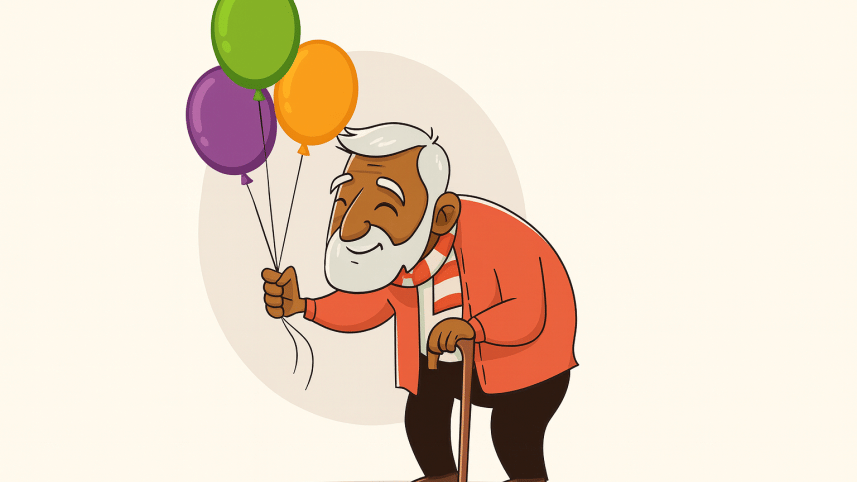
Is your actual birthday the same as the one listed on your birth certificate, national identity card, or passport? If so, congratulations! Because most Bangladeshis have an 'official' date of birth (DOB) and an 'actual' DOB. In rare instances, the 'actual' DOB matches the 'official' DOB. But why is this the case?
When I was a kid in the '80s and '90s, the common practice was to reduce a child's age by at least one year, so the child could appear for the admission tests of top-tier schools more than one time. If a child failed the first time, he or she could try again the following year.
 For all latest news, follow The Daily Star's Google News channel.
 In those days, when the private sector in Bangladesh was limited in scope and capacity, government jobs were the most sought-after. Decreasing age by one, two, or more years meant that individuals could apply for these competitive positions for a longer period of time. Consequently, once employed, they could stay in these jobs beyond the mandatory retirement age.
However, the secrecy surrounding a person's actual age can have a psychological impact. Even today, when someone asks me my age, I feel uneasy. I give a nervous smile and wonder whether I should tell my official age or my actual one. In contrast, here in the US, I see people talking about their age very frankly, as if there is nothing to hide. I wish I also possessed this level of frankness. But no, I can never be as frank as these Americans, especially when it comes to discussing age, because I grew up in a culture where we rarely discussed age, and even if we did, we always stated our 'official' age.
In our culture, asking someone's age is considered so impolite that many children never find out their parents' 'actual' DOBs. Our parents do not feel comfortable sharing their actual year of birth with their children.
A friend once asked me why we Bangladeshis lie so much. I said, "Because we grow up telling lies. We lie about our age throughout our lives. We lie every single time we utter or write our date of birth. Now imagine how many times we have already lied." I think that in this manner, we have normalised lying in our culture.
Healthcare
I know people who have their age reduced by as much as three or four years. When these people go to a doctor's office and state their 'official' age, they neither help the doctor nor themselves. For instance, age is important in determining the eligibility for certain tests and adult immunizations. For instance, colonoscopy or mammogram (for women) are generally recommended at age 45. However, if you're 41 years old on paper, your physician will delay recommending one of these tests for four years. This means that if you are not honest about your age while seeking healthcare, you might miss out on important life-saving medical tests.
Legal rights
Not having the correct age on paper also presents other challenges. For instance, you will have to wait to cast your first ballot or obtain a driver's license. In addition, you will not be able to sign contracts or make your own financial or medical decisions, if your 'official' age indicates that you are underage.
Nasir Uddin Ahmed, 62, is a non-resident Bangladeshi who lives in Sydney, Australia. Even though Ahmed is now eligible for the Seniors Card, a card that seniors can use to avail deals and discounts at restaurants, retail shops, and on public transport, he is unable to obtain the card because his 'official' age, that is, his age on paper, is 58. People can miss out on good opportunities and beneficial services when they are not truthful about their age.
In a country where birth certificates can be forged, and birthdates altered, and where lying about one's DOB is perfectly acceptable, lying about other things becomes just as easy.
Lying about the DOB is something we are taught from a young age and continue to practice until our last breath, and thus, our death certificates also display an inaccurate date of birth, a sad consequence of a long-standing custom.
Comments